
A Comparative Study of Loneliness among Adolescents from Single-Parent Families and Two-Parent Families
Keywords:
Loneliness, Adolescents, Single-Parent Families, Two-Parent FamiliesAbstract
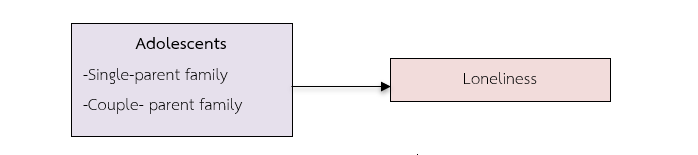
This cross-sectional comparative study aimed to: (1) examine and compare loneliness among adolescents from single-parent families and two-parent families, and (2) compare loneliness within each group according to personal characteristics. The participants consisted of 242 adolescents aged 13–18 years in Maha Sarakham Province, Thailand, including 121 adolescents from single-parent families and 121 adolescents from two-parent families. Cluster sampling was employed. Loneliness was assessed using the Revised UCLA Loneliness Scale–6 (RULS-6) (Cronbach’s Alpha = .86). Data were analyzed using independent samples t-tests. The findings revealed as follows.
1. Adolescents in single-parent families reported significantly higher mean loneliness scores (M = 14.89, SD = 3.97) than those in two-parent families (M = 13.75, SD = 4.17) (p-value = .030). Both groups demonstrated moderate levels of loneliness overall. Item-level analysis showed that adolescents in single-parent families had moderate mean scores across all items (2.12 – 2.74), while those in two-parent families also reported moderate overall scores (1.87 – 2.56).
2.. Within the single-parent family group, gender differences were statistically significant (p-value = .005), with female adolescents reporting higher loneliness scores than males (M = 15.56, SD = 4.03 vs. M = 13.38, SD = 3.42). No significant differences were found for age, family income, duration of living in a single-parent family, or age at the onset of living in a single-parent family. In the two-parent family group, family income was a significant factor (p-value = .048). Adolescents from families with monthly income below 10,000 THB reported higher loneliness scores than those from families with income of 10,000 THB or more (M = 14.44, SD = 3.90 vs. M = 12.80, SD = 4.19). Gender and age showed no significant differences.
These results highlight that factors associated with adolescent loneliness vary according to family structure: gender is a key factor in single-parent families, while family income is more influential in two-parent families.
References
Arnold, A. J., Kappes, H. B., Klimenberg, E., & Winkielman, P. (2021). The role of comparisons in judgments of loneliness. Frontiers in Psychology, 12, Article 498305. ttps://doi.org/10.3389/fpsyg.2021.498305.
Aufseeser, D., Jekielek, S., & Brown, B. (2006). The Family Environment and Adolescent Well-being: Exposure to Positive and Negative Family Influences. Child Trends; National Adolescent Health Information Center, University of California, San Francisco.
Bekhet, A. K., Zauszniewski, J. A., & Nakhla, W. E. (2008). Loneliness: A concept analysis. Nursing Forum, 43(4), 207-213. https://doi.org/10.1111/j.1744-6198.2008.00114.x.
Best, P., Manktelow, R., & Taylor, B. (2014). Online communication, social media and adolescent wellbeing: A systematic narrative review. Children and Youth Services Review, 41, 27-36. https://doi.org/10.1016/j.childyouth.2014.03.001.
Cacioppo, J. T., Cacioppo, S., & Boomsma, D. I. (2014). Evolutionary mechanisms for loneliness. Cognition & Emotion, 28(1), 3-21. https://doi.org/10.1080/02699931.2013.837379.
Cacioppo, J. T., Hawkley, L. C., Kalil, A., Hughes, M. E., Waite, L., & Thisted, R. A. (2008). Happiness and the Invisible Threads of Social Connection. In M. Eid & R. J. Larsen (Eds.), The Science of Subjective Well-being (pp. 195–219). New York, NY: Guilford Press.
Chanatsirikul, N., & Santirat, S. (2020). Social skills, social support, and loneliness of second-year students at the Faculty of Engineering, Kasetsart University, Bangkhen Campus. In Proceedings of the 15th RSU National Graduate Research Conference 2020 (pp. 2007-2018). Kasetsart University Graduate School. (in thai)
Cooper, K., Hards, E., Moltrecht, B., Reynolds, S., Shum, A., McElroy, E., et al. (2021). Loneliness, social relationships, and mental health in adolescents during the COVID-19 pandemic. Journal of Affective Disorders, 289, 98-104. https://doi.org/10.1016/j.jad.2021.04.016.
Department of Mental Health. (2019). Thai Adolescents' Depression and the Role of Understanding Listeners in Their Vicinity Retrieved March 8, 2021 from https://gnews.apps.go.th. (in thai)
Favotto, L., Michaelson, V., Pickett, W., & Davison, C. (2019). The role of family and computer-mediated communication in adolescent loneliness. PLoS One, 14(6), Article e0214617. https://doi.org/10.1371/journal.pone.0214617.
Goosby, B. J., Bellatorre, A., Walsemann, K. M., & Cheadle, J. E. (2013). Adolescent loneliness and health in early adulthood. Sociological Inquiry, 83(4), 505-536. https://doi.org/10.1111/soin.12018.
Heshmati, S., Blackard, M. B., Beckmann, B., & Chipidza, W. (2021). Family relationships and adolescent loneliness: An application of social network analysis in family studies. Journal of Family Psychology, 35(2), 182-191. https://doi.org/10.1037/fam0000660.
Larson, R., & Lampman-Petraitis, C. (1989). Daily emotional states as reported by children and adolescents. Child Development, 60(5), 1250-1260. https://doi.org/10.2307/1130798
Laursen, B., & Collins, W. A. (2009). Parent-Child Relationships during Adolescence. In R. M. Lerner & L. Steinberg (Eds.), Handbook of Adolescent Psychology: Contextual Influences on Adolescent Development (pp. 3–42). Hoboken, NJ: John Wiley & Sons. doi:10.1002/9780470479193.adlpsy002002
Narr, R. K., Allen, J. P., Tan, J. S., & Loeb, E. L. (2019). Close friendship strength and broader peer group desirability as differential predictors of adult mental health. Child Development, 90(1), 298-313. https://doi.org/10.1111/cdev.12905.
Perlman, D., & Peplau, L. A. (1981). Loneliness. In H. S. Friedman (Ed.), Personal Relationships: 3. Personal Relationships in Disorder (Vol. 2, pp. 571–581). New York, NY: Academic Press.
Perlman, D., & Peplau, L. A. (1981). Toward a Social Psychology of Loneliness. In S. Duck & R. Gilmour (Eds.), Personal Relationships: 3. Personal Relationships in Disorder (pp. 31–56). New York, NY: Academic Press.
Praizendorf, E., Lubimova, O., & Kumina, A. (2020). Loneliness in adolescence: A resource or a problem? Advances in Social Science, Education and Humanities Research, 396, 294-297. https://doi.org/10.2991/assehr.k.200515.062.
Russell, D. W. (1996). UCLA Loneliness Scale (Version 3): Reliability, validity, and factor structure. Journal of Personality Assessment, 66(1), 20-40. https://doi.org/10.1207/s15327752jpa6601_2.
Shahini, N. (2010). A study gauging perceived social support and loneliness with life satisfaction among students of Golestan University of Medical Sciences. European Psychiatry, 25(Suppl. 1), 842. https://doi.org/10.1016/S0924-9338(10)70835-8.
Steinberg, L. (2014). Age of Opportunity: Lessons from the New Science of Adolescence. Boston, MA: Houghton Mifflin Harcourt.
Thanaprakrit, W. (2002). Causes of Loneliness and Coping with Loneliness among Adolescent Students [Unpublished master's thesis]. Chulalongkorn University. (in thai)
Wongpakaran, N., Wongpakaran, T., Pinyopornpanish, M., Simcharoen, S., Suradom, C., Varnado, P., et al. (2020). Development and validation of a 6-item Revised UCLA Loneliness Scale (RULS-6) using Rasch analysis. British Journal of Health Psychology, 25(2), 233-256. https://doi.org/10.1111/bjhp.12404. (in thai)
Ying, M. (2023). Family influences on adolescent loneliness. SHS Web of Conferences, 171, Article 01011. doi:10.1051/shsconf/202317101011
Downloads
Published
Issue
Section
License
Copyright (c) 2026 Journal of Nursing and Education

This work is licensed under a Creative Commons Attribution-NonCommercial-NoDerivatives 4.0 International License.



