
Effects of a Behavioral Development Program for Preventing Complications on Perception, Preventive Behaviors, and Health Status among Hypertensive Patients in San Kamphaeng District, Chiang Mai Province
Keywords:
Complication-preventive Behaviors, Older with hypertension, health belief modelAbstract
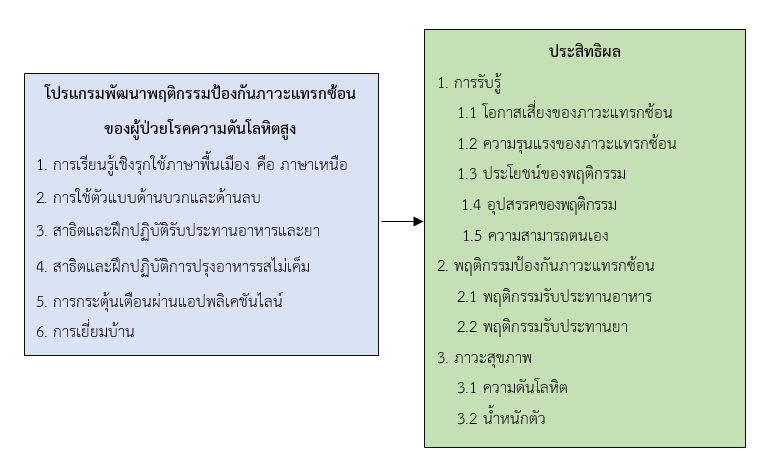
This two-group pretest-posttest design quasi-experimental study aimed to compare perceptions, complication prevention behaviors, and health status within both the experimental and control group after participation in the program. The participants were patients aged 35 – 65 years with essential hypertension, whose blood pressure was inadequately controlled. Participants for the experimental group who met the inclusion criteria were selected from the Ban Ko Salium Subdistrict Health Promoting Hospital, using simple random sampling. Participants for the control group were selected from the Ban Doi Yao Subdistrict Health Promoting Hospital, having the two groups matching for similar systolic blood pressure levels, and age. Each group consisted of 30 participants (n = 60). The instruments were: 1) the complication prevention behavior development program for patients with hypertension (based on the health belief model); 2) a recording form; and 3) access to a dedicated LINE channel. The data collection instruments included a blood pressure monitor, a digital weighing scale, as well as a questionnaire, divided in three sections: a) demographic and health information form, b) a perceptions of complications and health behaviors form, and c) a complication prevention behaviors form. Sections 2 and 3 of questionnaire had a content validity index of 1.00, and Cronbach’s alpha coefficients ranging from .82 to .90. Data were analyzed using descriptive statistics, t-tests, Wilcoxon matched-pairs signed-rank, and Mann–Whitney U test. Results were as follows.
1. After participating in the program, the experimental group had significantly higher mean scores for perceptions and complication preven. tion behaviors, while systolic blood pressure, diastolic blood pressure, and body weight significantly decreased (p-value < .05).
2. Compared with the control group, the experimental group demonstrated significantly higher mean scores for perception and complication-preventive behaviors, and significantly lower systolic and diastolic blood pressure (p-value < .05).
This study suggests that similar behavioral development programs should be developed for other chronic non-communicable diseases with high incidence, such as diabetes mellitus and cerebrovascular disease.
References
Aekplakorn, W. (2021). The Sixth National Health Examination Survey of Thailand, 2019–2020. Bangkok: Faculty of Medicine Ramathibodi Hospital, Mahidol University. (In Thai).
Ban Kosaliam Subdistrict Health Promoting Hospital. (2024). Annual Performance Report of Ban Kosaliam Subdistrict Health Promoting Hospital, Fiscal Year 2025. Ban Kosaliam Subdistrict Health Promoting Hospital. (in Thai)
Becker, M. H., Drachman, R. H., & Kirscht, J. P. (1974). A new approach to explaining sick role behavior in low-income populations. American Journal of Public Health, 64(3), 205–216. doi: 10.2105/ajph.64.3.205
Bonwell, C. C., & Eison, J. A. (1991). Acitve Learning: Creating Excitement in the Classroom. Washington, D.C.: The George Washington University.
Chanprasit, C., & Senaratana, W. (2023). Nursing and Health Promotion in Nursing Concept and Process (13rd ed). Nonthaburi: Sukhothai Thammathirat Open University. (In Thai).
Hirungerd, S., Vutiso, P., & Srimongkol, M. (2021). The effects of health belief model program on knowledge, stroke prevention behavior and blood pressure levels in hypertensive patients The Responsibility Area of Kaeng Khro Hospital, Chaiyaphum Province. Journal of The Royal Thai Army Nurses, 22(1), 478-487. https://he01.tci-thaijo.org/index.php/JRTAN/article/view/249047 (in Thai)
Kadjumpa, N. (2025). Effects of a health belief model application program on stroke prevention behavior among patients with high blood pressure. Bang Saai Hospital Phra Nakhon Si Ayutthaya Province. Journal of Environmental and Community Health, 10(4), 172-185. https://he03.tci-thaijo.org/index.php/ech/article/view/4602
Loussug, W., Lawang, W., & Homsin, P, (2019). The effects of application of the health belief model with family support program on preventive behaviors against cerebrovascular disease among individual at risk. Journal Nursing and Education, 12(4), 32-45. (in Thai). https://he01.tci-thaijo.org/index.php/JNAE/article/view/240156
Maneesriwongkul, W., (2016). Behavioral Theory for Community Nurse Practitioner. In Health Policy and Health System, Leadership, Concepts in Nursing and Community Nurse Practitioner’s Roles. Nonthaburi: Sukhothai Thammathirat Open University. (in Thai).
Ministry of Public Health. (2022). Health Data Center Report [Internet]. Retrieved June 15, 2023, from https://hdc.moph.go.th/cmi/public/standard-report-detail/6b9af46d0cc1830d3bd34589c1081c68 (in Thai).
Piamsukwilai, P. (2022). The Effect of Belief Modification of Reducing Sodium Consumption on Blood Pressure Level among Persons with Uncontrolled Hypertension [Master's thesis, Chulalongkorn University]. Chulalongkorn University Theses and Dissertations (Chula ETD). https://digital.car.chula.ac.th/chulaetd/6184
Rimsrithong, S., Thanjira, S., Techatsahong, A., & Patiprajak, S. (2013). Pathophysiology for Nursing, Vol. 2 (4th ed.). Ramathibodi School of Nursing, Faculty of Medicine Ramathibodi Hospital, Mahidol University. (in Thai).
Rosenstock, I. M., Strecher, V. J., & Becker, M. H. (1988). Social learning theory and the Health Belief Model. Health Education Quarterly, 15(2), 175–183. https://doi.org/10.1177/109019818801500203
Rotunda, W., Rains, C., Jacobs, S. R., Ng, V., Lee, R., Rutledge, S., et al. (2024). Weight loss in short-term interventions for physical activity and nutrition among adults with overweight or obesity: a systematic review and meta-analysis. Preventing chronic disease, 21, E21. https://doi.org/10.5888/pcd21.230347
Songthong, R., Iamsawasdikul, W., & Pothisapsuk, C. (2023). The effects of an eating behaviors development program on knowledge, health beliefs, eating behaviors, and blood pressure among people at risk of hypertention in rural Nakhon Si Thammarat Province. Journal of Nursing and Education, 16(2), 69-85. https://he01.tci-thaijo.org/index.php/JNAE/article/view/258935/176612 (in Thai)
Srisatitnarakun, B. (2010). Nursing Research Methodology (5th ed.). Bangkok: U&I Intermedia. (in Thai) Thai Hypertension Society. (2019). Thai Hypertension Society: Guidelines in the Treatment of hypertension. Chiang Mai: Trickthink. (in Thai).
Thai Hypertension Society. (2024). Thai Hypertension Society: Guidelines in the Treatment of Hypertension. Chiang Mai: Trickthink. (in Thai).
Wichaiyo, W., Jongsamak, P., Chaithong, S., & Krotbudda, S. (2021). The effect of the applying health belief model program of vascular disease preventive in patients with hypertension and diabetes mellitus at Namon District, Kalasin Province. Journal of Health System Research and Development, 14(2), 25-35. https://www.tci-thaijo.org/articles/health02-253188 (in Thai).
World Health Organization. (2023). Hypertension profiles 2023. Retrieved December 14, 2024 from https://www.who.int/docs/default-source/ncds/ncd-surveillance/hypertension-profiles-2023.
Downloads
Published
Issue
Section
License
Copyright (c) 2026 Journal of Nursing and Education

This work is licensed under a Creative Commons Attribution-NonCommercial-NoDerivatives 4.0 International License.



