
การศึกษาเปรียบเทียบความว้าเหว่ของวัยรุ่นในครอบครัวพ่อแม่เลี้ยงเดี่ยวและครอบครัวพ่อแม่อยู่ด้วยกัน
คำสำคัญ:
ความว้าเหว่ , วัยรุ่น , ครอบครัวพ่อแม่เลี้ยงเดี่ยว , ครอบครัวพ่อแม่อยู่ด้วยกันบทคัดย่อ
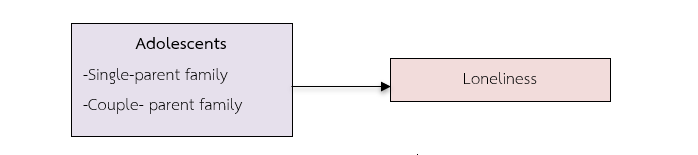
การวิจัยเชิงเปรียบเทียบแบบภาคตัดขวางนี้มีวัตถุประสงค์เพื่อ 1) ศึกษาและเปรียบเทียบความว้าเหว่ของวัยรุ่นในครอบครัวพ่อแม่เลี้ยงเดี่ยวและครอบครัวพ่อแม่อยู่ด้วยกัน และ 2) เปรียบเทียบความว้าเหว่ของวัยรุ่นใน
แต่ละกลุ่มตามปัจจัยส่วนบุคคล กลุ่มตัวอย่างเป็นเด็กวัยรุ่นอายุ 13 – 18 ปี จากครอบครัวพ่อแม่เลี้ยงเดี่ยวและครอบครัวพ่อแม่อยู่ด้วยกัน กลุ่มละ 121 คน ในจังหวัดมหาสารคาม สุ่มตัวอย่างแบบกลุ่ม วัดความว้าเหว่ด้วยแบบวัด RULS-6 (Cronbach's Alpha = .86) และวิเคราะห์ข้อมูลด้วยสถิติ Independent samples t-test ผลการวิจัยแยกตามวัตถุประสงค์ พบว่า
1. เด็กวัยรุ่นในครอบครัวพ่อแม่เลี้ยงเดี่ยวมีคะแนนเฉลี่ยความว้าเหว่ (M = 14.89, SD = 3.97) สูงกว่าเด็กวัยรุ่นในครอบครัวพ่อแม่อยู่ด้วยกัน (M = 13.75, SD = 4.17) อย่างมีนัยสำคัญทางสถิติ (p-value = .030) ทั้งสองกลุ่มมีระดับความว้าเหว่อยู่ในระดับปานกลาง เมื่อพิจารณารายข้อพบว่าเด็กวัยรุ่นในครอบครัวพ่อแม่เลี้ยงเดี่ยวมีคะแนนเฉลี่ยระดับปานกลางทุกข้อ (12 – 2.74) ส่วนครอบครัวพ่อแม่อยู่ด้วยกันมีคะแนนเฉลี่ยในภาพรวมระดับปานกลาง (1.87 – 2.56)
2. ในกลุ่มครอบครัวพ่อแม่เลี้ยงเดี่ยว พบว่าเพศมีความแตกต่างอย่างมีนัยสำคัญทางสถิติ (p-value = .005) โดยเด็กวัยรุ่นหญิงมีคะแนนความว้าเหว่สูงกว่าเด็กวัยรุ่นชาย (M = 15.56, SD = 4.03 และ M = 13.38 , SD = 3.42 ตามลำดับ) ส่วนปัจจัยด้านอายุ รายได้ครอบครัว ระยะเวลาที่อยู่ในครอบครัวพ่อแม่เลี้ยงเดี่ยว และอายุของเด็ก
3. เมื่อเริ่มอยู่ในครอบครัวพ่อแม่เลี้ยงเดี่ยว ไม่พบความแตกต่างอย่างมีนัยสำคัญทางสถิติ ในกลุ่มครอบครัวพ่อแม่อยู่ด้วยกัน พบว่ารายได้ครอบครัวมีความแตกต่างอย่างมีนัยสำคัญทางสถิติ (p-value = .048) โดยเด็กวัยรุ่นในครอบครัวที่มีรายได้ต่ำกว่า 10,000 บาทต่อเดือน มีคะแนนความว้าเหว่สูงกว่าครอบครัวที่มีรายได้ตั้งแต่ 10,000 บาทขึ้นไป (M = 14.44, SD = 3.90 และ M = 12.80, SD = 4.19 ตามลำดับ) ส่วนปัจจัยด้านเพศและอายุไม่พบความแตกต่างอย่างมีนัยสำคัญทางสถิติ
ผลดังกล่าวสะท้อนให้เห็นว่าปัจจัยที่สัมพันธ์กับความว้าเหว่แตกต่างกันตามโครงสร้างครอบครัว โดยเพศเป็นปัจจัยสำคัญในกลุ่มครอบครัวพ่อแม่เลี้ยงเดี่ยว ในขณะที่รายได้ครอบครัวเป็นปัจจัยสำคัญในกลุ่มครอบครัวพ่อแม่อยู่ด้วยกัน
เอกสารอ้างอิง
Arnold, A. J., Kappes, H. B., Klimenberg, E., & Winkielman, P. (2021). The role of comparisons in judgments of loneliness. Frontiers in Psychology, 12, Article 498305. ttps://doi.org/10.3389/fpsyg.2021.498305.
Aufseeser, D., Jekielek, S., & Brown, B. (2006). The Family Environment and Adolescent Well-being: Exposure to Positive and Negative Family Influences. Child Trends; National Adolescent Health Information Center, University of California, San Francisco.
Bekhet, A. K., Zauszniewski, J. A., & Nakhla, W. E. (2008). Loneliness: A concept analysis. Nursing Forum, 43(4), 207-213. https://doi.org/10.1111/j.1744-6198.2008.00114.x.
Best, P., Manktelow, R., & Taylor, B. (2014). Online communication, social media and adolescent wellbeing: A systematic narrative review. Children and Youth Services Review, 41, 27-36. https://doi.org/10.1016/j.childyouth.2014.03.001.
Cacioppo, J. T., Cacioppo, S., & Boomsma, D. I. (2014). Evolutionary mechanisms for loneliness. Cognition & Emotion, 28(1), 3-21. https://doi.org/10.1080/02699931.2013.837379.
Cacioppo, J. T., Hawkley, L. C., Kalil, A., Hughes, M. E., Waite, L., & Thisted, R. A. (2008). Happiness and the Invisible Threads of Social Connection. In M. Eid & R. J. Larsen (Eds.), The Science of Subjective Well-being (pp. 195–219). New York, NY: Guilford Press.
Chanatsirikul, N., & Santirat, S. (2020). Social skills, social support, and loneliness of second-year students at the Faculty of Engineering, Kasetsart University, Bangkhen Campus. In Proceedings of the 15th RSU National Graduate Research Conference 2020 (pp. 2007-2018). Kasetsart University Graduate School. (in thai)
Cooper, K., Hards, E., Moltrecht, B., Reynolds, S., Shum, A., McElroy, E., et al. (2021). Loneliness, social relationships, and mental health in adolescents during the COVID-19 pandemic. Journal of Affective Disorders, 289, 98-104. https://doi.org/10.1016/j.jad.2021.04.016.
Department of Mental Health. (2019). Thai Adolescents' Depression and the Role of Understanding Listeners in Their Vicinity Retrieved March 8, 2021 from https://gnews.apps.go.th. (in thai)
Favotto, L., Michaelson, V., Pickett, W., & Davison, C. (2019). The role of family and computer-mediated communication in adolescent loneliness. PLoS One, 14(6), Article e0214617. https://doi.org/10.1371/journal.pone.0214617.
Goosby, B. J., Bellatorre, A., Walsemann, K. M., & Cheadle, J. E. (2013). Adolescent loneliness and health in early adulthood. Sociological Inquiry, 83(4), 505-536. https://doi.org/10.1111/soin.12018.
Heshmati, S., Blackard, M. B., Beckmann, B., & Chipidza, W. (2021). Family relationships and adolescent loneliness: An application of social network analysis in family studies. Journal of Family Psychology, 35(2), 182-191. https://doi.org/10.1037/fam0000660.
Larson, R., & Lampman-Petraitis, C. (1989). Daily emotional states as reported by children and adolescents. Child Development, 60(5), 1250-1260. https://doi.org/10.2307/1130798
Laursen, B., & Collins, W. A. (2009). Parent-Child Relationships during Adolescence. In R. M. Lerner & L. Steinberg (Eds.), Handbook of Adolescent Psychology: Contextual Influences on Adolescent Development (pp. 3–42). Hoboken, NJ: John Wiley & Sons. doi:10.1002/9780470479193.adlpsy002002
Narr, R. K., Allen, J. P., Tan, J. S., & Loeb, E. L. (2019). Close friendship strength and broader peer group desirability as differential predictors of adult mental health. Child Development, 90(1), 298-313. https://doi.org/10.1111/cdev.12905.
Perlman, D., & Peplau, L. A. (1981). Loneliness. In H. S. Friedman (Ed.), Personal Relationships: 3. Personal Relationships in Disorder (Vol. 2, pp. 571–581). New York, NY: Academic Press.
Perlman, D., & Peplau, L. A. (1981). Toward a Social Psychology of Loneliness. In S. Duck & R. Gilmour (Eds.), Personal Relationships: 3. Personal Relationships in Disorder (pp. 31–56). New York, NY: Academic Press.
Praizendorf, E., Lubimova, O., & Kumina, A. (2020). Loneliness in adolescence: A resource or a problem? Advances in Social Science, Education and Humanities Research, 396, 294-297. https://doi.org/10.2991/assehr.k.200515.062.
Russell, D. W. (1996). UCLA Loneliness Scale (Version 3): Reliability, validity, and factor structure. Journal of Personality Assessment, 66(1), 20-40. https://doi.org/10.1207/s15327752jpa6601_2.
Shahini, N. (2010). A study gauging perceived social support and loneliness with life satisfaction among students of Golestan University of Medical Sciences. European Psychiatry, 25(Suppl. 1), 842. https://doi.org/10.1016/S0924-9338(10)70835-8.
Steinberg, L. (2014). Age of Opportunity: Lessons from the New Science of Adolescence. Boston, MA: Houghton Mifflin Harcourt.
Thanaprakrit, W. (2002). Causes of Loneliness and Coping with Loneliness among Adolescent Students [Unpublished master's thesis]. Chulalongkorn University. (in thai)
Wongpakaran, N., Wongpakaran, T., Pinyopornpanish, M., Simcharoen, S., Suradom, C., Varnado, P., et al. (2020). Development and validation of a 6-item Revised UCLA Loneliness Scale (RULS-6) using Rasch analysis. British Journal of Health Psychology, 25(2), 233-256. https://doi.org/10.1111/bjhp.12404. (in thai)
Ying, M. (2023). Family influences on adolescent loneliness. SHS Web of Conferences, 171, Article 01011. doi:10.1051/shsconf/202317101011
ดาวน์โหลด
เผยแพร่แล้ว
ฉบับ
ประเภทบทความ
สัญญาอนุญาต
ลิขสิทธิ์ (c) 2026 วารสารการพยาบาลและการศึกษา

อนุญาตภายใต้เงื่อนไข Creative Commons Attribution-NonCommercial-NoDerivatives 4.0 International License.


