
Effectiveness on Patient with and without Stroke Fast Track Program in Phetchaburi
Keywords:
Effectiveness, Stroke, need to supportsAbstract
This retrospective study examined the situation and effectiveness of urgent care services for patients with ischemic stroke. Data were collected from patients diagnosed with ischemic stroke or cerebral infarction who received treatment at Phra Chomklao Hospital, Phetchaburi Province, between 2019 and 2023, using the HosXP database under the special-case health service funds for ischemic stroke (Stroke Fast Track: SFT). The study included three funding sources: the National Health Security Fund, the Social Security Fund, and the Civil Servant Medical Benefit Fund. Patient service records were analyzed using descriptive statistics. Stroke severity was assessed using the National Institute of Health Stroke Scale (NIHSS), and survival rates within six months after diagnosis were analyzed using the Kaplan–Meier method. Results showed that:
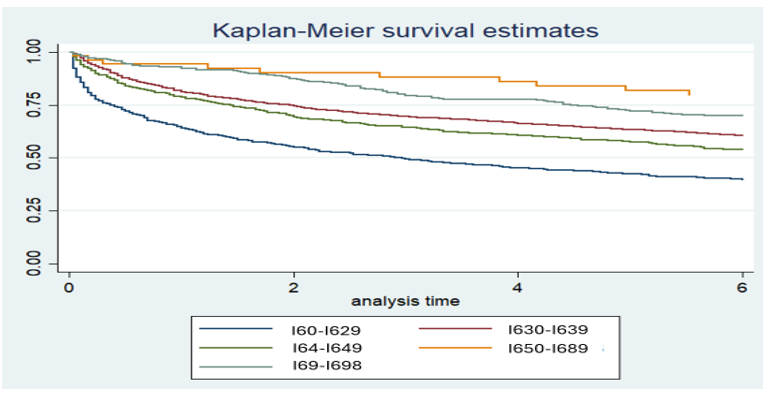
During fiscal years 2019–2023, a total of 6,410 stroke patients were recorded, with a higher prevalence among men, and an increasing trend in both sexes. Among patients who did not receive rtPA, 90% presented with mild to moderate symptoms, while all patients who received rtPA had moderate severity. Effective coverage of stroke patients entering the SFT system was 43.49%, with 68.66% of ischemic stroke patients accessing SFT services. Of these, 23.91% received thrombolytic therapy (rtPA), with a survival rate of 93.56%. Patients with hemorrhagic stroke (ICD-10: I60.0–I62.9) had the lowest six-month survival rate, followed by those with ischemic stroke (ICD-10: I63.0–I63.9).
The results suggest that expanding coverage through network hospitals is essential to improve access to urgent treatment services (Stroke Fast Track) for patients with ischemic stroke, thereby enhancing survival outcomes.
References
Collaborators., G. S. (2021). Global, regional, and national burden of stroke and its risk factors, 1990-2019: a systematic analysis for the Global Burden of Disease Study. Lancet Neurol, 20(10), 795-820. doi:10.1016/S1474-4422 (21) 00252-0
Lei, Z., Li, S., Feng, H., Wu, X., Hu, S., Li, J., et al. (2024). Effects of intravenous rtPA in patients with minor stroke. Annaly of Medicine, 56(1), 2304653. doi.org/10.1080/07853890.2024.2304653
National Health Security Office. (2022). Guidelines for Requesting Expenses for Public Health Services in Fiscal Year 2022. Nonthaburi: Sahamitr Printing & Publiching Company Limited.
National Institute for Emergency Medicine. (2564). Stroke Knowledge for Emergency Medical Practitioners. Nonthaburi: Ultimate printing. (in Thai)
Phokum S., (2020). Perception of stroke emergency response in acute ischemic stroke patients at Somdej Phra Yupparat Kranuan Hospital, Khon Kaen Province. North-Eastern Thai Journal of Neuroscience, 15(4), 66-75. (in Thai)
Thai College of Emergency Physicians. (2020). Guidelines for Treatment and Administration of Anticoagulants for Acute Ischemic Stroke Outside the Hospital and in the Emergency Room, 2020. Bangkok: Thai College of Emergency Physicians. (in Thai)
Tiamkao S., (2019). Development of the stroke service system in the 7th Health Zone (Roi Et, Khon Kaen, Maha Sarakham and Kalasin province). J Thai Stroke Soc, 18(1), 25-41. (in Thai)
Tiamkao S., (2021). Stroke situation analysis. Thai Journal of Neurology, 37(4), 54-60. (in Thai)
Tiamkao S., (2023). 13 Years – Learning and Development of stroke fast track in Thailand. Journal of Health. Systems Research 17(1), 191-199. (in Thai) https://he04.tci-thaijo.org/index.php/j_hsr/article/view/3219
Wellappuli, N. T., Perera, H. S. R., Chang, T., Kasthuriratne, G., & Gunawardena, N. S. (2022). Coverage and equity of essential care services among stroke survivors in the Western Province of Sri Lanka: a community-based cross-sectional study. BMC health services research, 22(1), 1017. https://doi.org/10.1186/s12913-022-08404-5
World Health Organization. (2016). Universal Health Coverage: Moving Towards Better Health Action Framework for the Western Pacific Region. Geneva: World Health Organization.
You, S., Saxena, A., Wang, X., Tan, W., Han, Q., Cao, Y., et al. (2018). Efficacy and safety of intravenous recombinant tissue plasminogen activator in mild ischaemic stroke: a meta-analysis. Stroke and vascular neurology, 3(1), 22–27. https://doi.org/10.1136/svn-2017-000106
Downloads
Published
Issue
Section
License
Copyright (c) 2026 Journal of Nursing and Education

This work is licensed under a Creative Commons Attribution-NonCommercial-NoDerivatives 4.0 International License.



