
การพัฒนาและประสิทธิผลของโปรแกรมการเสริมสร้างแรงจูงใจด้วยระบบออนไลน์ ต่อการกำกับตนเองเพื่อการเลิกยาของผู้ป่วยติดยาเสพติดในระยะติดตามผลการรักษา
คำสำคัญ:
โปรแกรมออนไลน์ , การเสริมสร้างแรงจูงใจ , การกำกับตนเอง , ผู้ป่วยติดยาเสพติด , ระยะติดตามผลการรักษาบทคัดย่อ
การวิจัยและพัฒนานี้มีวัตถุประสงค์เพื่อพัฒนาและทดสอบผลของโปรแกรมการเสริมสร้างแรงจูงใจด้วยระบบออนไลน์ ต่อการกำกับตนเองเพื่อการเลิกยาของผู้ป่วยติดยาเสพติดในระยะติดตามผลการรักษา ดำเนินการ 3 ระยะ ระยะที่ 1 การพัฒนาโปรแกรมฯ โดยการทบทวนเวชระเบียน สนทนากลุ่ม สัมภาษณ์เชิงลึก และทบทวนวรรณกรรม ระยะที่ 2 การทดลองใช้และปรับปรุงโปรแกรม ผ่านการตรวจสอบโดยผู้ทรงคุณวุฒิ 5 คน ระยะที่ 3 การทดสอบผลการใช้โปรแกรมฯ กับกลุ่มตัวอย่างผู้ป่วยที่ผ่านการบำบัดรักษาระยะฟื้นฟู และอยู่ในระยะติดตามผลการรักษา จำนวน 60 คน แบ่งเป็นกลุ่มควบคุมและกลุ่มทดลอง กลุ่มละ 30 คน เครื่องมือวิจัยประกอบด้วย โปรแกรมการเสริมสร้างแรงจูงใจด้วยระบบออนไลน์ และแบบประเมินการกำกับตนเองเพื่อการเลิกยา ได้ค่าสัมประสิทธิ์แอลฟาครอนบาค เท่ากับ .95 วิเคราะห์ข้อมูลโดยใช้สถิติ Paired t-test และ Independent t-test ผลการวิจัยพบว่า
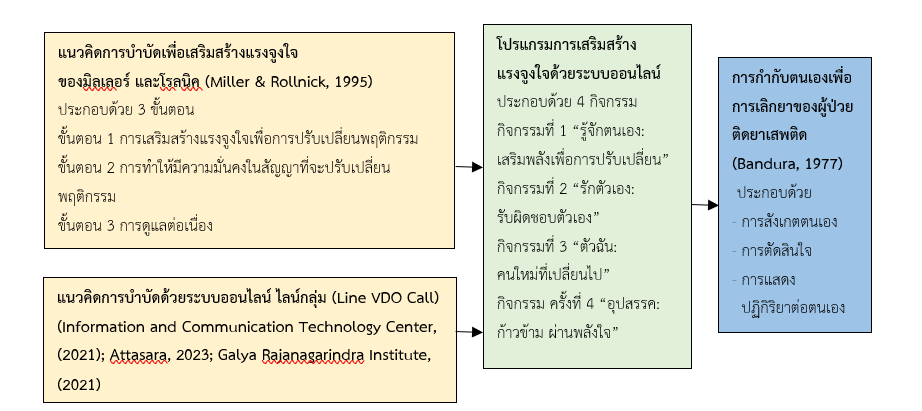
1. มีโปรแกรมการเสริมสร้างแรงจูงใจด้วยระบบออนไลน์ของผู้ป่วยติดยาเสพติดในระยะติดตามผลการรักษา เป็นกิจกรรมกลุ่ม ๆ ละ 60 นาที 4 กิจกรรมหลัก สัปดาห์ละ 1 ครั้ง เป็นระยะเวลา 4 สัปดาห์ ร่วมกับคู่มือการเสริมสร้างแรงจูงใจด้วยระบบออนไลน์สำหรับผู้ป่วยติดยาเสพติดในระยะติดตามผลการรักษา
2. มีความแตกต่างของค่าเฉลี่ยคะแนนการกำกับตนเองเพื่อการเลิกยาของผู้ป่วยติดยาเสพติดในระยะติดตามผลการรักษาก่อนและหลังสิ้นสุดโปรแกรมฯ ของกลุ่มทดลอง โดยมีค่าเฉลี่ยคะแนนการกำกับตนเองหลังทดลองสูงกวา กอนทดลองอย่างมีนัยสําคัญทางสถิติที่ระดับ .05 (t = -7.383, p-value < .001)
3. มีความแตกต่างของค่าเฉลี่ยคะแนนการกำกับตนเองเพื่อการเลิกยาของผู้ป่วยติดยาเสพติดในระยะติดตามผลการรักษา ระหว่างกลุ่มทดลองและกลุ่มควบคุม โดยหลังได้รับโปรแกรม ค่าเฉลี่ยคะแนนการกำกับตนเองของกลุ่มทดลองสูงกว่ากลุ่มควบคุมอย่างมีนัยสำคัญทางสถิติที่ระดับ .05 (t = 441, p-value < .001)
โปรแกรมการเสริมสร้างแรงจูงใจด้วยระบบออนไลน์สามารถเพิ่มการกำกับตนเองเพื่อการเลิกยาของผู้ป่วยติดยาเสพติดในระยะติดตามผลการรักษาได้อย่างมีประสิทธิภาพ และสามารถนำไปประยุกต์ใช้ในการดูแลผู้ป่วยในสถานบริการสุขภาพ และสถานฟื้นฟูสมรรถภาพผู้ติดยาเสพติดได้
เอกสารอ้างอิง
Aiamsaart, N., Somprasert, C., & Keawkingkeo, S. (2018). The Effect of Motivation Program on the Drinking Behavior among Persons with Alcohol Dependence. A Thesis Master of Nursing Science in Psychiatric and Mental Health Nursing Science. Faculty of Nursing, Thammasat University. (in Thai)
Attasara, P. (2023). Guidelines for the Use of DMS Telemedicine. Department of Medical Services, Ministry of Public Health. (in Thai)
Bandura, A. (1977). Self-efficacy: Toward a nifying theory of behavioral change. Psychological Review, 84(2), 191–215.
Boonyamanee, B., & Nukaew, O. (2023). The development and effects of an enhancing empowerment program on self-regulation for quitting illegal drugs among patients with amphetamine addiction during rehabilitation phase. The Southern College Network Journal of Nursing and Public Health, 11(2), e267558. (in Thai)
Boyle, P. (1981). Planning Better Program. Sydney: Mc Graw Hill Book Company. Butpunya, Y., Uthis, P., & Suktrakul, S. (2016). The Effect of Countinuing Motivational Interviewing Telephone – Based Program on Alcohol Consumption in Person with Alcohol Dependence. Faculty of Nursing, Chulalongkorn University, Bangkok. (in Thai)
Carroll, K. M., Ball, S. A., Nich, C., Martino, S., Frankforter, T. L., Farentinos, C., et al. (2006). Motivational interviewing to improve treatment engagement and outcome in individuals seeking treatment for substance abuse: A multisite effectiveness study. Drug and Alcohol Dependence, 81, 301–312.
Chantrachula, A., Laehmad, N., & Boonmanee, M. (2010). Self-regulation and Social Support for Drug Cessation among Drug-dependent Patients After Treatment at the Southern Drug Addiction Treatment Center. Songkhla: Nursing Division, Songkhla Drug Addiction Treatment Center, Department of Medical Services, Ministry of Public Health. (in Thai)
Faul, F., Erdfelder, E., Lang, A.-G., & Buchner, A. (2009). Statistical power analyses using G*Power 3.1: Tests for correlation and regression analyses. Behavior Research Methods, 41(4), 1149–1160.
Galya Rajanagarindra Institute. (2021). Guidelines for Outpatient Telepsychiatry Services for Agencies under the Department of Mental Health, Ministry of Public Health. Bangkok: Department of Mental Health, Ministry of Public Health. (in Thai)
Hanpattanachaikul, K., Kasemphon, N., Toinn, P., & Thongkoatt, N. (2021). Factors influencing relapse treatment among substance abusers. Journal of Health Science Research, 15(2), 1-12 (in Thai)
Iamsupasit, S. (2000). Theory and Techniques of Behavior Modification (4th ed.). Bangkok. (in Thai)
Information and Communication Technology Center. (2021). Digital health strategy of Ministry of Public Health 2021–2025. Retrieved November 1, 2024, from https://ict.moph.go.th. (in Thai)
Joanna Briggs Institute for Evidence Based Nursing and Midwifery. (2008). Reviewers’ Manual. Retrieved January 25, 2022, from http://www.joannabriggs.edu.au
Kaewlai, K., Thewela, S., & Sutthiphet, S. (2023). Effects of a motivational enhancement program combined with therapy on self-management behaviors among patients with substance-induced psychotic disorder. Journal of Health and Environmental Education, 8(3), 187-197 (in Thai)
Kim, H.-Y. (2013). Statistical notes for clinical researchers: Assessing normal distribution (2) using skewness and kurtosis. Restorative Dentistry & Endodontics, 38(1), 52–54.
Kinnon, P., Renuwattanannon, A., & Jaipratum, W. (2021). Outpatient Rehabilitation Manual for Drug and Substance Users based on the Matrix Program Model. Bangkok: Chulalongkorn University Press. (in Thai)
Kothtong, P. (2017). The Research and Development of the Program for Health Behavior Promoting. Doctoral Dissertation. Rajabhat Maha Sarakham University. Retrieved March 15, 2025 from https://fulltext.rmu.ac.th/fulltext/2560/ 121868/Kothtong%20Pichetpons.pdf. (in Thai)
Lapchok, W. Jantacumma, N., & Prajankett, O. (2024). Effects of a motivational enhancement program on smoking cessation among active-duty soldiers at Sri Patcharin Camp, Khon Kaen Province. Khon Kaen. (in Thai)
Medical Record Unit, Thanyarak Songkhla Hospital. (2024). Annual Statistical Report of Thanyarak Songkhla Hospital. Songkhla: Thanyarak Songkhla Hospital. (in Thai)
Mezirow, J. (2009). An Overview on Transformative Learning. In K. Illeris (Ed.), Contemporary Theories of Learning (pp. 90–105). Routledge.
Miller, W. R., & Rollnick, S. (1995). Motivational Interviewing: Preparing People for Change in Addictive Behavior. New York: Guilford Press.
Musikachai, S., Laemad, N., Wongsarawit, W., & Chamnan, S. (2022). Motivation and Motivational Enhancement among Drug-dependent Patients through Family Participation. Songkhla: Thanyarak Songkhla Hospital. (in Thai)
Nualsuth, S., Sriraksa, J., Sumpatanara, T., & Khotchanam, S. (2022). Effect of modify motivational enhancement therapy program on readiness and treatment acceptance of substance-use patients in initial treatment. Songklanagarind Journal of Nursing, 42(2), 163 – 177. (in Thai)
Office of the Narcotics Control Board, Ministry of Justice. (2023). Annual Performance Report based on the Government Operational Plan for the Fiscal Year 2023. Retrieved November 1, 2024, from http://www.oncb.go.th. (in Thai)
Pattarakorn, A., Lakkhanaphichonchach, L., & Chomphukham, P. (2023). Manual for Treatment and Rehabilitation of Drug and Substance Users in Mini-Thanyarak Model. Department of Medical Services, Ministry of Public Health. The Raffigo Systems Co., Ltd. Printing, Nonthaburi. (in Thai)
Pinsuwan, S. (2022). Effects of an Interactive Learning Program via Technology Combined with Family Support on Self-care Behaviors and Hematocrit Levels in Pregnant Women with Anemia Master’s Thesis, Faculty of Nursing, Prince of Songkla University. Songkhla. (in Thai)
Polit, D. F., & Beck, C. T. (2012). Essentials of Nursing Research: Appraising Evidence for Nursing Practice (8th ed.). Philadelphia, PA: Wolters Kluwer Health/Lippincott Williams & Wilkins.
Prohmnim, S. (2015). Inspiration and Self-management among Drug Addict. A thesis submitted in partial fulfillment of the requirements for the Master of Education degree in Research and Human Potential Development. Bangkok: Graduate School, Srinakharinwirot University. (in Thai)
Saengcharnchai, P. (Ed.). (2010). Training Couse Manual : Counseling and Motivational Interviewing and Motivational enhancement Therapy : MI & MET for patients with alcohol drinking problems. Chiang Mai: Wanida Printing. (in Thai)
Srijan, K., Vannakam, R., Kleawaom, P., & Jongwilaikasem, K. (2025). Digital treatment program to promote prevention of relapse in amphetamine-type substance users: A systematic review and meta-analysis. Journal of Environmental Health and Community Health, 10(1), 229 – 247. (in Thai)
Srisatitnarakun, B. (2017). Nursing Research Methodology (5th ed.). Bangkok: U & I Inter Media. (in Thai)
Supphiphat, P., & Prachaiyo, K. (2024). Manual on Guidelines for Treatment and Rehabilitation of Drug Addicts According to the Revised Narcotics Act. Secretariat Office of the Committee on Treatment and Rehabilitation of Drug Addicts, Ministry of Public Health. (in Thai)
ดาวน์โหลด
เผยแพร่แล้ว
ฉบับ
ประเภทบทความ
สัญญาอนุญาต
ลิขสิทธิ์ (c) 2026 วารสารการพยาบาลและการศึกษา

อนุญาตภายใต้เงื่อนไข Creative Commons Attribution-NonCommercial-NoDerivatives 4.0 International License.


