
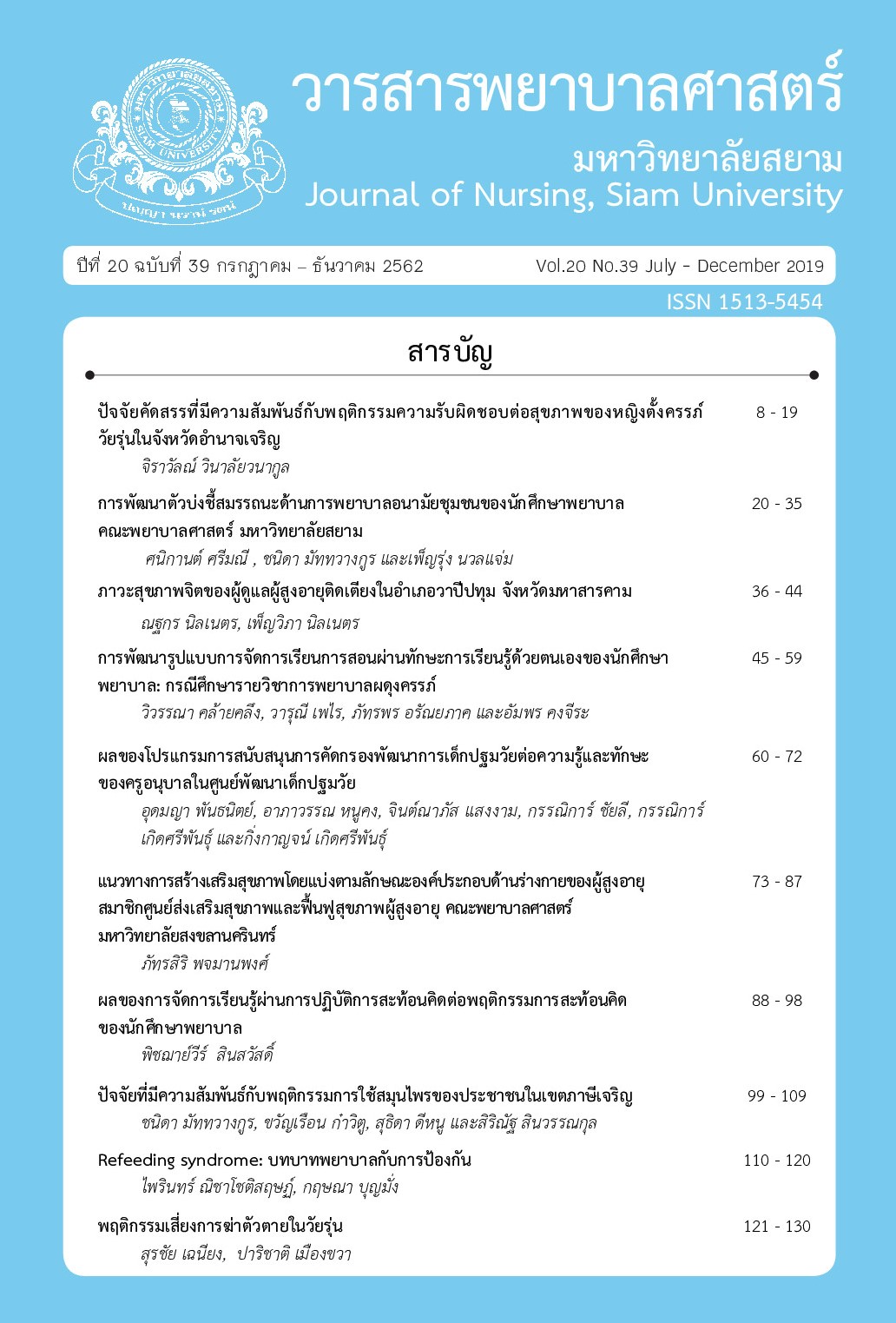
พฤติกรรมการฆ่าตัวตายในวัยรุ่น
DOI:
https://doi.org/10.14456/jnsu.v20i39.154669คำสำคัญ:
พฤติกรรมเสี่ยงการฆ่าตัวตาย, การป้องกันการฆ่าตัวตาย, ปัจจัยเสี่ยง, ปัจจัยปกป้อง, วัยรุ่น, ประเทศไทยบทคัดย่อ
พฤติกรรมเสี่ยงการฆ่าตัวตายในวัยรุ่นเป็นปัญหาสำคัญทางด้านสาธารณสุขทั่วโลกรวมทั้งประเทศไทย บทความนี้มีวัตถุประสงค์เพื่อนำเสนอหลักฐานเชิงประจักษ์ที่เกี่ยวข้องกับพฤติกรรมการฆ่าตัวตายในวัยรุ่น การป้องกันการฆ่าตัวตายสำหรับวัยรุ่นควรมีการจัดกิจกรรมเพื่อลดปัจจัยเสี่ยงและเพิ่มปัจจัยปกป้องป้องโดยใช้กลยุทธ์ในการเข้าถึงกลุ่มเป้าหมายในวัยรุ่นทั้ง 3 กลุ่ม ได้แก่ กลุ่มทั่วไป กลุ่มเสี่ยง และกลุ่มที่มีเคยมีประวัติการฆ่าตัวตาย องค์ประกอบในการป้องกันการฆ่าตัวตายสำหรับวัยรุ่นมีจุดเน้นที่สำคัญในแต่ละกลุ่ม ประกอบด้วย การสร้างความตระหนัก การให้ความรู้และวิธีการป้องกันการฆ่าตัวตาย เพื่อนช่วยเพื่อน การประเมินเสี่ยง การฝึกทักษะการคัดกรองความเสี่ยงสำหรับผู้ดูแล การให้คำปรึกษาและการสนับสนุนทางสังคม การบำบัดทางความคิดและพฤติกรรม และการบำบัดด้วยสัมพันธภาพระหว่างบุคคล ข้อค้นพบดังกล่าวเป็นข้อมูลพื้นฐานที่สำคัญในการพัฒนาระบบการป้องกันพฤติกรรมการฆ่าตัวตายสำหรับวัยรุ่นไทย พยาบาลสุขภาพจิตและจิตเวชเป็นผู้มีบทบาทที่สำคัญในการเริ่มต้นดำเนินกิจกรรมและประสานความร่วมมือระหว่าง วัยรุ่น ครอบครัว โรงเรียน แหล่งบริการด้านสุขภาพ และชุมชนในการป้องกันพฤติกรรมการฆ่าตัวตายในวัยรุ่นอย่างมีประสิทธิภาพ
คำสำคัญ; พฤติกรรมเสี่ยงการฆ่าตัวตาย, การป้องกันการฆ่าตัวตาย, ปัจจัยเสี่ยง, ปัจจัยปกป้อง, วัยรุ่น, ประเทศไทย
เอกสารอ้างอิง
Boonyamalik, P. (2005). Epidemiology of adolescent suicidal ideation: Roles of perceived life stress, depressive symptoms,andsubstanceuse.Unpublished Dissertration, Johns Hopkins University, US.
Chaimongkol, N., Deoisres, W., & Wongnam, P. (2017). Suicidal Ideation among Thai Adolescents: An Empirical Test of a Causal Model. Pacific Rim International Journal of Nursing Research, 21(2), 97-107.
Ciffone, J. (2007). Suicide prevention: An analysis and replication of a curriculum-based high school program. Social Work, 52(1), 41-49.
Garber, J., Clarke, G. N., Weersing, V. R., Beardslee, W. R., Brent, D. A.,Gladstone, T. R., ... & Shamseddeen, W. (2009). Prevention of depression in at-risk adolescents: a randomized controlled trial. jama, 301(21), 2215 - 2224.
King, K. A., Strunk, C. M., & Sorter, M. T. (2011). Preliminary effectiveness of surviving the Teens® Suicide Prevention and Depression Awareness Program on adolescents' suicidality and self‐efficacy in performing help‐seeking behaviors. Journal of school health, 81(9), 581-590.
Kleiman, E. M., & Liu, R. T. (2013). Social support as a protective factor in suicide: Findings from two nationally representative samples. Journal of affective disorders, 150(2), 540-545.
Nintachan, P. (2008). Resilience and risk-taking behavior among Thai adolescents living in Bangkok, Thailand (Doctoral dissertation).Quinnett, P. (2007). QPR gatekeeper training for suicide prevention: The model,rationale and theory. Retrieved July, 28, 2008.
Robinson, J., Cox, G., Malone, A., Williamson, M., Baldwin, G., Fletcher, K., & O'brien, M. (2013). A systematic review of school-based interventions aimed at preventing, treating, and responding to suicide-related behavior in young people. Crisis: The Journal of Crisis Intervention and Suicide Prevention, 34(3), 164.
Rungsang & Chaimongkol (2017). The Prevalence of Suicidal Ideation among High School Students in Thailand and Its Potential Related Risk Factors. Thai Pharmaceutical and Health Science Journal, 12(1), 31-35.
Schilling, E. A., Lawless, M., Buchanan, L., & Aseltine, R. H. (2014). “Signs of Suicide” shows promise as a middle school suicide prevention program. Suicide and life-threatening behavior, 44(6), 653-667.
Smith, J. P., & Smith, G. C., (2010). Long-term economic costs of psychological problems during childhood. Social Science & Medicine, 71, 110-115.
Strunk, C. M., King, K. A., Vidourek, R. A., & Sorter, M. T. (2014). Effectiveness of the surviving the teens® suicide prevention and depression awareness program: An impact evaluation utilizing a comparison group. Health Education & Behavior, 41(6), 605-613.
Strunk, C. M., Sorter, M. T., Ossege, J., & King, K. A. (2014). Emotionally troubled teens’ help-seeking behaviors: An evaluation of surviving the teens® suicide prevention and depression awareness program. The Journal of School Nursing, 30(5), 366-375.
Tang, T. C., Jou, S. H., Ko, C. H., Huang, S. Y., & Yen, C. F. (2009). Randomized study of school‐based intensive interpersonal psychotherapy for depressed adolescents with suicidal risk and parasuicide behaviors. Psychiatry and Clinical Neurosciences, 63(4), 463-470.
Thanoi, W., Phancharoenworakul, K., Thompson, E. A., Panitrat, R., & Nityasuddhi, D. (2010). Thai adolescent suicide risk behaviors: testing a model of negative life events, rumination, emotional distress, resilience and social support. Pacific Rim International Journal of Nursing Research, 14(3), 187-202.
Thiamkaew, K., Phuaphanprasert, U., Mahatnirunkul, S., Pannarunothai, S. (2007). Depression care cost in Thai public service settings. Journal of Mental Health of Thailand, 15(1).
Thompson, E. A., Eggert, L. L., Randell, B. P., & Pike, K. C. (2001).Evaluation of indicated suicide risk prevention approaches for potential high school dropouts. American Journal of Public Health, 91(5), 742.
Thompson, E. A., Mazza, J. J., Herting, J. R., Randell, B. P., & Eggert, L. L. (2005). The mediating roles of anxiety, depression, and hopelessness on adolescent suicidal behaviors. Suicide and Life-Threatening Behavior, 35(1), 14-34.
Tusaie, K., Puskar, K., & Sereika, S. M. (2007). A predictive and moderating model of psychosocial resilience in adolescents. Journal of Nursing Scholarship, 39(1), 54-60.
U.S. Department of Health and Human Services Substance Abuse and Mental Health Services Administration Center for Mental Health Services (2012). Preventing Suicide: A Toolkit For High Schools. Center for Mental Health Services, Substance Abuse and Mental Health Services Admintration, 1 Cherry Road, Rockville, MD 20857, HHS Publication No. SMA-12-4669. Printed 2012.
Vuthiarpa, S., Sethabouppha, H., Soivong, P., & Williams, R. (2012). Effectiveness of a school-based cognitive behavioral therapy program for Thai adolescents with depressive symptoms. Pacific Rim International Journal of Nursing Research, 16(3), 206-221.
Whitlock, J., Wyman, P. A., & Moore, S. R. (2014). Connectedness and suicide prevention in adolescents: Pathways and implications. Suicide and life-threatening behavior, 44(3), 246-272.
World Health Organization [WHO]. (2015). Available from https://www.who.int/maternal_child_adolescent/en/
Wyman, P. A., Brown, C. H., Inman, J., Cross, W., Schmeelk-Cone, K., Guo, J., & Pena, J. B. (2008). Randomized trial of a gatekeeper program for suicide prevention: 1-year impact on secondary school staff. Journal of consulting and clinical psychology, 76(1), 104.
Wyman, P. A., Brown, C. H., LoMurray, M., Schmeelk-Cone, K., Petrova, M., Yu, Q., ... & Wang, W. (2010). An outcome evaluation of the Sources of Strength suicide prevention program delivered by adolescent peer leaders in high schools. American journal of public health, 100(9), 1653-1661.
ดาวน์โหลด
เผยแพร่แล้ว
รูปแบบการอ้างอิง
ฉบับ
ประเภทบทความ
สัญญาอนุญาต
เนื้อหาและข้อมูลที่เผยแพร่ในวารสารพยาบาลศาสตร์ มหาวิทยาลัยสยามถือเป็นข้อคิดเห็นและความรับผิดชอบของผู้นิพนธ์บทความโดยตรง
บทความ เนื้อหา ข้อมูล รูปภาพ ฯลฯ ที่ได้รับการเผยแพร่ในวารสารพยาบาลศาสตร์ มหาวิทยาลัยสยาม ถือเป็นลิขสิทธิ์ของวารสารพยาบาลศาสตร์ มหาวิทยาลัยสยาม หากบุคคลหรือหน่วยงานใดต้องการนำทั้งหมดหรือส่วนหนึ่งส่วนใดไปเผยแพร่หรือเพื่อกระทำการใด ๆ จะต้องอ้างอิงวารสารพยาบาลศาสตร์ มหาวิทยาลัยสยามทุกครั้ง

