
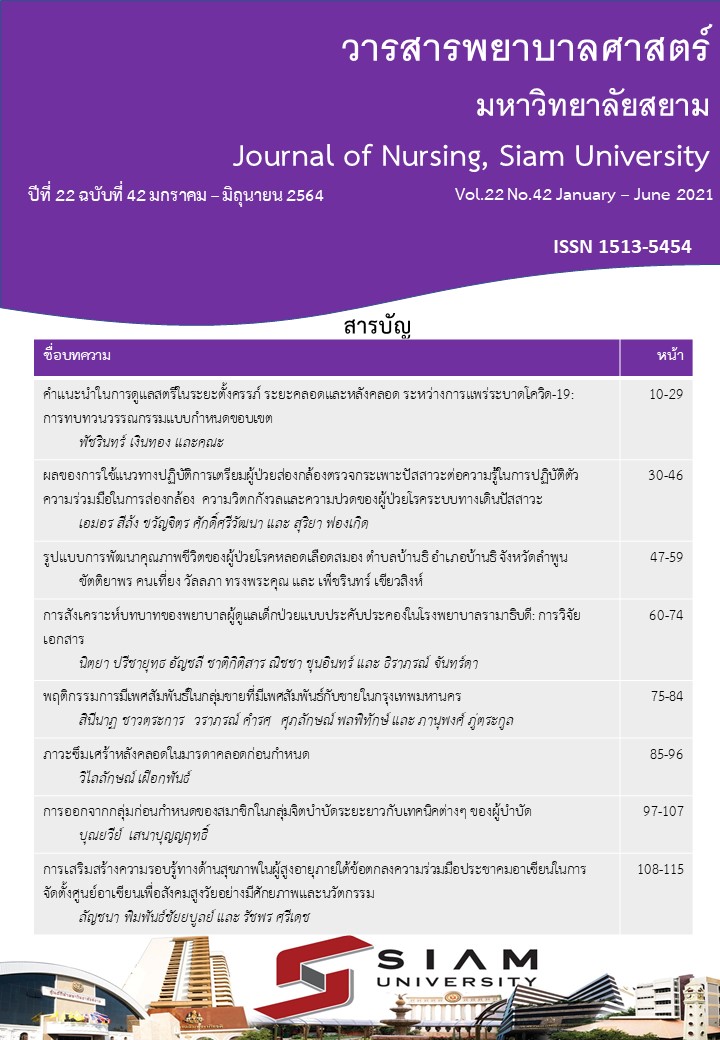
การออกจากกลุ่มก่อนกำหนดของสมาชิกในกลุ่มจิตบำบัดระยะยาวกับเทคนิคต่างๆ ของผู้บำบัด
คำสำคัญ:
กลุ่มระยะยาว, การออกจากลุ่มก่อนเวลาที่กำหนด, เทคนิคของผู้บำบัดบทคัดย่อ
ในการทำกลุ่มระยะยาวถึงจะมีการเลือกสมาชิกที่เหมาะสมแล้วก็ตาม แต่มักจะหลีกเลี่ยงไม่พ้นในเรื่องของสมาชิกที่มีความประสงค์ออกจากกลุ่มก่อนกำหนด (Immature termination or premature drop out) พบว่าในระยะทำกลุ่ม 12-20 ครั้งของการทำกลุ่ม จะมีสมาชิกออกจากลุ่มประมาณ 20-60 % ทำให้เกิดผลกระทบต่อกลุ่มระยะยาวได้ ซึ่งเป็นความท้าทายอย่างยิ่งต่อผู้นำกลุ่มในการทำให้กลุ่มดำเนินต่อไปท่ามกลางอุปสรรค ดังนั้นผู้นำกลุ่มควรมีทักษะเกี่ยวกับการสังเกต การฟัง รับรู้ และแปลความหมายที่ถูกต้องเกี่ยวกับการแสดงออกของสมาชิกในกลุ่ม นอกจากนี้ผู้นำกลุ่มต้องมีประสบการณ์และความชำนาญในการใช้เทคนิคต่างๆ ต่อไปนี้ คือ เทคนิคที่นี่และเดี๋ยวนี้ การเปิดเผยตนเองของผู้นำกลุ่ม การระบาย การวิเคราะห์และตีความ การช่วยเหลือผู้อื่น การใช้สัจธรรม สร้างความหวัง ผู้นำกลุ่มที่ชำนาญนั้นต้องสามารถดึงศักยภาพของสมาชิกแต่ละคนในกลุ่มให้ช่วยเหลือซึ่งกันและกันในแนวทางที่สร้างสรรได้ด้วย เหล่านี้นอกจากสามารถลดผลกระทบที่เกิดจาก premature drop out ที่จะเกิดขึ้นได้แล้วยังทำให้สมาชิกแต่ละคนในกลุ่มได้พัฒนาตนเองอีกด้วย
เอกสารอ้างอิง
ทินกร วงษ์ปการันย์. (2552) จิตบำบัด: ทฤษฎีและเทคนิค. เชียงใหม่: เชียงใหม่โรงพิมพ์แสงศิลป์.
Abramowitz, S.I., & Jackson, C. (1974). Comparative effectiveness of there-and-then versus here-and-now therapist interpretations in group psychotherapy. Journal of Counseling Psychology, 21(4), 288–293. Retrieve from https://doi.org/10.1037/h0036719
Alonso, J.T. (2011). Cohesion’s relationship to outcome in group psychotherapy: A meta-analytic review of empirical research. (Doctoral dissertations, Brigham Young University, Provo, Utah, United States). ScholarsArchive. BYU Brigham Young University. Retrieved from https://scholarsarchive.byu.edu/etd/2658
Anderson, K.N. (2015). Premature Termination of Outpatient Psychotherapy: Predictors, Reasons, and Outcomes. (Doctoral dissertation, The University of Nebraska–Lincoln, USA). ProQuest Dissertations and Theses database. Retrieved from http://www.digitalcommons.unl.edu.
Anthony, M.T. & Jacob, A. F., Ryan, J. M., Yossef, S.B. (2015). Marek RJ, Ben-Porath YS, Van Dulmen MH. Premature termination from psychotherapy and internalizing psychopathology: The role of demoralization. J Affect Disord.,174, 549-555. doi.org/10.1016/j.jad.2014.12.018.
Barrett MS, Chua W-J, Christoph PC, Gibbons MB, Casiano D, Thompson D. (2009). Early withdrawal from mental health treatment: Implications for psychotherapy practice. Psychotherapy (Chic), 45(2):247-67.
Batch, A. (2018) Dropout in Group Therapy: Causes and prevention strategies. (Master’s thesis, The City University of Seattle, USA). Library & LRC CityUniversity of Seattle. Retrieved from http://www.repository.cityu.edu.
Bhikkhu B. (2001). Conditionality. Bangkok: Sukkapabjai.
Cooper, A.A., ConKlin, L.R. (2015). Dropout from individual psychotherapy for major depression: A meta-analysis of randomized clinical trials. Clin Psychol Rev 40, 57-65.
Donelson, R. F. (2017). Group dynamic (7th ed.). Boston: Cengage.
Duff, C.T. & Bedi, R. P. (2010). Counsellor behaviours that predict therapeutic alliance: From the client’s perspective. Counselling Psychology Quarterly, 23(1), 91-110.
Ghazaleh, S., Jalal, Y., Ahmad, B., & Shahla A. (2012). The effectiveness of group hope therapy on hope and depression of mothers with children suffering from cancer in Tehran. Iran J Cancer Prev, 5(4), 183-188.
Gregory, E.S., Victoria D., Rebecca H., Paul F., Evette L., Leo M., Belinda O., & James S. (2012). Early Dropout from Psychotherapy for Depression with Group- and Network-model Therapists. Adm Policy Ment Health and Ment Health Research, 39(6), 440-447.
Jensen, H.H., Mortensen, E.L., Lotz, M. (2014). Drop-out from a psychodynamic group psychotherapy outpatient unit. Nord J Psychiatry 68(8), 594-604. doi: 10:3109/08039488.2014.902499
Howard, B.R. (2000). Adverse outcomes in group psychotherapy: Risk factor, prevention, and research directions. J Psychother Pract Res, 9(3), 113-122.
Jan, V.B., Therasa, W., Ole, K., & Steinar, L. (2013). Development of group climate in short and long term psychodynamic group psychotherapy. International Journal of Group Psychotherapy, 63(3), 366-393.
Jensen, H.H., Mortensen, E.L., & Lotz, M. (2014). Drop-out from a psychodynamic group psychotherapy outpatient unit. Nord J Psychiatry, 68(8), 594-604.
Joshua, K. S. & Roger, P.G. (2015). Premature termination in psychotherapy: Strategies for engaging clients and improving outcomes. Washington DC: American Psychological Association.
Kivlighan, D.M. (2014). Three important clinical process in individual and group interpersonal psychotherapy sessions. American Psychological Association, 51(1), 20-24.
Koukourikos, K. & Pasmatzi, E. (2014). Group psychotherapy in psychotic patients. Health Science Journal, 8(3), 400-408. Retrieved From http://www.researchgate.net.
Knox, S. & Hill, C.E. (2003). Therapist self-disclosure: Research-based suggestions for practitioners. Journal of Clinical Psychology, 59(5), 529-539.
Lorentzen, S., Bakali, J. V., Hersoug, A.G., Ruud, T. & Hoglend, P. (2012). Psychodynamic group psychotherapy: Impact of group length and therapist professional characteristics on development of therapeutic alliance. Clinical Psychology & Psychotherapy, 19(5), 420-433.
Marmarosh, C. L., & Sproul, A. (2021). The psychology of groups: Group cohesion: Empirical evidence from group psychotherapy for those studying other areas of group work. Washington, DC: American Psychological Association.
Matthias, E., & Alf, G. (2014). Psychoanalytic psychotherapy: A hand book. New York: Karnac Books.
Martha, S. (2016). How does psychotherapy work. International psychotherapy institute. United States of America. Retrieved From http://www.ijp.org.uk.
Pingitore, F.R.B. (2015). Exploring the experiences of adolescents participating in interpersonal group psychotherapy. (Doctoral dissertation, The University of Rhode, Island.) Retrieve from http://core.ac.uk/download/pdf/56697369
Piper, W.E., Joyce, A.S., Weideman, R. & Rosie, J.S. (2007). Group composition and group therapy for complicated grief. Journal of Consulting and Clinical Psychology, 75(1), 116-25.
Riches, S., Schrank, B., Brownell, T., Slade, M., & Lawrence, V. (2020). Therapist self-disclosure in positive psychotherapy for psychosis. Clinical Psychology Forum, 2020 (327), 14-21. Retrieved from https://nottingham-repository. worktribe.com/output/3776787
Roos, J. & Werbart, A. (2013). Therapist and relationship factors influencing drop out from individual psychotherapy: a literature review. Psychotherapy Research, 23(4), 394-418.
Rutan, J.S., Walter, N.S. & Joseph, J.S. (2007). Psychodynamic group psychotherapy: Therapeutic factor in group psychotherapy. (4th ed.). New York: Guilford.
Sanaa, A., Samir A., Mona R, Salwa E., & Rania M. (2010). Therapeutic factor ingroup psychotherapy: A study of Egyptian drug addicts. Journal of group in addiction & recovery 5(3-4), 194-213.
Senaboonyarit, B. (2013). Learner’s awareness of Yalom’s therapeutic factors in group psychotherapy demonstration of the Thai association psychotherapists. J Psychiatr Assoc Thailand; 58(2), 197-206.
Senaboonyarit, B. & Chaowasilt, P. (2015). The Yalom’s therapeutic factor using in long term group psychotherapy after premature drop out: pilot study: Proceedings of International Symposium on Social Sciences and Management Conference (pp.494-500) Tokyo, Japan.
Senaboonyarit, B. (2016) Long-term Group and Premature Drop out Groups in Psychotherapy: Yalom’s ‘Here and Now’ Techniques. Universal Journal of Psychology, 4(5), 215-221.
Sharf, J., Primavera, L. H., & Diener, M. J. (2010). Dropout and therapeutic alliance: A meta-analysis of adult individual psychotherapy. Psychotherapy: Theory, Research, Practice, Training, 47(4), 637-645.
Sharon, Ziv-B., Giora, K., Elad, L., Patrick, S. M., & Golan S. (2016). Immediate therapist self-disclosure bolsters the effect of brief integrative psychotherapy on psychiatric symptoms and the perceptions of therapists: A randomized clinical trial. Psychotherapy Research, 27(5), 1-13. Retrieved from: http://dx.doi.org/10.1080/10503307
Shedler, J. (2010). The efficacy of psychodynamic psychotherapy. America Psychological Association, 65(2), 98-100.
Sue, A.E. (2009). Therapeutic factors in group counseling: Implications for audiologic rehabilitation. Perspectives on Aural Rehabilitation and Its instrumentation, 16 (1), 15-28.
Therapistaid.com (2016). Dealing with dropout: client retention. Retrieved from http://www. Therapistaid. Com/therapy-guide/client-dropout.
Walter, V., & Maarten, V. (2009). Let eating disorder patients decide: Providing choice may reduce early drop-out from inpatient treatment. Eur Eat Disord Rev, (17)3, 177-183. doi: 10.1002/erv.917.
Wheeler, K. (2014). Psychotherapy for the advanced practice psychiatric nurse: how to guide for evidence based practice. USA: Spinger.
Winger, S.J. (2010). Hope: The essential therapeutic factor. (Master’s thesis), The Adlerian Counseling and Psychotherapy, USA). Retrieved from http://www.alfredadler.edu.
Yalom, I.D., & Leszcz M. (2005). The theory and practice of group psychotherapy. (5th ed.) New York: Basic Books.
ดาวน์โหลด
เผยแพร่แล้ว
รูปแบบการอ้างอิง
ฉบับ
ประเภทบทความ
สัญญาอนุญาต
เนื้อหาและข้อมูลที่เผยแพร่ในวารสารพยาบาลศาสตร์ มหาวิทยาลัยสยามถือเป็นข้อคิดเห็นและความรับผิดชอบของผู้นิพนธ์บทความโดยตรง
บทความ เนื้อหา ข้อมูล รูปภาพ ฯลฯ ที่ได้รับการเผยแพร่ในวารสารพยาบาลศาสตร์ มหาวิทยาลัยสยาม ถือเป็นลิขสิทธิ์ของวารสารพยาบาลศาสตร์ มหาวิทยาลัยสยาม หากบุคคลหรือหน่วยงานใดต้องการนำทั้งหมดหรือส่วนหนึ่งส่วนใดไปเผยแพร่หรือเพื่อกระทำการใด ๆ จะต้องอ้างอิงวารสารพยาบาลศาสตร์ มหาวิทยาลัยสยามทุกครั้ง

