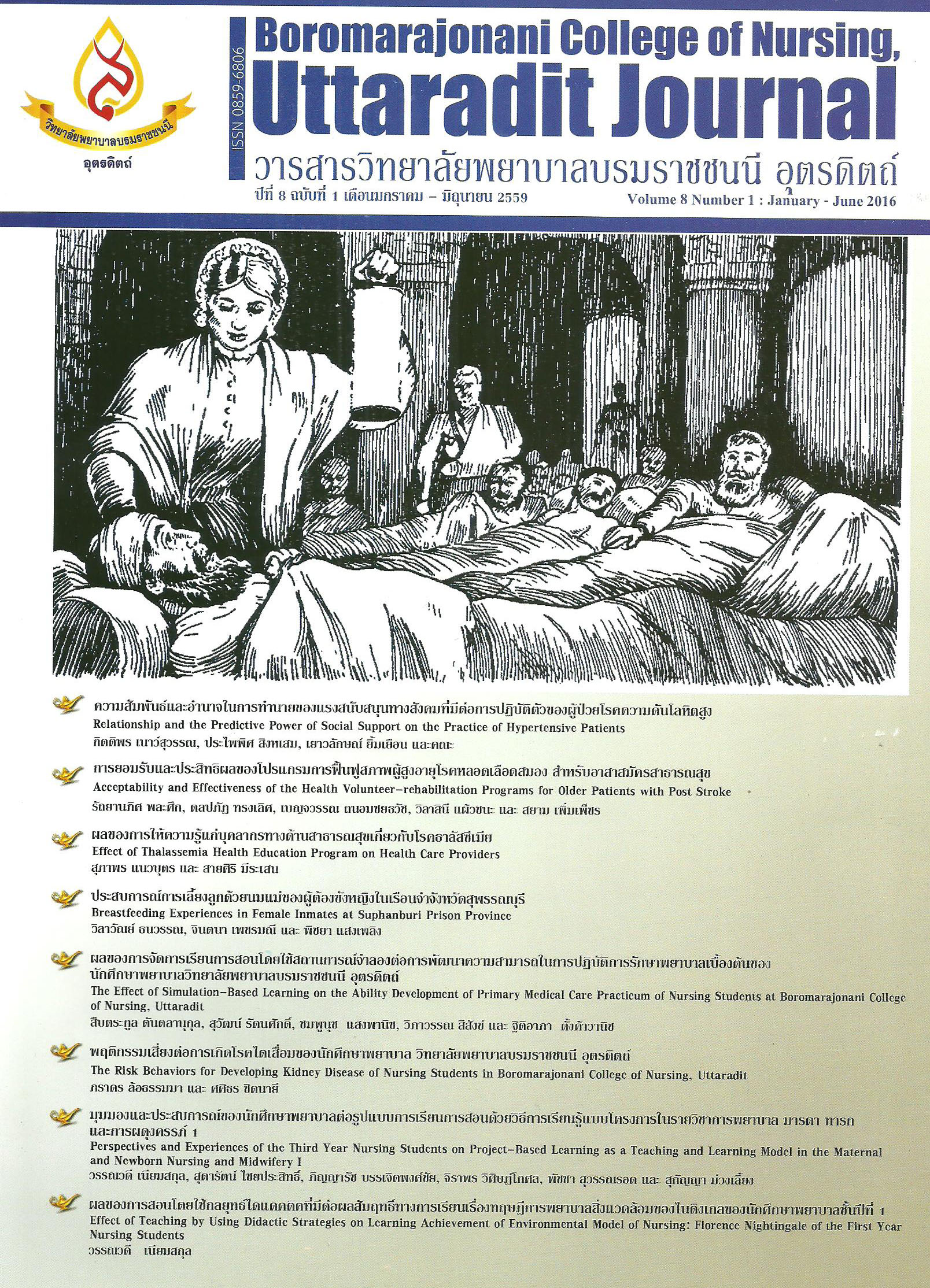
ผลของการสอนโดยใช้กลยุทธ์ไดแดคติคที่มีต่อผลสัมฤทธิ์ทางการเรียนเรื่องทฤษฎี การพยาบาลสิ่งแวดล้อมของไนติงเกลของนักศึกษาพยาบาลชั้นปีที่ 1
Article Sidebar
Main Article Content
Abstract
The purposes of this quasi-experimental research were to compare achievement of nursing
students before and after teaching by didactic strategies and traditional method. Research subjects were
60 first year nursing students from Boromarajonani College of Nursing Uttaradit which were matched
pairs by randomly assigned into one experiment group and one control group. Research instruments
were didactic strategies lesson plan and achievement test developed by the researcher and the contents
were validated by groups of experts. The reliability of the test was .86. Statistical techniques used in data
analysis were percentage, mean, standard deviation, and t-test.
Major findings were as the followings:
1. Achievement of nursing students after teaching by didactic strategies was significantly higher
than before at .05 level.
2. Achievement of nursing students whom being taught by didactic strategies was significantly
higher than the control group at .05 level.
Article Details
Journal of Nursing and Health Science Research attribution-non-commercial 4.0 international (CC BY-NC 4.0). For more detail please visit https://creativecommons.org/licenses/by-nc/4.0/ . The ideas and opinions expressed in the Journal of Nursing and Health Science Research are those of the authors and not necessarily those of the editor .
References
2. ประดับ แก้วแดง. (2542). ผลของการสอนแบบจัดกรอบมโนทัศน์ที่มีต่อความคงทนในการเรียนรู้และผลสัมฤทธิ์ทางการเรียนของนักศึกษาพยาบาล. วิทยานิพนธ์ปริญญาพยาบาลศาสตรมหาบัณฑิต คณะแพทยศาสตร์จุฬาลงกรณ์ มหาวิทยาลัย, กรุงเทพฯ.
3. ประเวศ วะสี. ปฏิรูปการเรียนรู้ ผู้เรียนสำคัญที่สุด.กรุงเทพ: บริษัทพิมพ์ดีจำกัด.แผนพัฒนาเศรษฐกิจและสังคมแห่งชาติ ฉบับที่ 11(พ.ศ. 2555-2559).สำนักงานคณะกรรมการพัฒนาการเศรษฐกิจและสังคมแห่งชาติ.สำนัก นายกรัฐมนตรี.
4. แผนพัฒนาสุขภาพแห่งชาติ ฉบับที่ 11 (พ.ศ. 2555-2559). สำนักงานปลัดกระทรวง. กระทรวงสาธารณสุข จังหวัดนนทบุรี
5. พัชรภัณฑ์ ไชยสังข์ และ ศราวิน เทพสถิตภรณ์.(2558). รายงานวิจัยเรื่องการจำแนกรูปแบบการเรียนรู้ของนักศึกษาพยาบาลวิทยาลัยนานาชาติเซนต์เทเรซา: นครนายกretrievefromhttp://mis.cola.kku.ac.th/files/gs28_attachment_files/files/348/ED_032.pdf?1402718868 June 28, 2015
6. แฟ้มรายงานแผนการสอนวิทยาลัยพยาบาลบรมราชชนนี อุตรดิตถ์. (2555). วิทยาลัยพยาบาลบรมราชชนนี อุตรดิตถ์.
7. รายงานประจำปีของวิทยาลัยพยาบาลบรมราชชนนี อุตรดิตถ์. (2555). วิทยาลัยพยาบาลบรมราชชนนี อุตรดิตถ์.
8. สุภรณ์ สภาพงศ์. (2544). วิธีการเรียนรู้ตามหลักสูตรการศึกษาขั้นพื้นฐาน พุทธศักราช 2544มุ่งให้เกิดความสุขที่ยั่งยืน. หนังสือพิมพ์เดลินิวส์. 19039: พฤศจิกายน. หน้า 6
9. หลักสูตรพยาบาลศาสตรบัณฑิต หลักสูตรปรับปรุง2555. (2555). วิทยาลัยพยาบาลบรมราชชนนีอุตรดิตถ์. สถาบันพระบรมราชชนก สำนักงานปลัดกระทรวงสาธารณสุข กระทรวงสาธารณสุขจ.นนทบุรี
10. Alkhasawneh, I., Mrayyan, M. T., Docherty, C.,Alashram, S., & Yousef, H. Y. (2008).Problem-based learning (PBL): assessingstudents’ learning preferences using vark.Nurse Education Today, 28, 572-579.
11. Alkhasawneh, E. (2013). Using VARK to assesschanges in learning preferences of nursing students at a public university in Jordan: Implication for teaching. Nurse EducationToday, 33, 1546-1549.
12. Edgar, D. (1969). Audio-Visual Methods inTeaching. 3rd ed. Holt Rinehart Winston.
13. Fleming, N. D. (2004). VARK: A guide to learningstyles: Retrieve from www.vark-learn.com/english. June 28, 2015
14. Meehan-Andrews, T. A. (2009). Teaching modeefficiency and learning preferences of first year nursing students. Nurse EducationToday, 29, 24-32.
15. The Fontys UAS Team. (2013). Training/course manual. Fontys University of Applied Science: The Netherlands.
