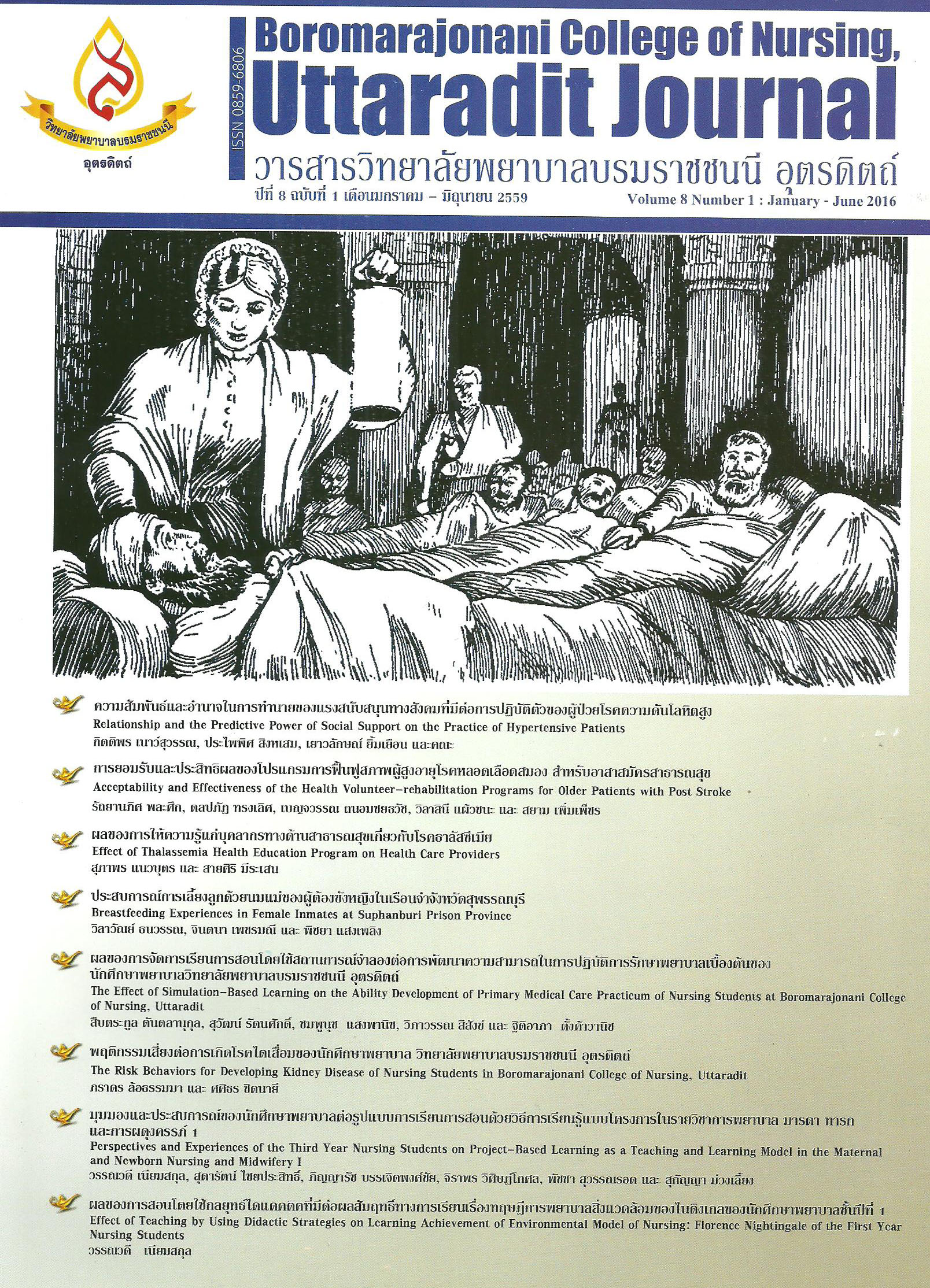
ความสัมพันธ์และอำนาจในการทำนายของแรงสนับสนุนทางสังคมที่มีต่อการปฏิบัติตัว ของผู้ป่วยโรคความดันโลหิตสูง
Article Sidebar
Main Article Content
Abstract
Social support promoted behavior control effecting on sustainably health behavior modification.
The study employed mixed methods to examine the relationship and the predictive power of social
support on the practice of hypertensive patients, and the good practice to control blood pressure level of
hypertensive patients. The study was divided into two stages. Stage I to examine the relationship and
the power predictive, samples were 138 hypertensive patient visiting Diabetic and Hypertensive Clinic
at Singha Nakhon Hospital, Songkhla. Using G*Power to compute the sample size and using sampling
without replacement to recruit sample. The instrument was the questionnaire which the content validity
was tested by three experts and the reliability using Cronbach’ Alpha Coefficient with reliability was
.81 Data were analyzed using Pearson product-moment Correlation and simple regression. Stage II to
examine the good practice to control blood pressure level of hypertensive patients, in-depth interview
was employed to collect data from nine hypertensive patients who could control their blood pressure
level, then, data were analyzed using content analysis. The findings indicated:
1. Social support had positive relationship at medium level with the practice of Hypertensive
patients at the Diabetic Hypertensive Clinic of Singha Nakhon Hospital, Songkhla as well as
statistically significant at .001 (r=.543) and could predict 29.50 %.
2. The good practice to control blood pressure level of hypertensive patients at the Diabetic
Hypertensive Clinic of Singha Nakhon Hospital, Songkhla were to keep the doctor appointment, take
medicine and exercise regularly, consume three meals daily focusing on fishes and fruits, avoid salty
foods, cook for themselves, consult with family members, participate in community activities and
Elderly club, perform religious activities daily, set their goal on good offspring, join the relaxing
activities with clear mind, have a sense of forgiveness and be an optimistic.
Article Details
Journal of Nursing and Health Science Research attribution-non-commercial 4.0 international (CC BY-NC 4.0). For more detail please visit https://creativecommons.org/licenses/by-nc/4.0/ . The ideas and opinions expressed in the Journal of Nursing and Health Science Research are those of the authors and not necessarily those of the editor .
References
2. จีราพร ทองดี, ดาราวรรณ รองเมือง และฉันทนานาคฉัตรีย์. (2555). ภาวะสุขภาพและคุณภาพชีวิตของผู้สูงอายุในจังหวัดชายแดนภาคใต้.วารสารพยาบาลกระทรวงสาธารณสุข,22(3), 88-99.
3. จุฬาลักษณ์ บารมี. (2551). สถิติเพื่อการวิจัยทางสุขภาพและการวิเคราะห์ข้อมูลด้วยโปรแกรมSPSS. ชลบุรี: ศรีศิลปการพิมพ์.
4. บำเพ็ญ สุขสีเสน. (2549). ความสัมพันธ์ระหว่างปัจจัยส่วนบุคคลกับพฤติกรรมส่งเสริมสุขภาพของผู้สูงอายุโรคความดันโลหิตสูงในเขตรับผิดชอบของสถานีอนามัย ต.เขารูปช้างสาขา 1 อ.เมือง จ.สงขลา. สงขลา : โรงพยาบาลสงขลา.
5. ปฐญาภรณ์ ลาลุน, นภาพร มัธยมางกูร และอนันต์มาลารัตน์. (2554). พฤติกรรมการดูแลตนเองของผู้ป่วยโรคความดันโลหิตสูงที่มารับบริการแผนกผู้ป่วยนอกอายุรกรรมโรงพยาบาลศูนย์การแพทย์สมเด็จพระเทพรัตนราชสุดาฯ สยามบรมราชกุมารี. วารสารการแพทย์และวิทยาศาสตร์สุขภาพ, 18(3),160-169.
6. ประภาส ขำมาก, สมรัตน์ ขำมาก และมาลิน แก้วมูณี.(2558). ปัจจัยที่มีความสัมพันธ์กับพฤติกรรมการดูแลตนเองของผู้ป่วยโรคความดันโลหิตสูง. วารสารเครือข่ายวิทยาลัยพยาบาลและการสาธารณสุขภาคใต้, 2(3) , 74-91.
7. ปิยะวรรณ ขนาน, ศศิมา กุสุมา ณ อยุธยา, สุวิมลกิมปี และกุลภา ศรีสวัสดิ์. (2550). ความสัมพันธ์ระหว่างความเชื่ออำนาจควบคุมทางสุขภาพ และการสนับสนุนทางสังคมกับพฤติกรรมการดูแลเท้าในผู้ป่วยเบาหวานที่มีแผลที่เท้า. วารสารพยาบาล, 56(1-2),102-113.
8. พานทิพย์ แสงประเสริฐ. (2550). ความดันโลหิตสูงกับการออกกำลังกาย: บทบาทของพยาบาล.วารสารพยาบาล, 56(1), 1-13.
9. ภัสราวลัย ศีติสาร,อรุณวรรณ สุวรรณรัตน์ และจารุวรรณ ใจลังกา. (2556). ปัจจัยที่มีผลต่อพฤติกรรมการดูแลตนเองของผู้ป่วยภาวะความดันโลหิตสูงที่ควบคุมไม่ได้โรงพยาบาลดอกคำใต้ อ.ดอกคำใต้ จ.พะเยา.วารสารสาธารณสุขล้านนา, 9(2), 136.
10. โรงพยาบาลสิงหนคร. (2557). สรุปผลการดำเนินงานโรคเบาหวาน/ความดันโลหิตสูง. สงขลา:โรงพยาบาลสิงหนคร. เอกสารอัดสำเนา
11. วรวรรณ จันทวีเมือง และบุษยา สังขชาติ. (2557).การดูแลตนเองแบบผสมผสานของผู้ป่วยโรคเบาหวานกรณีศึกษา: ภายใต้บริบทของสังคมวัฒนธรรมท้องถิ่นภาคใต้. วารสารเครือข่ายวิทยาลัยพยาบาลและการสาธารณสุข
ภาคใต้, 1(3), 15-35.
12. วันวิสา รอดกล่อม, นิสาพร วัฒนศัพท์, ปัทมาสุพรรณกุล, และอรอุษา สุวรรณประเทศ.(2555). การสนับสนุนทางสังคมและความเชื่อด้านสุขภาพกับพฤติกรรมการดูแลตนเองของผู้ป่วยโรคความดันโลหิตสูงชนิดไม่ทราบสาเหตุที่มารับบริการโรงพยาบาลพรหมพิรามจ.พิษณุโลก. วารสารการพยาบาลและสุขภาพ,6(2), 76-87.
13. สำนักนโยบายและยุทธศาสตร์ กระทรวงสาธารณสุข.(2556). จำนวนและอัตราผู้ป่วยในด้วยโรคความดันโลหิตสูง. จาก http://thaincd.com/information-statistic/non-communicabledisease-data.php.
14. สุนทรีย์ คำเพ็ง และอรธิรา บุญประดิษฐ์. (2555). ผลของการจัดโปรแกรมการสร้างเสริมสุขภาพร่วมกับการสนับสนุนทางสังคมในผู้ป่วยความดันโลหิตสูง ต.ดงตะงาว อ.ดอนพุดจ.สระบุรี.วารสารพยาบาลกระทรวงสาธารณสุข, 22(3), 112-123.
15. สุพัตรา บัวที. (2545). การพยาบาลกับการสนับสนุนการปฏิบัติตัวเพื่อควบคุมระดับความดันโ ล หิ ต อ ย ่ า ง ส ม่ำเ ส ม อ แ ล ะ ต ่ อ เ นื่ อ ง .วารสารวิทยาลัยพยาบาลบรมราชชนนีนครราชสีมา, 18(1), 49-61.
16. สุสารี ประคินกิจ. (2552). การศึกษาความสัมพันธ์ระหว่างแรงสนับสนุนทางสังคมและความวิตกกังวลของผู้ติดเชื้อเอชไอวีที่เข้ารับการตรวจรักษาในโรงพยาบาลสมุทรสาคร.กรุงเทพฯ: มหาวิทยาลัยสยาม.
17. อภัสริน มะโน, วันเพ็ญ แก้วปาน, อาภาพร เผ่าวัฒนาและปาหนัน พิชยภิญโญ. (2555). ประสิทธิผลของโปรแกรมการประยุกต์ทฤษฎีแรงจูงใจในการป้องกันโรคร่วมกับแรงสนับสนุนทางสังคมในการป้องกันความดันโลหิตสูงในชายวัยกลางคน เขตกรุงเทพมหานคร.วารสารวิทยาลัยพยาบาลบรมราชชนนี กรุงเทพ,28(1), 1-16.
18. Cohen, S. (2004). Social Relationships and Health. American Psychological Society, 14(5), 676-684.
19. House, J. S., Umberson, D., & Landis, K. R. (1988). Structure and Processes of Social Support. Annual Review of Sociology,14, 293-318.
20. Ozbay,B. ,Johnson, D. C., Dimoulas, E., Morgan, C.A., Charney, D., & Southwick, S. (2007). Social Support and Resilience to Stress. Psychiatry(Edgmont),4(5), 35–40.
21. Pender, N. J. (2011).Heath Promotion Model Manual. Michigan: University of Michigan.
22. U.S. Department of Health and Human Services. (2004). The Seventh Report of the Joint National Committee on Prevention, Detection, Evaluation, and Treatment of High Blood Pressure. This work was supported entirely by the National Heart, Lung, and Blood Institute.
23. Warren-Findlow, J., Seymou, R. B.,& Brunner, L. R. (2012). The Association between Self-efficacy and Hypertension Self-care Activities among African American Adults. Journal Community Health, 37(1):15-24.
24. Wiersma, W. &Jurs, S.G.(2009). Research Methods in Education. Massachusetts: Pearson.
25. World Health Organization.(2012). New Data Highlight Increases in Hypertension, Diabetes Incidence.Retrieved July 2, 2015, Fromhttp://www.who.int/mediacentre/ news/releases/2012/world_health_statistics_ 20120516/en/.
