
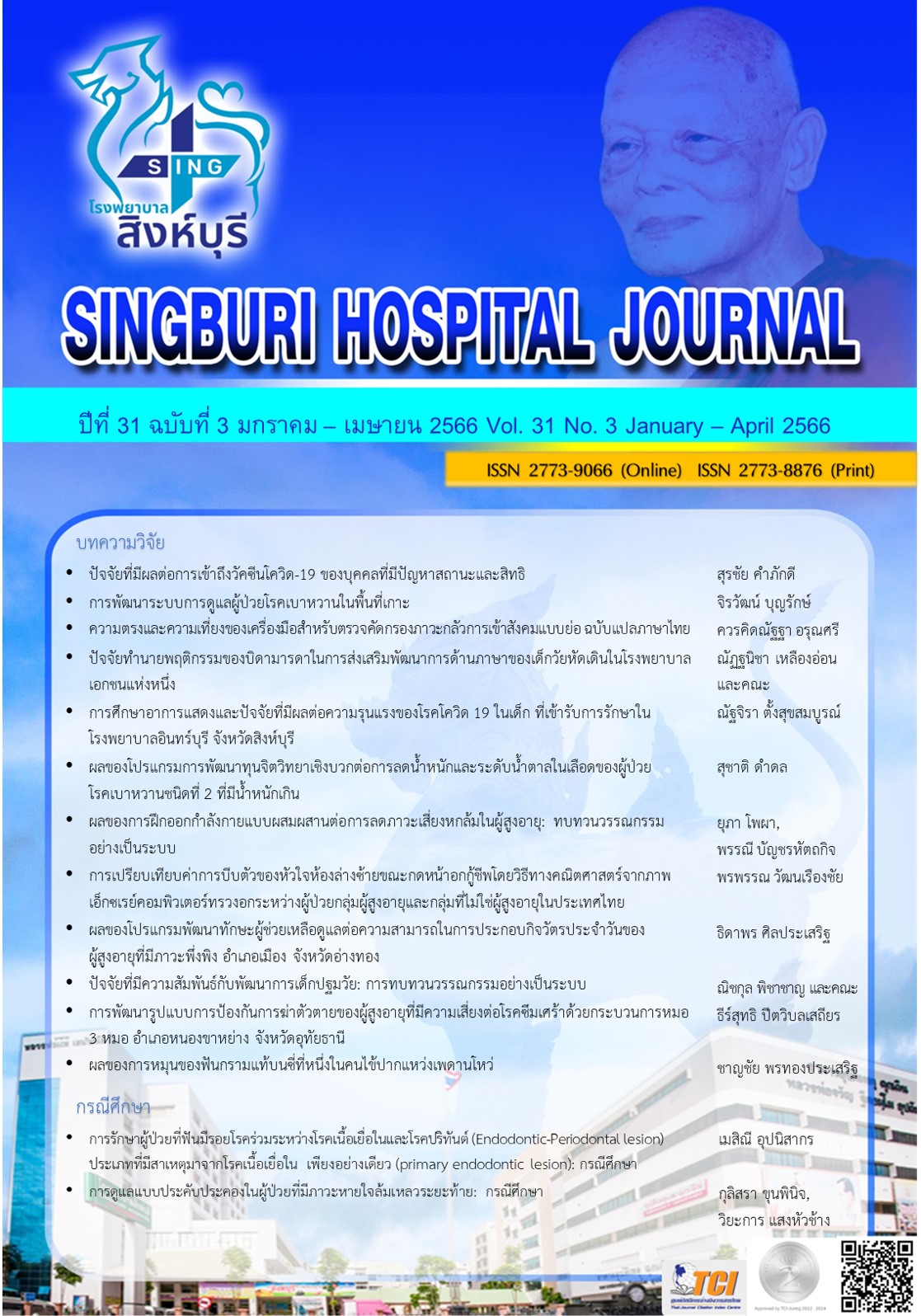
การเปรียบเทียบค่าการบีบตัวของหัวใจห้องล่างซ้ายขณะกดหน้าอกกู้ชีพ โดยวิธีทางคณิตศาสตร์จากภาพเอ็กซเรย์คอมพิวเตอร์ทรวงอก ระหว่างผู้ป่วยกลุ่มผู้สูงอายุและกลุ่มที่ไม่ใช่ผู้สูงอายุในประเทศไทย
คำสำคัญ:
ความลึกของการกดหน้าอกกู้ชีพ, ผู้ป่วยสูงอายุ , น้ำหนักตัวบทคัดย่อ
วัตถุประสงค์: การศึกษานี้มีวัตถุประสงค์เพื่อหาความลึกที่เหมาะสมในกดหน้าอกกู้ชีพ (ค่าการบีบตัวของหัวใจห้องล่างซ้ายคำนวณโดย % fractional change of left ventricular; %LVfc) ในผู้ป่วยกลุ่มสูงอายุ เปรียบเทียบกับกลุ่มที่ไม่ใช่ผู้สูงอายุ ที่ขนาดตัวแตกต่างกัน
วิธีการ: เป็นการศึกษาแบบย้อนกลับ โดยเก็บข้อมูลจากภาพเอ็กซเรย์คอมพิวเตอร์หน้าอกของผู้ป่วยไทยในโรงพยาบาลเจ้าพระยายมราช ตั้งแต่ปี พ.ศ. 2558 ถึง 2562 โดยวัดค่าพารามิเตอร์ที่เกี่ยวข้องแล้วคำนวณเป็นค่าการบีบตัวของหัวใจห้องล่างซ้าย (%LVfc) เมื่อกดหน้าอกที่ความลึก 50 และ 60 มิลลิเมตร
ผลข้อมูล: จากผู้ป่วยทั้งหมด 320 ราย ซึ่งมีอายุเฉลี่ย 62.46±15.01 ปี และมีดัชนีมวลกายเฉลี่ย 21.53±4.12 กิโลกรัม/เมตร2 พบว่า กลุ่มผู้สูงอายุมีดัชนีมวลกายน้อยกว่ากลุ่มที่ไม่ใช่ผู้สูงอายุ อย่างไรก็ตาม เมื่อวัดสัดส่วนของเส้นผ่านศูนย์กลางลำตัวบริเวณกึ่งกลางหน้าอก เส้นผ่านศูนย์กลางหัวใจ และความลึกเนื้อเยื่อบริเวณหน้าอกหน้าต่อหัวใจเทียบระหว่างกลุ่มผู้สูงอายุและกลุ่มที่ไม่ใช่ผู้สูงอายุพบว่าไม่แตกต่างกัน เมื่อกดหน้าอกที่ทั้งความลึก 50 และ 60 มิลลิเมตร พบว่า ค่าการบีบตัวของหัวใจห้องล่างซ้าย (%LVfc) ในกลุ่มผู้สูงอายุไม่แตกต่างกับกลุ่มที่ไม่ใช่ผู้สูงอายุ โดยพบว่าการกดหน้าอกลึก 60 มิลลิเมตร มีผลเพิ่มการบีบตัวของหัวใจห้องล่างซ้ายมากกว่าการกดหน้าอกที่ความลึก 50 มิลลิเมตร (%LVfc: 35.25±10.15 vs 34.83±10.02; p=0.711 และ 47.15±11.35 vs 46.61±11.12; p=0.671 ที่กดการหน้าอกลึก 50 และ 60 มิลลิเมตร ในกลุ่มผู้สูงอายุและกลุ่มที่ไม่ใช่ผู้สูงอายุ ตามลำดับ) แม้ค่าการบีบตัวของหัวใจของประชากรทั้งสองกลุ่มไม่แตกต่างกันเลยในทุกเกณฑ์มาตรฐานของน้ำหนักตัว อย่างไรก็ตาม เมื่อแจกแจงผู้ป่วยในแต่ละกลุ่มแบ่งตามเกณฑ์มาตรฐานของน้ำหนักตัว จะพบว่า ผู้ที่มีน้ำหนักตัวต่ำกว่าเกณฑ์ปกติจะมีค่าการบีบตัวของหัวใจสูงกว่าผู้ที่มีน้ำหนักปกติ และผู้ที่มีน้ำหนักตัวสูงกว่าเกณฑ์จะมีค่าการบีบตัวของหัวใจน้อยกว่าผู้ที่น้ำหนักตัวปกติ ที่การกดหน้าอกที่ความลึกเท่ากัน
สรุป: ค่าการบีบตัวของหัวใจห้องล่างซ้ายจากการกดหน้าอกกู้ชีพที่ความลึก 50 และ 60 มิลลิเมตร พบว่าไม่มีความแตกต่างกันระหว่างกลุ่มผู้สูงอายุ และกลุ่มที่ไม่ใช่ผู้สูงอายุ อย่างไรก็ตาม กลับพบว่าขนาดตัวเป็นปัจจัยที่มีผลต่อค่าการบีบตัวของหัวใจ
Downloads
เอกสารอ้างอิง
Mehra R. Global public health problem of sudden cardiac death. J Electrocardiol. 2007;40(6 Suppl):S118-22.
Nichol G, Thomas E, Callaway CW, Hedges J, Powell JL, Aufderheide TP, et al. Regional variation in out-of-hospital cardiac arrest incidence and outcome. JAMA. 2008;300(12) :1423-31.
Gräsner J-T, Herlitz J, Tjelmeland IBM, Wnent J, Masterson S, Lilja G, et al. European Resuscitation Council Guidelines 2021: Epidemiology of cardiac arrest in Europe. Resuscitation. 2021;161:61-79.
Ong ME, Shin SD, De Souza NN, Tanaka H, Nishiuchi T, Song KJ, et al. Outcomes for out-of-hospital cardiac arrests across 7 countries in Asia: The Pan Asian Resuscitation Outcomes Study (PAROS). Resuscitation. 2015;96:100-8.
Chanthawong S, Chau-In W, Pipanmekaporn T, Chittawatanarat K, Kongsayreepong S, Rojanapithayakorn N. Incidence of Cardiac Arrest and Related Factors in a Multi-Center Thai University-Based Surgical Intensive Care Units Study (THAI-SICU Study). J Med Assoc Thai. 2016;99 Suppl 6:S91-s9.
Assawasanti K, Sahasthasz D. Causes of Sudden Cardiac Arrest at Queen Sirikit Heart Center of the Northeast, Khon Kaen, Thailand. KKUJM. 2016;2(4):31-8.
Yeeheng U, Rawiworrakul T. Bystander Cardio-Pulmonary Resuscitation Practice among Out- of- Hospital Cardiac Arrest: Rajavithi Hospital’s Narenthorn Emergency Medical Service Center, Thailand. J Public Health. 2018;48(2):256-69.
Development Foundation for Older Persons’ Development. Ageing population in Thailand [Internet]. [cited 2021 Sep 24]. Available from: https://ageingasia.org/ageing-population-thailand /
Beesems SG, Blom MT, van der Pas MH, Hulleman M, van de Glind EM, van Munster BC, et al. Comorbidity and favorable neurologic outcome after out-of-hospital cardiac arrest in patients of 70 years and older. Resuscitation. 2015;94:33-9.
Herlitz J, Eek M, Engdahl J, Holmberg M, Holmberg S. Factors at resuscitation and outcome among patients suffering from out of hospital cardiac arrest in relation to age. Resuscitation. 2003;58(3):309-17.
Merchant RM, Topjian AA, Panchal AR, Cheng A, Aziz K, Berg KM, et al. Part 1: Executive Summary: 2020 American Heart Association Guidelines for Cardiopulmonary Resuscitation and Emergency Cardiovascular Care. Circulation. 2020;142(16_suppl_2):S337-s57.
Paradis NA, Martin GB, Rivers EP, Goetting MG, Appleton TJ, Feingold M, et al. Coronary perfusion pressure and the return of spontaneous circulation in human cardiopulmonary resuscitation. JAMA. 1990;263 (8):1106-13.
Katzman WB, Wanek L, Shepherd JA, Sellmeyer DE. Age-related hyperkyphosis: its causes, consequences, and management. JOSPT. 2010;40(6):352-60.
Sharma G, Goodwin J. Effect of aging on respiratory system physiology and immunology. Clin Interv Aging. 2006; 1(3):253-60.
Yoo KH, Oh J, Lee H, Lee J, Kang H, Lim TH, et al. Comparison of Heart Proportions Compressed by Chest Compressions Between Geriatric and Nongeriatric Patients Using Mathematical Methods and Chest Computed Tomography: A Retrospective Study. Ann Geriatr Med Res. 2018;22(3):130-6.
Khunkhlai N, Aiempaiboonphan P, Kaewlai R, Jenjitranant P, Dissaneevate K, Khruekarnchana P. Estimation of optimal chest compression depth based on chest computed tomography in Thai patients. Resuscitation. 2017;118(56)43.
Bernard R. Fundamentals of biostatistics. 5th ed. Duxbery: Thomson learning; 2000.
Pickard A, Darby M, Soar J. Radiological assessment of the adult chest: implications for chest compressions. Resuscitation. 2006; 71(3):387-90.
Meyer A, Nadkarni V, Pollock A, Babbs C, Nishisaki A, Braga M, et al. Evaluation of the Neonatal Resuscitation Program's recommended chest compression depth using computerized tomography imaging. Resuscitation . 2010; 81(5):544-8.
Cha KC, Kim YJ, Shin HJ, Cha YS, Kim H, Lee KH, et al. Optimal position for external chest compression during cardiopulmonary resuscitation: an analysis based on chest CT in patients resuscitated from cardiac arrest. EMJ. 2013;30(8):615-9.
Martinez-Pitre PJ, Sabbula BR, Cascella M. Restrictive Lung Disease.[Internet]. [cited 2023 Feb 20]. Available from: https://www.ncbi.nlm.gov/ books/NBK560880/
Lee H, Oh J, Lee J, Kang H, Lim TH, Ko BS, et al. Retrospective Study Using Computed Tomography to Compare Sufficient Chest Compression Depth for Cardiopulmonary Resuscitation in Obese Patients. JAHA. 2019;8(23):e013948.
ดาวน์โหลด
เผยแพร่แล้ว
รูปแบบการอ้างอิง
ฉบับ
ประเภทบทความ
สัญญาอนุญาต
ลิขสิทธิ์ (c) 2023 โรงพยาบาลสิงห์บุรี

อนุญาตภายใต้เงื่อนไข Creative Commons Attribution-NonCommercial-NoDerivatives 4.0 International License.
บทความที่ได้รับการตีพิมพ์เป็นลิขสิทธิ์ของโรงพยาบาลสิงห์บุรี
ข้อความที่ปรากฏในบทความแต่ละเรื่องในวารสารวิชาการเล่มนี้เป็นความคิดเห็นส่วนตัวของผู้เขียนแต่ละท่านไม่เกี่ยวข้องกับโรงพยาบาลสิงห์บุรี และบุคคลากรท่านอื่นๆในโรงพยาบาลฯ แต่อย่างใด ความรับผิดชอบองค์ประกอบทั้งหมดของบทความแต่ละเรื่องเป็นของผู้เขียนแต่ละท่าน หากมีความผิดพลาดใดๆ ผู้เขียนแต่ละท่านจะรับผิดชอบบทความของตนเองแต่ผู้เดียว