
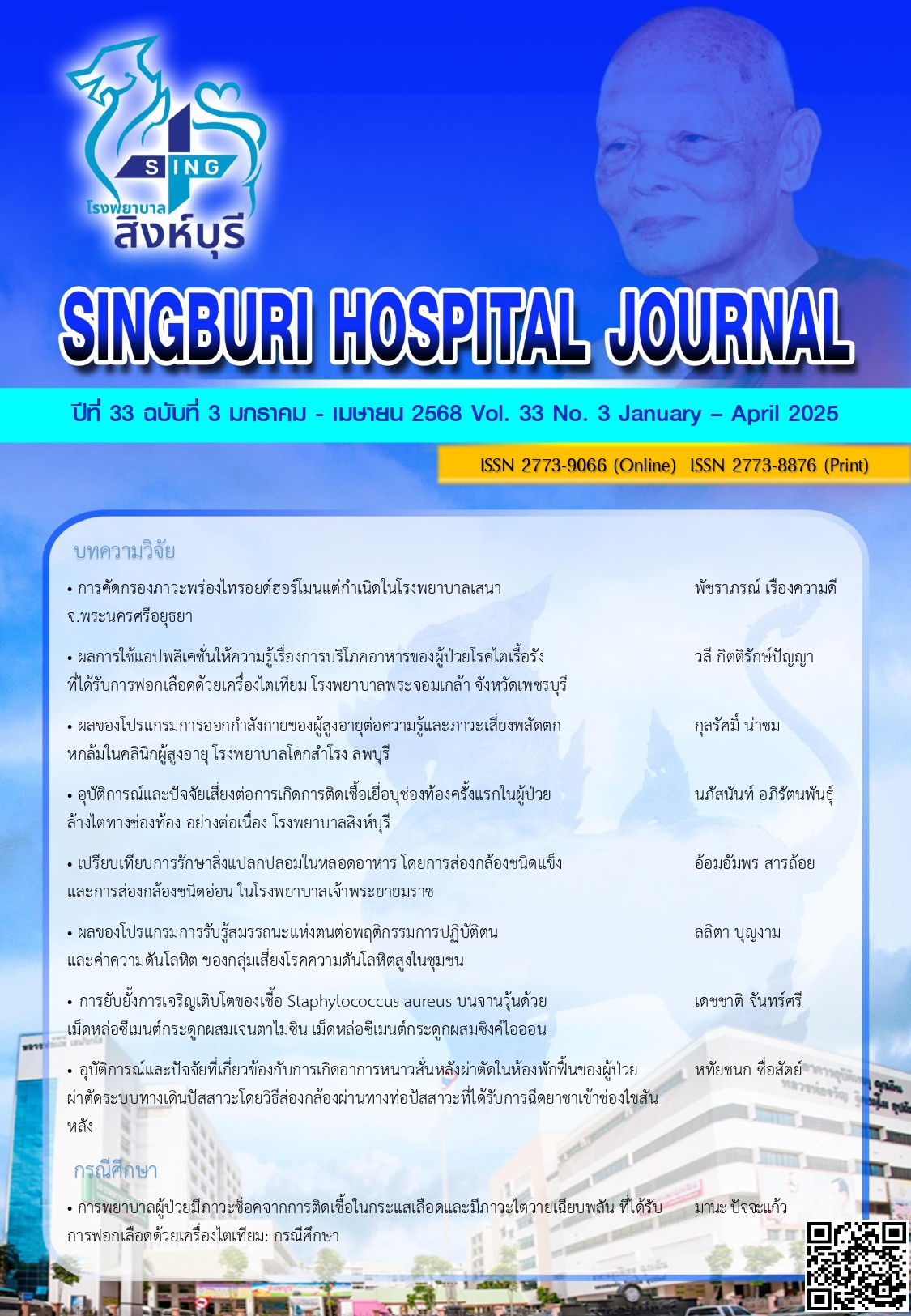
Nursing Care for Patients with Septic Shock and Kidney Injury Undergoing Hemodialysis: Case Study
Keywords:
Septic shock, Acute Kidney Injury, Hemodialysis, Case studyAbstract
Septic shock is a critical and emergency condition that requires rapid resolution along with treatment of the underlying causative factors because it can cause serious complications, especially acute kidney failure which requires hemodialysis using a hemodialysis machine This retrospective study was conducted on the medical records of one patient with septic shock and acute kidney failure in the intensive care unit who received emergency hemodialysis.
A 67-year-old Thai female patient was diagnosed with septic shock and acute kidney failure. She received care according to the guidelines for managing severe sepsis and septic shock, as well as standard hemodialysis and nursing procedures, until she was discharged home. The total duration of her hospital stay was 11 days.
Patients with septic shock and acute kidney failure Shock and hemodialysis should be treated promptly. Helps patients have a chance of survival. Hemodialysis nurses must have knowledge and expertise in the nursing process of care and adhere to the standards for hemodialysis. For the effectiveness of dialysis treatment, it is essential that no complications occur before, during, or after the procedure.
Downloads
References
กระทรวงสาธารณสุข. รายงานทางสถิติอัตราตายผู้ป่วยติดเชื้อในกระแสเลือด [อินเตอร์เน็ต]. 2567 [เข้าถึงเมื่อ 30 พฤษภาคม 2567] เข้าถึงจาก:https://hdcservice.moph.go.th/hdc/reports/
ประสิทธิ์ อุพาพรรณ. SEPSIS. [อินเตอร์เน็ต]. 2566 [เข้าถึงเมื่อ 13 พ.ย.2566] เข้าถึงจากhttp://med.swu.ac.th/internalmed/images/documents/handout/ID/PU/sepsis.pdf
คณะอนุกรรมการกำหนดแนวทางการรักษาด้วยการฟอกเลือดและการ
กรองพลาสมา สมาคมโรคไตแห่ง ประเทศไทย. 2561. คู่มือการรักษาด้วยการฟอกเลือดและการกรองพลาสมาสำหรับผู้ป่วยโรคไต พ.ศ. 2561. มปท.
ชัยรัตน์ ฉายากุล (บรรณาธิการ). ข้อแนะนำเวชปฏิบัติการฟอกเลือดด้วยเครื่องไตเทียม พ.ศ. 2557. กรุงเทพมหานคร: โรงพิมพ์เดือนตุลาคม; 2557.
วิจิตรา กุสุมภ์. กระบวนการพยาบาลและข้อวินิจฉัยการพยาบาล: การนำไปใช้ทางคลินิก. กรุงเทพฯ: บพิธการพิมพ์; 2556.
ชัชวาล วงค์สารี, อรนันท์ หาญยุทธ. การใช้กระบวนการพยาบาลในการดูแลผู้ป่วยไตวายระยะสุดท้ายที่ฟอกเลือดด้วยเครื่องไตเทียม.วารสารพยาบาลตำรวจ. 2557;6(2):220-33.
Kanbay M, Ertuglu LA, Afsar B, Ozdogan E, Siriopol D, Covic A, et al. An update review of intradialytic hypotension: concept, risk factors, clinical implications and management. Clinical Kidney Jour. 2020;13(6):981-93.
สุภาพร เพชรรักษ์. การพยาบาลผู้ป่วยภาวะติดเชื้อในกระแสเลือด: กรณีศึกษา 2 ราย. วารสารวิจัยและ นวัตกรรมทางสุขภาพ. 2020;3(2):85-97.
Douvris A, Zeid K, Hiremath S, et al. Mechanisms for hemodynamic instability related to renal replacement therapy: a narrative review. Intensive care med 2019;45(10):1333-46.
รุ่งรักษ์ ภิรมย์ลาภ. การพยาบาลผู้ป่วยฟอกเลือดด้วยเครื่องไตเทียมในภาวะไตวายเฉียบพลัน: กรณีศึกษา. วารสารโรงพยาบาลสกลนคร. 2021; 24(1):94-105.
ณีรชา บุญมาตย์และอธิษฐาน ชินสุวรรณ. การพัฒนาคุณภาพการวางแผนจำหน่ายสำหรับผู้ป่วยโรคไตเรื้อรังและครอบครัว. วารสารการพยาบาลและการดูแลสุขภาพ. 2014;32(2):78-85.
ซ่อนกลิ่น ชูจันทร์. การพยาบาลผู้ป่วยที่มีภาวะช็อคจากการติดเชื้อในกระแสเลือด: กรณีศึกษาเปรียบเทียบ. โรงพยาบาลสิงห์บุรีเวชสาร. 2563; 29(3):13-22.
Downloads
Published
How to Cite
Issue
Section
License
Copyright (c) 2025 Singburi Hospital Journal

This work is licensed under a Creative Commons Attribution-NonCommercial-NoDerivatives 4.0 International License.
The published articles are copyrighted by Singburi Hospital.
The statements appearing in each article in this academic journal are the personal opinions of each author and are not related in any way to Singburi Hospital or other hospital personnel. Each author is solely responsible for all contents of their article. If there are any errors, each author alone will be responsible for their own article.