
Nursing Care for Bedridden Elders with Pressure Injury at Home: A Case Study
Keywords:
Advance wound care, Bedridden Patients, Nursing care, Pressure injuryAbstract
Pressure injury is the most common complication in impaired mobility patients, especially older patients who are bedridden. Infection is the most frequent serious complication of pressure injuries resulting in waste of hospital resources and a prolonged length of stay. Additionally, patients who experience both physical and psychological pressure injuries may become morbid and mortal. Therefore, a nurse plays a significant role in providing preventative care to patients through promotion, prevention, and treatment. In order to avoid complications from hospital wound infections, nursing care for patients with pressure injuries at home is recommended. Therefore, it is necessary to apply the SHA process (SHA: sustainable health care and health promotion by appreciation and accreditation) to provide patients in the community with high-quality procedures. The advantage of pressure injury treatment is that it encourages healing of the wound. A nurse participating as a consultant expends a minimal period of time with the family member or the primary caregiver. In this case study, a procedure called advanced wound care was applied using various types of wound care supplies to enhance the effectiveness of the wound healing process to reduce infection, inflammation, or re-admissions to hospitals and shorten the time it takes for wounds to heal. SHA principles could provide services for long-term health and health promotion.
Downloads
References
Gefen A, Brienza DM, Cuddigan J, Haesler E, Kottner J. Our contemporary understanding of the aetiology of pressure ulcers/pressure injuries. International Wound Journal 2021;12:1-13.
Zhaoyu Li, Frances Lin, Lukman Thalib and Wendy Chaboyer. Global prevalence and incidence of pressure injuries in hospitalized adult patients: A systematic review and meta-analysis. International Journal of Nursing Studies. 2020;105:103546: 1-13.
Nguyen HM, Le TTN, Nguyen AT, Lea HNT, Pham TT. Biomedical materials for wound dressing: recent advances and applications. RSC Adv 2023;13:5509–28.
Jiamtanopachai R And Sanveingchan S. Nursing practice guidelines for the prevention of pressure ulcers. Thai Journal of Nursing 2018;67(4):53-61.
Lavin W, Yooyadmak P, Praepataraprasit R. The nutritional status and association of new pressure ulcer in patients who transfer from in-patient ward to intensive care unit (ICU). Journal of Nursing Science & Health 2017;43(3):162-71.
Kottner J, Black J, Call E, Gefen A, Santamaria N. Microclimate: a critical review in the context of pressure ulcer prevention. Clinical Biomechanics 2018; 59:62-70.
Mamom J, Rungroungdouyboon B, Chuanasa J. Enhancing the quality of long-term patient care by use of the innovative electrical bed-turning system for the prevention of pressure injuries: A pilot study. Science and Technology Asia 2022;27,1-19
Chiaprasert S, Dumsangsawad N, Yok-in J, Junwin B. Pressure sore prevention of person with cerebrovascular disease at home: The caregiver development in Thailand 4.0 era. The Journal of Faculty of NursingBurapha Universit 2020;28(1): 107-15
Whitty JA, McImmes E, Bucknall T, Webster J, Gillespie B., Banks M. The cost-effectiveness of a patient-centred pressure ulcer prevention carebundle: Findings from the INTACT cluster randomised trial. International Journal of Nursing Studie 2017;75:35-42.
Uccioli L, Meloni M, Vainieri E, Ruotolo V, Giurato L. Non-healing Foot Ulcers in Diabetic Patients: General and Local Interfering Conditions and Management Options with Advanced Wound Dressings. Journal of wound care 2015;24:35-42.
Ousey K, Rogers AA, Rippon MG. Hydro-responsive wound dressings simplify T.I.M.E. wound management framework. Community Wound Care 2016;11:39-49.
Dabiri G, Damstetter E, Phillips T. Choosing a wound dressing based on common wound characteristics. Adv Wound Care 2016;5: 32–41
Boonpadung D. Spiritual Health Care [Internet]. 2560 [cited 2023 Apr 10]. Available from: http://km.fsh.mi.th/wp-content/uploads/2012/ 12/SHA_1.pdf
Kerr A. Multifunctional and patient-focused Mepilex Border Flex: an exploration of its holistic clinical benefits. Journal of Wound Care 2019;28:4-31
Pheetarakorn P. Nursing care of the patients with Pressure injury: Nurse’s Role. Hua Hin Medical Journal 2021;1(1):1-16
Rippon MG, Ousey K, Cutting KF.Wound healing and hyper-hydration: a counterintuitive model. J Wound Care 2016;25:68–75.
Dissemond J. Non-healing surgical wound with exposed bone: Case studies. Journal of Wound Care 2020;29:11-13.
Walkera RM, Gillespieb BM, McInnesc E, Moored Z,. Eskesi AM, Pattonk D, Harbeckn EL, Whiten C, Scotto IA, Chaboyerp W. Prevention and treatment of pressure injuries: A meta-synthesis of Cochrane Reviews. Journal of Tissue Viability 2020;29:227–43.
McKenzie JF, Neiger BL, Thackeray R. Planning implementing and Evaluating Health promotion program. 8 editions. United States of America: World headquarter; 2023.
The Healthcare Accreditation Institute (Public Organization). Development of spiritual healthcare in action (sha). 1 editions: Famous & Successful; 2022.
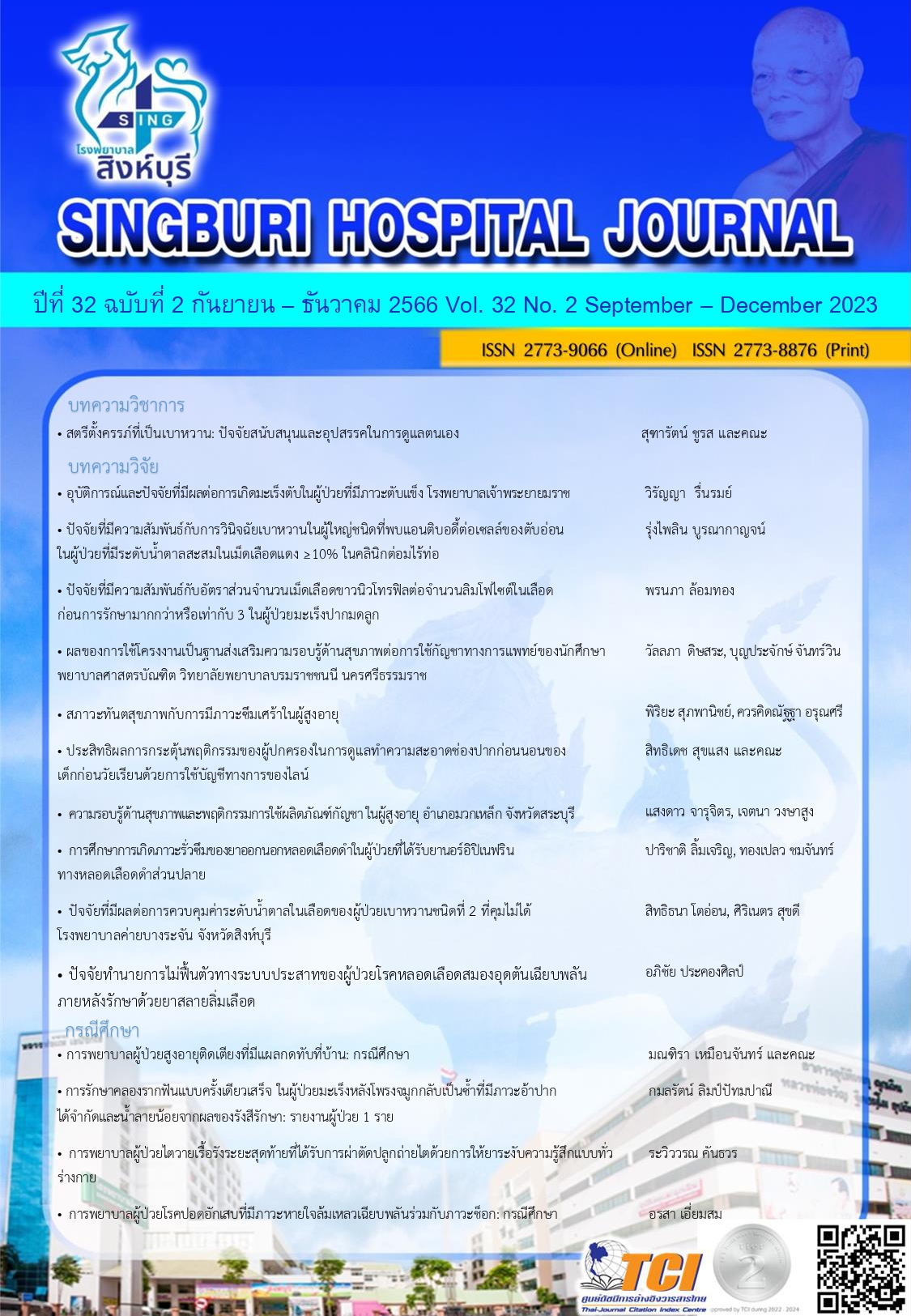
Downloads
Published
How to Cite
Issue
Section
License
Copyright (c) 2023 Singburi Hospital Journal

This work is licensed under a Creative Commons Attribution-NonCommercial-NoDerivatives 4.0 International License.
The published articles are copyrighted by Singburi Hospital.
The statements appearing in each article in this academic journal are the personal opinions of each author and are not related in any way to Singburi Hospital or other hospital personnel. Each author is solely responsible for all contents of their article. If there are any errors, each author alone will be responsible for their own article.