
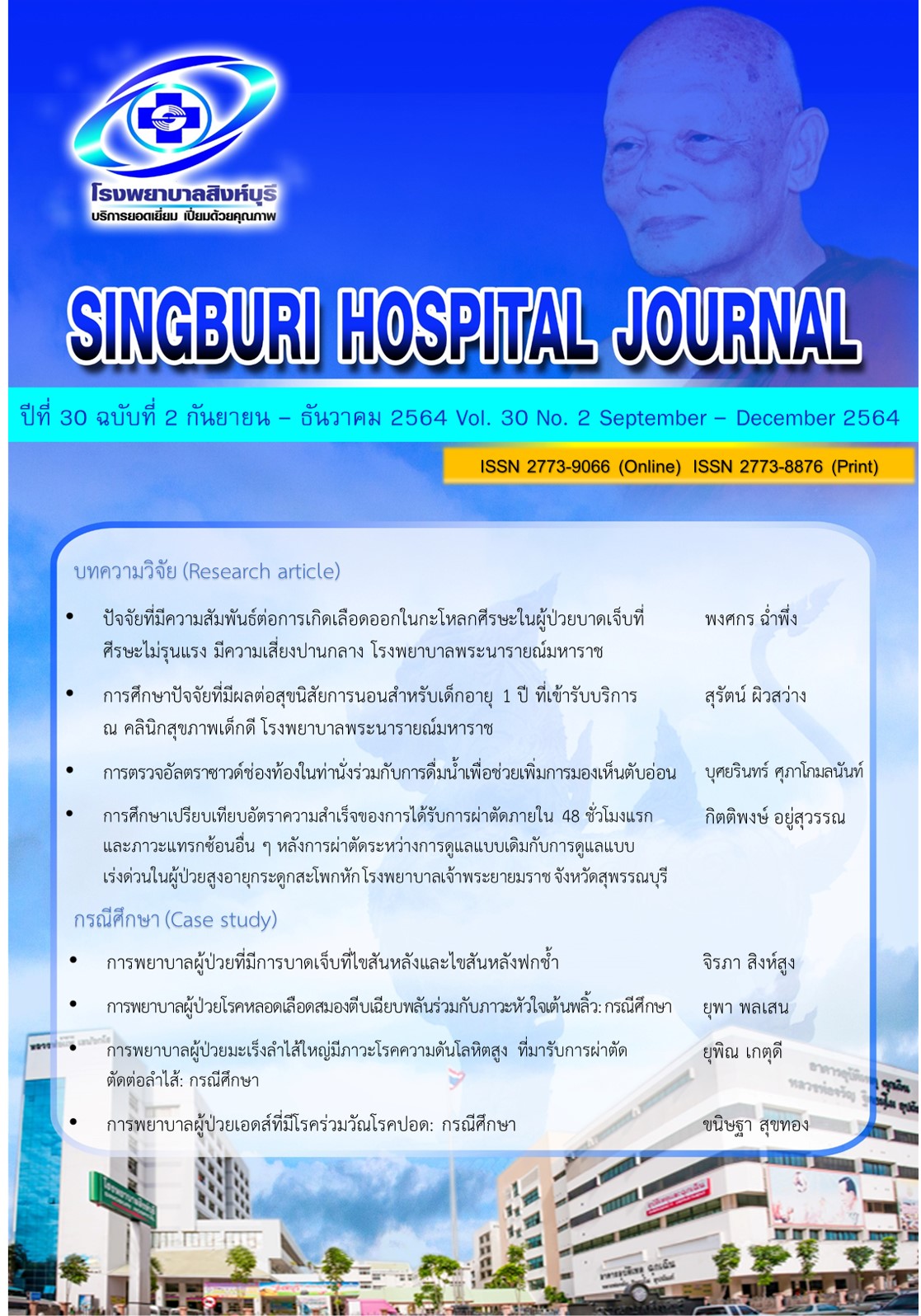
การศึกษาเปรียบเทียบอัตราความสำเร็จของการได้รับการผ่าตัดภายใน 48 ชั่วโมงแรก และภาวะแทรกซ้อนอื่นๆหลังการผ่าตัดระหว่างการดูแลแบบเดิมกับการดูแลแบบเร่งด่วน ในผู้ป่วยสูงอายุกระดูกสะโพกหัก โรงพยาบาลเจ้าพระยายมราช จังหวัดสุพรรณบุรี
บทคัดย่อ
บทนำ: โรงพยาบาลเจ้าพระยายมราชได้เริ่มระบบการดูแลแบบเร่งด่วนในผู้ป่วยสูงอายุกระดูกะโพกหักขึ้นใน ปี 2563 ซึ่งก่อนหน้านี้ยังไม่เคยมีการศึกษามาก่อนจึงทำการศึกษาเพื่อเปรียบเทียบอัตราความสำเร็จของการผ่าตัดได้ภายใน 48 ชั่วโมงแรกและภาวะแทรกซ้อนอื่นๆระหว่างการดูแลแบบเดิมกับการดูแลแบบเร่งด่วนในผู้ป่วยสูงอายุกระดูกสะโพกหัก โรงพยาบาลเจ้าพระยายมราช จังหวัดสุพรรณบุรี
วิธีการศึกษา: การศึกษาย้อนหลังวิเคราะห์จากเหตุไปหาผลผู้ป่วยกระดูกสะโพกหักชนิดไม่รุนแรงจำนวน 312 คนอายุมากกว่า 50 ปี แบ่งเป็น 2 กลุ่ม คือ กลุ่มที่ 1 การดูแลแบบเดิมและกลุ่มที่ 2 การดูแลแบบเร่งด่วน กลุ่มละ 156 คน รวบรวมข้อมูลตั้งแต่เดือนตุลาคม 2562 ถึงเดือนกันยายน 2564 เก็บข้อมูลการรักษาในโรงพยาบาลและติดตามข้อมูลต่อจนครบ 6 เดือนหลังออกจากโรงพยาบาล ข้อมูลที่เก็บได้แก่ การผ่าตัดได้ภายใน 48 ชั่วโมง ภาวะแทรกซ้อนหลังผ่าตัด อัตราการเสียชีวิตและอุบัติการณ์การหักซ้ำภายใน 6 เดือน สถิติที่ใช้ได้แก่ จำนวนร้อยละ ค่าเฉลี่ยและค่าเบี่ยงเบนมาตรฐาน เปรียบเทียบ ความแตกต่างข้อมูลด้วย chi-square test และ Unpaired t test
ผลการศึกษา: พบว่ากลุ่มที่ 2 มีอัตราความสำเร็จของการผ่าตัดได้ภายใน 48 ชั่วโมงแรกมากกกว่ากลุ่มที่ 1 อย่างมีนัยสำคัญทางสถิติ(ร้อยละ61.6 กับ 38.4 p<0.05) กลุ่มที่ 2 มีเวลานอนโรงพยาบาลเฉลี่ยได้น้อยกว่ากว่ากลุ่มที่ 1 มีความแตกต่างกันอย่างมีนัยสำคัญทางสถิติ(9.24 วันกับ 10.80 วัน p<0.05) กลุ่มที่ 2 ลดภาวะทางเดินปัสสาวะติดเชื้อจากร้อยละ 2.56 เป็นร้อยละ 0 และลดภาวะซึมสับสนในโรงพยาบาลจากร้อยละ 3.84 เป็นร้อยละ 0.64 มีความแตกต่างกันอย่างมีนัยสำคัญทางสถิติ อัตราการเสียชีวิตในโรงพยาบาลและอัตราการเสียชีวิตภายใน 6 เดือนหลังออกจากโรงพยาบาลของกลุ่มที่ 1 มากกว่ากลุ่มที่ 2 (ร้อยละ 2.56 กับ 1.28 และร้อยละ 1.92 กับ 1.28) อุบัติการณ์การหักซ้ำภายใน 6 เดือนพบว่ากลุ่มที่ 1 มากกว่ากลุ่มที่ 2(ร้อยละ 1.28 กับ 0)
สรุป: การดูแลผ่าตัดแบบเร่งด่วนสามารถเพิ่มอัตราความสำเร็จของการผ่าตัดได้ภายใน 48 ชั่วโมงแรก ลดเวลานอนโรงพยาบาลและลดภาวะแทรกซ้อนหลังผ่าตัด ลดอัตราการตายและลดอุบัติการณ์การหักซ้ำภายใน 6 เดือนได้มากกว่าการดูแลผ่าตัดแบบเดิม
คำสำคัญ: การดูแลผ่าตัดแบบเดิม ผู้ป่วยสูงอายุกระดูกะโพกหัก การดูแลผ่าตัดแบบเร่งด่วน
Downloads
เอกสารอ้างอิง
2. Roberts K C, Brox W T, David S, et al., Management of hip fractures in the elderly. J Am Acad Orthop Surg, 2015. 23(2): p. 131-7.
3. Brox W T, Roberts K C, Sudeep T, et al. American Academy of orthopedic Surgeons. Management of Hip Fractures in the Elderly:Evidence-Based Clinical Practice Guideline [internet]. 2014 [cited 2020 Aug 20]; Available from: https://aaos.org/globalassets/quality-and-practice-resources/hip-fractures-in-the elderly/management_of_hip_fractures_in_the_elderly-7-24-19.pdf
4. Cheng S Y, Levy A R, Lefaivre K A, et al. Geographic trends in incidence of hip fractures: a comprehensive literature review. 2011. 22(10): p. 2575-2586.
5. Bhandari M and Swiontkowski M. Management of Acute Hip Fracture. 2017. 377(21): p. 2053-2062.
6. Kanis J A, Odén A, McCloskey E V, et al. A systematic review of hip fracture incidence and probability of fracture worldwide. Osteoporosis international : a journal established as result of cooperation between the European Foundation for Osteoporosis and the National Osteoporosis Foundation of the USA, 2012. 23(9): p. 2239-2256.
7. Vaseenon T, Luevitoonvechkij S, Wongtriratanachai P, et al. Long-term mortality after osteoporotic hip fracture in Chiang Mai, Thailand. J Clin Densitom, 2010. 13(1): p. 63-67.
8. Sambrook P and Cooper C, Osteoporosis. The Lancet, 2006. 367(9527): p. 2010-2018.
9. Khan R, Fernandez C, Kashifl F, et al. Combined orthogeriatric care in the management of hip fractures: a prospective study. Ann R Coll Surg Engl, 2002. 84(2): p. 122-4.
10. Kammerlander C, Roth T, Friedman S M, et al. Ortho-geriatric service--a literature review comparing different models. Osteoporos Int, 2010. 21(Suppl 4): p. S637-46.
11. Ellis G, Gardner M, Tsiachristas A, et al. Comprehensive geriatric assessment for older adults admitted to hospital. Cochrane Database Syst Rev, 2011(7): p. Cd006211.
12. Gilchrist W J, Newman R J, Hamblen D L, et al. Prospective randomised study of an orthopaedic geriatric inpatient service. Bmj, 1988. 297(6656): p. 1116-8.
13. Brañas F, Ruiz-Pinto A, Fernández E, et al. Beyond orthogeriatric co-management model: benefits of implementing a process management system for hip fracture. International Osteoporosis Foundation and National Osteoporosis Foundation 2018.
14. Fisher A A, Davis M W, Rubenach S E, et al. Outcomes for older patients with hip fractures: the impact of orthopedic and geriatric medicine cocare. J Orthop Trauma, 2006. 20(3): p. 172-8; discussion 179-80.
15. Leung A H, Ping Lam T, Hoi Cheung W, et al. An orthogeriatric collaborative intervention program for fragility fractures: a retrospective cohort study. J Trauma, 2011. 71(5): p. 1390-4.
16. Deschodt M, Braes T, Flamaing J, et al. Preventing delirium in older adults with recent hip fracture through multidisciplinary geriatric consultation. J Am Geriatr Soc, 2012. 60(4): p. 733-9.
17. Shyu Y I, Liang J, Wu C C, et al. Interdisciplinary intervention for hip fracture in older Taiwanese: benefits last for 1 year. J Gerontol A Biol Sci Med Sci, 2008. 63(1): p. 92-7.
18. Muangpaisan W, Wongprikron A, Srinonprasert V, et al., Incidence and risk factors of acute delirium in older patients with hip fracture in Siriraj Hospital. J Med Assoc Thai, 2015. 98(4): p. 423-30.
19. Lundstrom M, Edlund A, Bucht G, et al. Dementia after delirium in patients with femoral neck fractures. J Am Geriatr Soc, 2003. 51(7): p. 1002-6.
20. Gruber-Baldini A L, Zimmerman S, Morrison R S, et al. Cognitive impairment in hip fracture patients: timing of detection and longitudinal follow-up. J Am Geriatr Soc, 2003. 51(9): p. 1227-36.
21. Vidan M, Serra J A, Moreno C,et al. Efficacy of a comprehensive geriatric intervention in older patients hospitalized for hip fracture: a randomized, controlled trial. J Am Geriatr Soc, 2005. 53(9): p. 1476-82.
22. Prestmo A, Hagen G, Sletvold O, et al. Comprehensive geriatric care for patients with hip fractures: a prospective, randomised, controlled trial. Lancet, 2015. 385(9978): p. 1623-33.
ดาวน์โหลด
เผยแพร่แล้ว
รูปแบบการอ้างอิง
ฉบับ
ประเภทบทความ
สัญญาอนุญาต
ลิขสิทธิ์ (c) 2021 โรงพยาบาลสิงห์บุรี

อนุญาตภายใต้เงื่อนไข Creative Commons Attribution-NonCommercial-NoDerivatives 4.0 International License.
บทความที่ได้รับการตีพิมพ์เป็นลิขสิทธิ์ของโรงพยาบาลสิงห์บุรี
ข้อความที่ปรากฏในบทความแต่ละเรื่องในวารสารวิชาการเล่มนี้เป็นความคิดเห็นส่วนตัวของผู้เขียนแต่ละท่านไม่เกี่ยวข้องกับโรงพยาบาลสิงห์บุรี และบุคคลากรท่านอื่นๆในโรงพยาบาลฯ แต่อย่างใด ความรับผิดชอบองค์ประกอบทั้งหมดของบทความแต่ละเรื่องเป็นของผู้เขียนแต่ละท่าน หากมีความผิดพลาดใดๆ ผู้เขียนแต่ละท่านจะรับผิดชอบบทความของตนเองแต่ผู้เดียว