
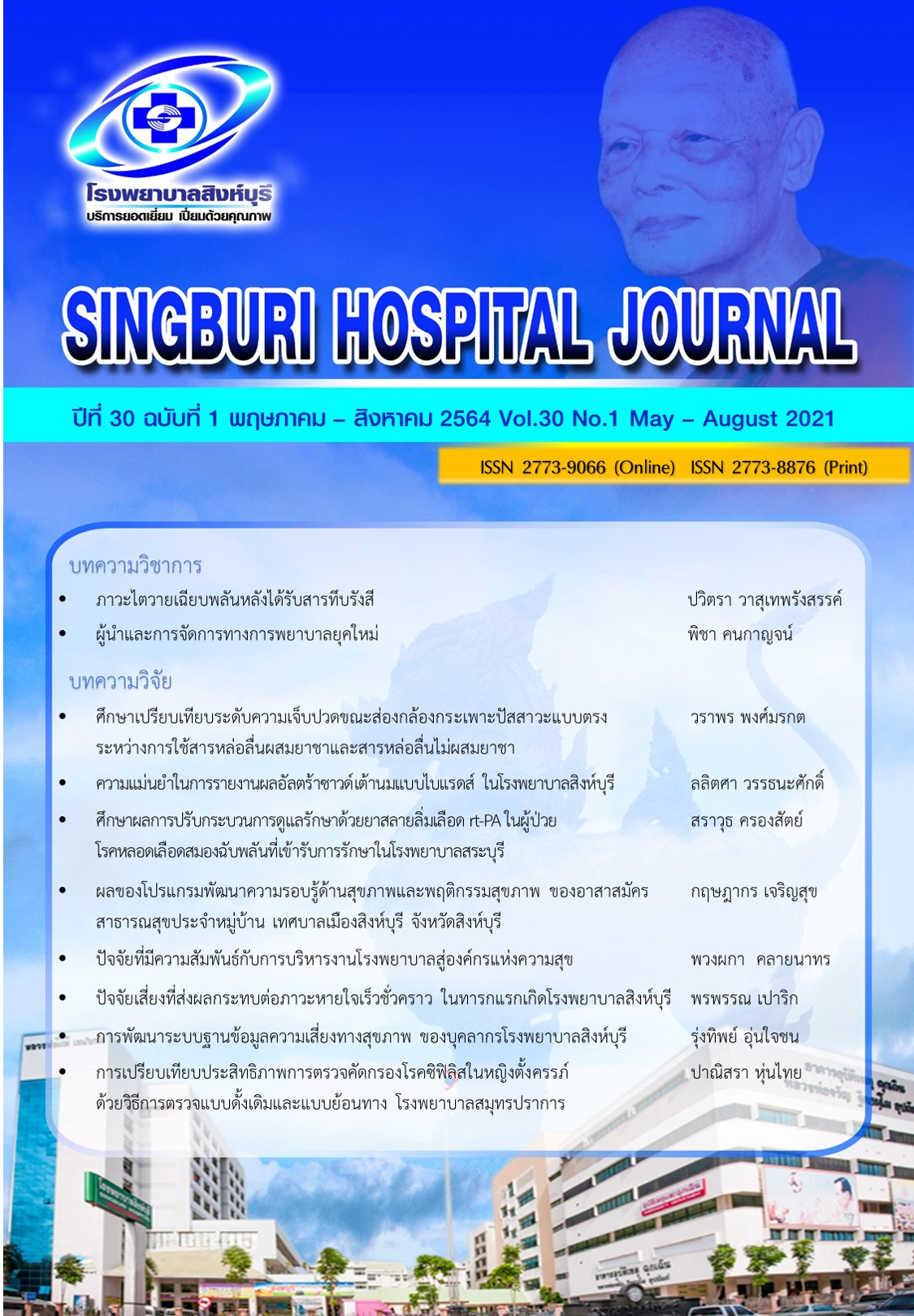
Risk Factors Affecting Transient Tachypnea of the Newborn in Singburi Hospital
Keywords:
Transient Tachypnea, Newborn, RiskAbstract
Background: Transient Tachypnea of the Newborn (TTN) is a common respiratory distress problem in the newborn. Previous studies revealed that cesarean section, male, LGA, LBW, preterm birth, twins, maternal diabetes mellitus, and asthma were risk factors of TTN. However, in Thailand, controversy surrounds these risk factors.
Objective: To study risk factors of TTN in the newborn delivered at Singburi Hospital and investigate optimal gestational ages for elective cesarean section
Methods: This case-control study was conducted in the newborn delivered at Singburi Hospital during 2012-2020. A total of 184 newly born infants were categorized into 2 groups: 92 cases (TTN) and 92 cases (non-TTN).
Results: 68.5% of the newborn with TTN were male infants with an average gestational age of 37.57 (± 1.73) weeks. 28.3% were preterm infants. 25% and 14.1% were LGA and LBW infants, respectively. Most of them (81.5%) were delivered through cesarean section and 29.3% were delivered through elective C/S. The 1-minute and 5-minute Apgar scores were 9.08 (±1.19) and 9.74 (± 0.55), respectively. 22.8% and 1.1% were found to have mothers with Maternal DM and asthma, respectively. The average length of stay was 6.72 (± 3.65) days. Male, preterm birth, and emergency and elective C/S were significantly associated with TTN and could increase the risk factors of TTN by 2.95, 4.53, 2.32 and 5.65 times, respectively, greater than non-TTN infants. A minimum of 39 gestational weeks was a statistically significant protective factor against TTN (OR 0.39, 95%CI =0.18-0.83, P=0.007).
Conclusion: The risk factors of TTN in infants delivered at Singburi Hospital included male, preterm birth, emergency and elective cesarean section. Therefore, elective cesarean section was recommended to perform after a minimum of 39 gestational weeks.
Downloads
References
2. Sabzehei, Mohammad Kazem, et al. “Risk factors affecting transient tachypnea of the newborn in fatemieh hospital of Hamadan, Iran, 2015-2016.” Iranian Red Crescent Medical Journal 20.S1 (2018).
3.Chiluka S, Srinivas M, Anitha K, Basha S, Reddy P. Incidence, clinical profile and outcome of transient
tachypnea of newborn. Int J Pediatr Res. 2017;4(10):623-628.
4.Bekdas, Mervan, Sevil Bilir Goksugur, and Beyhan Kucukbayrak. “The causes of prolonged transient tachypnea of the newborn: a cross-sectional study in a Turkish maternity hospital.” South Eastern Europe Health Sci J 3.2 (2013): 152-158.
5.Hagen, Eunice, Alison Chu, and Cheryl Lew. “Transient tachypnea of the newborn.” NeoReviews 18.3 (2017): e141-e148.
6. Jha, Kanishk, and Kartikeya Makker. “Transient tachypnea of the newborn.” (2019).
7. Correia, Claudia, et al. “Respiratory morbidity in late preterm infants.” Minerva pediatrica 70.4 (2016): 345-354.
8. Limlikhit, Mr Tippawan. “Risk factors of transient tachypnea of the newborn in detudom crown Prince hospital.” Mahasarakham Hospital Journal-วารสารโรงพยาบาลมหาสารคาม (2015).
9. Tutdibi, Erol, et al. “Impact of labor on outcomes in transient tachypnea of the newborn: population-based study.” Pediatrics 125.3 (2010): e577-e583.
10. Suangtho, Natthawan. “Risk Factors of Transient Tachypnea of the Newborn in Chaiyaphum Hospital=ปัจจัยเสี่ยงที่มีผลต่อภาวะหายใจเร็วชั่วคราวของทารกแรกเกิดในโรงพยาบาลชัยภูมิ.” Chaiyaphum Medical Journal: ชัยภูมิเวชสาร (2020): 89-89.
11.สุรีพร ศรีโพธิ์อุ่น. “ภาวะหายใจเร็วชั่วคราวในทารกแรกเกิด: บทบาทพยาบาลห้องคลอด.” Nursing Journal of The Ministry of Public Health 29.1 (2019): 11-20.
12. Kawakita, T., et al. “Increased neonatal respiratory morbidity associated with gestational and pregestational diabetes: a retrospective study.” American journal of perinatology 34.11 (2017): 1160.
13. Zanardo, V., et al. “Neonatal respiratory morbidity risk and mode of delivery at term: influence of timing of elective caesarean delivery.” Acta pædiatrica 93.5 (2004): 643-647.
14.Zanardo, Vincenzo, et al. “The influence of timing of elective cesarean section on neonatal resuscitation risk.” Pediatric Critical Care Medicine 5.6 (2004): 566-570.
15. Gundogdu, Zuhal. “New Risk Factors for Transient Tachypnea of the Newborn and Childhood Asthma: A Study of Clinical Data and a Survey of Parents.” Cureus 11.12 (2019).
16. Smith, G. C. S., et al. “Neonatal respiratory morbidity at term and the risk of childhood asthma.” Archives of disease in childhood 89.10 (2004): 956-960.
17. Golshantafti, Mohammad, Tahereh Yavari, and Mohammadhosain Afrand. “Risk of wheezing attacks in infants with transient tachypnea newborns.” Iranian journal of pediatrics 26.1 (2016).
Downloads
Published
How to Cite
Issue
Section
License
The published articles are copyrighted by Singburi Hospital.
The statements appearing in each article in this academic journal are the personal opinions of each author and are not related in any way to Singburi Hospital or other hospital personnel. Each author is solely responsible for all contents of their article. If there are any errors, each author alone will be responsible for their own article.