การพัฒนาและทดสอบคุณภาพแบบประเมินสมรรถนะการจัดการสุขภาวะชุมชนของบัณฑิตพยาบาล
คำสำคัญ:
สมรรถนะการจัดการสุขภาวะชุมชน , บัณฑิตพยาบาล , การวิเคราะห์องค์ประกอบเชิงสำรวจบทคัดย่อ
การวิจัยแบบผสมผสานนี้ ใช้รูปแบบการวิจัยเชิงคุณภาพนำเชิงปริมาณ ตามแนวทางการพัฒนาเครื่องมือของDeVellis มีวัตถุประสงค์เพื่อพัฒนาและทดสอบคุณสมบัติเชิงจิตวิทยาของแบบประเมินสมรรถนะการจัดการสุขภาวะชุมชนของบัณฑิตพยาบาล ประกอบด้วย 2 ระยะ ได้แก่ ระยะที่ 1 การพัฒนาแบบประเมิน โดยการทบทวนวรรณกรรม การวิเคราะห์แนวคิดตามกรอบ Walker และ Avant การสัมภาษณ์เชิงลึกผู้ทรงคุณวุฒิ จำนวน 5 ท่าน และการสร้างแบบประเมินเชิงพฤติกรรมตามองค์ประกอบที่ได้จากการสังเคราะห์ และระยะที่ 2 การทดสอบคุณสมบัติของแบบประเมิน โดยการตรวจสอบความตรงเชิงเนื้อหา ความเข้าใจข้อคำถาม การประเมินคุณภาพเบื้องต้น โดยผ่านการตรวจสอบ ความเชื่อมั่นภายใน ด้วยค่าสัมประสิทธิ์แอลฟาของครอนบาค จากนั้นจึงทำการทดสอบภาคสนามโดยตรวจสอบความเชื่อมั่นภายใน การวิเคราะห์ข้อคำถาม และการตรวจสอบโครงสร้างองค์ประกอบด้วยการวิเคราะห์องค์ประกอบเชิงสำรวจ ในนักศึกษาพยาบาลชั้นปีที่ 4 จำนวน 577 คน ผลการวิจัยพบว่า
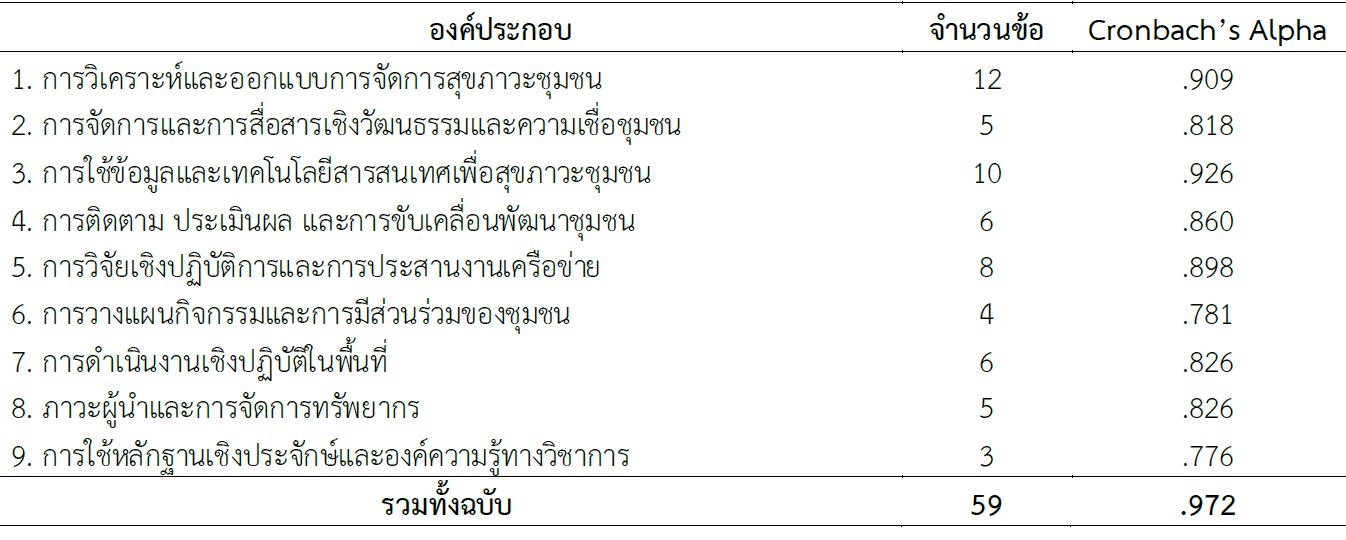
แบบประเมินที่พัฒนาขึ้นประกอบด้วย 9 องค์ประกอบ จำนวน 59 ข้อ ได้แก่ (1) การวิเคราะห์และออกแบบการจัดการสุขภาวะชุมชน (2) การจัดการและการสื่อสารเชิงวัฒนธรรมและความเชื่อชุมชน (3) การใช้ข้อมูลและเทคโนโลยีสารสนเทศเพื่อสุขภาวะชุมชน (4) การติดตามประเมินผลและขับเคลื่อนพัฒนาชุมชน (5) การวิจัยเชิงปฏิบัติการและการประสานงานเครือข่าย (6) การวางแผนกิจกรรมและการมีส่วนร่วมของชุมชน (7) การดำเนินงานเชิงปฏิบัติในพื้นที่ (8) ภาวะผู้นำและการจัดการทรัพยากร และ (9) การใช้หลักฐานเชิงประจักษ์และองค์ความรู้ทางวิชาการ องค์ประกอบทั้ง 9 สามารถอธิบายความแปรปรวนรวมได้ร้อยละ 50.04 และแบบประเมินมีค่าความเชื่อมั่นภายในสูง (Cronbach’s Alpha เท่ากับ .972)
ผลการศึกษานี้ชี้ว่า แบบประเมินที่พัฒนาขึ้นมีคุณภาพเหมาะสม สามารถใช้เป็นเครื่องมือมาตรฐานเพื่อประเมินสมรรถนะการจัดการสุขภาวะชุมชนของบัณฑิตพยาบาลได้อย่างมีประสิทธิภาพ อันจะเป็นประโยชน์ต่อการวางแผนพัฒนาหลักสูตรและการผลิตกำลังคนพยาบาลให้สอดคล้องกับบริบทระบบสุขภาพปฐมภูมิของประเทศ
เอกสารอ้างอิง
พรรณี บัญชรหัตถกิจ และธนปนันท์ อัครวีรวัฒน์. (2565). การสื่อสารสุขภาพเพื่อการสร้างเสริมสุขภาพในชุมชน. วารสารสาธารณสุขแพร่เพื่อการพัฒนา, 2(1), 78–89. https://thaidj.org/index.php/jpphd/article/view/12516/10380
ยุพาวรรณ ทองตะนุนาม และศุกร์ใจ เจริญสุข. (2564). สมรรถนะการจัดการสุขภาวะชุมชนของบัณฑิตพยาบาล: แนวคิดการพัฒนา. วารสารวิจัยและพัฒนาหลักสูตร, 11(2), 24-34.
https://so03.tci-thaijo.org/index.php/jrcd/article/view/249751
วิชัย เทียนถาวร, ณรงค์ ใจเที่ยง, เพ็ญพรรณ พิทักษ์สงคราม, ดุสิต สกุลปิยะเทวัญ, จุฬารัตน์ ห้าวหาญ. (2569). การพัฒนารูปแบบระบบการศึกษาเพื่อเป้าหมายที่ยั่งยืนด้านระบบสุขภาพปฐมภูมิ. วารสารเครือข่ายวิทยาลัยพยาบาลและการสาธารณสุขภาคใต้, 13(1), e283554. https://he01.tci-thaijo.org/index.php/scnet/article/view/283554
สภาการพยาบาล. (2553). ประกาศสภาการพยาบาล เรื่อง สมรรถนะของพยาบาลวิชาชีพ พ.ศ. 2553. กรุงเทพฯ: สภาการพยาบาล.
สภาการพยาบาล. (2556). มาตรฐานสมรรถนะพยาบาลวิชาชีพ. กรุงเทพฯ: สภาการพยาบาล.
สำนักงานคณะกรรมการพัฒนาเศรษฐกิจและสังคมแห่งชาติ. (2564). แผนพัฒนาเศรษฐกิจและสังคม แห่งชาติ ฉบับที่ 13 (พ.ศ. 2566–2570). กรุงเทพฯ: สำนักงานคณะกรรมการพัฒนาเศรษฐกิจและสังคมแห่งชาติ.
สุธารัตน์ ชำนาญช่าง, สมสมัย รัตนกรีฑากุล และสุวรรณา จันทร์ประเสริฐ. (2560). สมรรถนะการสร้างเสริมสุขภาพและการปฏิบัติบทบาทการสร้างเสริมสุขภาพ ของพยาบาลในการบริการสุขภาพระดับปฐมภูมิ เขตพื้นที่ตะวันออก. วารสารคณะพยาบาลศาสตร์ มหาวิทยาลัยบูรพา, 25(2), 19–30.
https://he02.tci-thaijo.org/index.php/Nubuu/article/view/96526
Community Health Nurses of Canada. (2019). Canadian Community Health Nursing Professional Practice Model & Standards of Practice. Toronto, ON: CHNC. Retrieved March 10, 2024, from https://www.chnc.ca
DeVellis, R. F. (2017). Scale Development: Theory and Applications (4th ed.). Sage.
DeVellis, R. F., & Thorpe, C. T. (2021). Scale Development: Theory and Applications (5th ed.). Sage.
Field, A. (2017). Discovering Statistics Using IBM SPSS Statistics (5th ed.). Sage Publications.
Frenk, J., & Gómez-Dantés, O. (2011). The triple burden: Disease in developing nations. Harvard International Review, 33(3), 36–40.
Goodwin, L. D. (1996). Focus on quantitative methods. Determining cut-off scores. Research in Nursing & Health, 19(3), 249-256. doi: 10.1002/(SICI)1098-240X(199606)19:3<249::AID-NUR8>3.0.CO;2-K
Hair, J. F., Black, W. C., Babin, B. J., & Anderson, R. E. (2019). Multivariate Data Analysis (8th ed.). Cengage Learning.
Lynn, M. R. (1986). Determination and quantification of content validity. Nursing Research, 35, 328-385.
Polit, D. F., & Beck, C. T. (2021). Nursing Research: Generating and Assessing Evidence for Nursing Practice (11th ed.). Philadelphia, PA: Wolters Kluwer.
Polit, D. F., & Hungler, B. P. (1999). Nursing Research: Principles and Methods (6 th ed.): Philadelphia, Pa.: Lippincott
Public Health Foundation. (2021). Core Competencies for Public Health Professionals (CCPHF) – 2021 Version. Washington, DC: Public Health Foundation. Retrieved March 10, 2024, from https://www.phf.org/resourcestools/pages/core_public_health_competencies.aspx
Quad Council Coalition (QCC) of Public Health Nursing Organizations. (2018). Community/Public Health Nursing Competencies. Retrieved March 10, 2024, from https://www.cphno.org/wp-content/uploads/2020/08/QCC-C-PHN-COMPETENCIES-Approved_2018.05.04_Fin
Quad Council Coalition of Public Health Nursing Organizations. (2020). Community/Public Health Nursing Competencies. Retrieved March 10, 2024 from https://www.quadcouncilphn.org
Ravaghi, H., Guisset, A. L., Elfeky, S., Nasir, N., Khani, S., Ahmadnezhad, E., et al. (2023). A scoping review of community health needs and assets assessment: concepts, rationale, tools and uses. BMC health services research,23(1), 44. doi.org/10.1186/s12913-022-08983-3
Tabachnick, B. G., & Fidell, L. S. (2019). Using Multivariate Statistics (7th ed.). Pearson Education.
Tavakol, M., & Dennick, R. (2011). Making sense of cronbach’s alpha. International Journal of Medical Education, 2, 53–55. doi.org/10.5116/ijme.4dfb.8dfd
Thailand. (2019). Primary Health Care System Act B.E. 2562 (2019). Bangkok: Government Gazette.
Walker, L. O., & Avant, K. C. (2019). Strategies for Theory Construction in Nursing (6th ed.). Pearson.
Waltz, C. F., Strickland, O. L., & Lens, E. R. (2005). Measurement in Nursing and Health Research. (3rd ed.) New York: Springer Publishing Company.
Willis, G. B. (2005). Cognitive Interviewing: A Tool for Improving Questionnaire Design. Thousand Oaks, CA: Sage.
World Health Organization. (2020). Global Competency and Outcomes Framework for Universal Health Coverage. Geneva: World Health Organization. Retrieved March 10, 2024 from https://www.who.int/publications/i/item/9789240034686
ดาวน์โหลด
เผยแพร่แล้ว
ฉบับ
ประเภทบทความ
สัญญาอนุญาต
ลิขสิทธิ์ (c) 2026 วารสารเครือข่ายวิทยาลัยพยาบาลและการสาธารณสุขภาคใต้

อนุญาตภายใต้เงื่อนไข Creative Commons Attribution-NonCommercial-NoDerivatives 4.0 International License.
1. บทความหรือข้อคิดเห็นใด ๆ ที่ปรากฏในวารสารเครือข่าย วิทยาลัยพยาบาลและการสาธารณสุขภาคใต้ ที่เป็นวรรณกรรมของผู้เขียน บรรณาธิการหรือเครือข่ายวิทยาลัยพยาบาลและวิทยาลัยการสาธารณสุขภาคใต้ ไม่จำเป็นต้องเห็นด้วย
2. บทความที่ได้รับการตีพิมพ์ถือเป็นลิขสิทธิ์ของ วารสารเครือข่ายวิทยาลัยพยาบาลและการสาธารณสุขภาคใต้