The Effects of a Community Empowerment Program to Promote Self-Care on Ergonomic Self-Care and Severity of Knee Osteoarthritis among Older Rubber Tappers
Keywords:
Knee Osteoarthritis, Rubber Tappers, Self-care, Self-care Promotion Community Empowerment ProgramAbstract
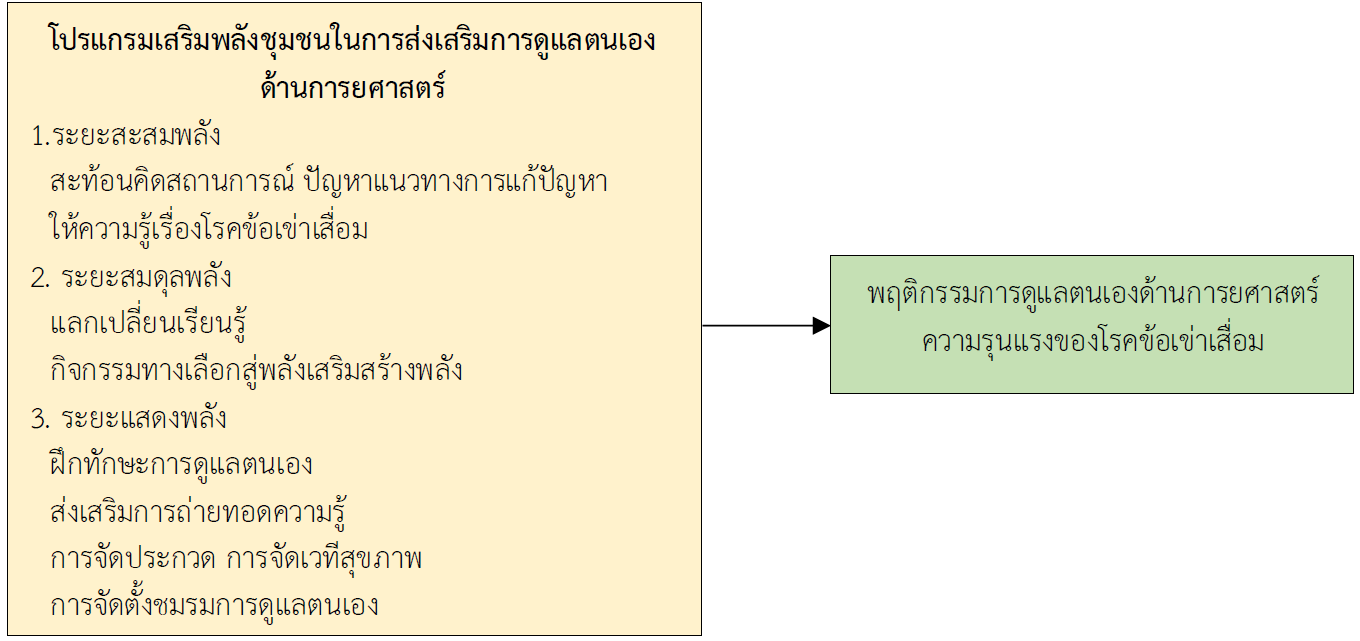
This quasi-experimental study on osteoarthritis among older rubber tappers aimed to evaluate the effects of a community empowerment program to promote self-care, based on the concept of community empowerment and integrated with Orem’s Self-Care Theory. The sample consisted of 60 purposively selected participants, divided into an experimental group (n = 30) and control group (n = 30). The experimental group received routine care along with a 12-week community empowerment program developed for this study, while the control group received only routine care. Research instruments included the new community empowerment program to promote self-care (IOC = 1), an ergonomic self-care behavior assessment (CVI = .82; reliability = .87), and the Thai version of the Western Ontario and McMaster Universities Osteoarthritis Index (WOMAC) (CVI = .77; reliability = .97). Data were analyzed using descriptive statistics frequency, percentage, mean, and standard deviation and t-tests. The results showed as follows.
1. After the intervention, the experimental group demonstrated a statistically significant increase in ergonomic self-care scores (t = 46.33, p-value < .001) and a significant decrease in knee osteoarthritis severity scores (t = 48.08, p-value < .001) compared to baseline.
2. Following the intervention, the experimental group had significantly higher ergonomic self-care scores than the control group (t = 1.03, p-value = .03), and significantly lower knee osteoarthritis severity scores (t = 27.13, p-value < .001).
The findings indicate that the community empowerment program effectively improved ergonomic self-care behaviors and reduced the severity of knee osteoarthritis. Health agencies and community leaders may apply this program to promote health and prevent or delay knee degeneration among older adults engaged in rubber tapping.
References
กนกวรรณ หวนศรี และแสงอรุณ อิสระมาลัย (2558). ผลของโปรแกรมส่งเสริมการดูแลตนเองด้านการยศาสตร์ต่อการดูแลตนเองและความรุนแรงของโรคข้อเข่าเสื่อมในเกษตรกรกรีดยางพาราสูงอายุ. วารสารสภาการพยาบาล, 30(2), 101–112.
คอรีเย๊าะ เลาะปนสา. (2561). ผลของโปรแกรมเสริมพลังชุมชนต่อพฤติกรรมการบริโภคอาหารเพื่อป้องกันภาวะไขมันในเลือดสูงในสตรีมุสลิมที่มีปัจจัยเสี่ยง. [วิทยานิพนธ์พยาบาลศาสตรมหาบัณฑิต, มหาวิทยาลัยสงขลานครินทร์].
ธนพงศ์ แสงส่องสิน. (2560). ผลของโปรแกรมการออกกำลังกายแบบแรงต้านและการจัดการยศาสตร์แบบมีส่วนร่วมในผู้สูงอายุที่ทำงานสวนยางพาราที่เป็นโรคข้อเข่าเสื่อม [วิทยานิพนธ์วิทยาศาสตรมหาบัณฑิต (อาชีวเวชศาสตร์) มหาวิทยาลัยสงขลานครินทร์].
ภาวินี ช่วยแท่น, ภรณี วัฒนสมบุญ, และสุปรียา ตันสกุล. (2563). ผลของการให้ความรู้ในการส่งเสริมพฤติกรรมป้องกันการกลับมารักษาซ้ำในมารดาที่มีบุตรป่วยปอดบวม. วารสารสุขศึกษา, 43(1), 12-24.
สมฤดี พูนทอง (2561). ผลของโปรแกรมการออกกำลังกายด้วยยางยืดร่วมกับการปรับท่าทางต่อพฤติกรรมการดูแลตนเองและอาการปวดเข่าในเกษตรกรกรีดยางพารา [วิทยานิพนธ์พยาบาลศาสตรมหาบัณฑิต, สาขาการพยาบาลเวชปฏิบัติชุมชน, มหาวิทยาลัยสงขลานครินทร์, สงขลา].
สำนักงานสถิติแห่งชาติ. (2563). สรุปผลที่สำคัญของการทำงานของผู้สูงอายุในประเทศไทย พ.ศ. 2563. กรุงเทพมหานคร: สำนักงานสถิติแห่งชาติ.
อารียา หมัดอะดั้ม. (2559). การพัฒนาโปรแกรมเสริมพลังชุมชนเพื่อปรับเปลี่ยนพฤติกรรมการควบคุมน้ำหนักของสตรีมุสลิมที่มีภาวะน้ำหนักเกิน. วารสารพยาบาลสงขลานครินทร์, 36(2), 118–132.
Boonyasopun, U. (2000). Ways of Promoting a Healthy Community A Critical Ethnography of Rural Thai Women. [Unpublished doctoral dissertation]. University of Maryland Baltimore.
Cieza, A., Causey, K., Kamenov., K., Hanson, S. W., Chatterji, S., & Vos, T. (2020). Global estimates of the need for rehabilitation based on the Global Burden of Disease study 2019: A systematic analysis for the Global Burden of Disease study 2019. The Lancet, 396(10267), 2006–2017. doi.org/10.1016/S0140-6736(20)32340-0
Fransen, M., McConnell, S., Harmer, A. R., Van der Esch, M., Simic, M., & Bennell, K. L. (2015).
Exercise for osteoarthritis of the knee. Cochrane Database of Systematic Reviews, (1), Article CD004376. doi.org/10.1002/14651858.CD004376.pub3
Isaramalai, S. A., Hounsri, K., Kongkamol, C., Wattanapisitkul, P., Tangadulrat, N., Kaewmanee, T.,
et al. (2018). Integrating participatory ergonomic management in non-weight-bearing exercise and progressive resistance exercise on self-care and functional ability in aged farmers with knee osteoarthritis: A clustered randomized controlled trial. Clinical Interventions in Aging 17(13); 101-108. doi: 10.2147/CIA.S144288.
Jormand, H., Mohammadi, N., Jeihooni, A. K., & Harsini, P. A. (2022). Self-care behaviors in older adults suffering from knee osteoarthritis: Application of theory of planned behavior. Frontiers in Public Health, 10, 958614. doi:10.3389/fpubh.2022.958614.
Kuptniratsaikul, V., & Rattanachaiyanont, M. (2007). Validation of a modified Thai version of the Western Ontario and McMaster (WOMAC) osteoarthritis index for knee osteoarthritis. Clinical Rheumatologyl, 29(12),1641-1645.
Mo, L., Jiang, B., Mei, T., & Zhou, D. (2023). Exercise therapy for knee osteoarthritis: A systematic review and network meta-analysis. Orthopaedic Journal of Sports Medicine, 11(7), 23259671231172773. doi.org/10.1177/23259671231172773
Nimit-arnun, N., Klinhom, W., & Morsup, T. (2020). Community empowerment: Concept and application in community practitioner nursing practice. Songklanagarind Journal of Nursing and Health Sciences, 14(1), 13–23.
Orem, D. E. (2001). Nursing: Concepts of Practice (6th ed.). Mosby.
Polit, D. F., & Beck, C. T. (2017). Nursing Research: Generating and Assessing Evidence for Nursing Practice (10th ed.). Wolters Kluwer.
Satayavongthip, B., Kerdchantuk, P., Hanrinth, R., Methieng, T., & Khunpimul, P. (2011). Development of the Thai knee osteoarthritis screening questionnaire (Thai-KOA-SQ) in Kanleurng sub-district, Nakronpanom province. Journal of Medical Association Thai, 94(8), 947-951.
Sinatti, P., Sánchez Romero, E. A., Martínez-Pozas, O., & Villafañe, J. H. (2022). Effects of patient education on pain and function and its impact on conservative treatment in elderly patients with pain related to hip and knee osteoarthritis: A systematic review. International Journal of Environmental Research and Public Health, 19(10), 6194. doi.org/10.3390/ijerph19106194
Wang, X., Perry, T., Arden, N., Chen, L., Parsons, C., Cooper, C., et al. (2020). Occupational risk in knee osteoarthritis: A systematic review and meta-analysis of observational studies. Arthritis Care & Research, 72(9), 1213-1223
World Health Organization [WHO]. (2020). WHO Guidelines on Physical Activity and Sedentary Behaviour. Geneva: World Health Organization.
Downloads
Published
Issue
Section
License
Copyright (c) 2025 The Southern College Network Journal of Nursing and Public Health

This work is licensed under a Creative Commons Attribution-NonCommercial-NoDerivatives 4.0 International License.
1. บทความหรือข้อคิดเห็นใด ๆ ที่ปรากฏในวารสารเครือข่าย วิทยาลัยพยาบาลและการสาธารณสุขภาคใต้ ที่เป็นวรรณกรรมของผู้เขียน บรรณาธิการหรือเครือข่ายวิทยาลัยพยาบาลและวิทยาลัยการสาธารณสุขภาคใต้ ไม่จำเป็นต้องเห็นด้วย
2. บทความที่ได้รับการตีพิมพ์ถือเป็นลิขสิทธิ์ของ วารสารเครือข่ายวิทยาลัยพยาบาลและการสาธารณสุขภาคใต้