Effects of a Teaching Guidance with Self-Care Booklet on Self-Care Behavior and Infection Rate among Patients with Percutaneous Nephrostomy (PCN)
Keywords:
Percutaneous Nephrostomy, PCN, Self-Care Behavior, Urinary Tract Infection (UTI)Abstract
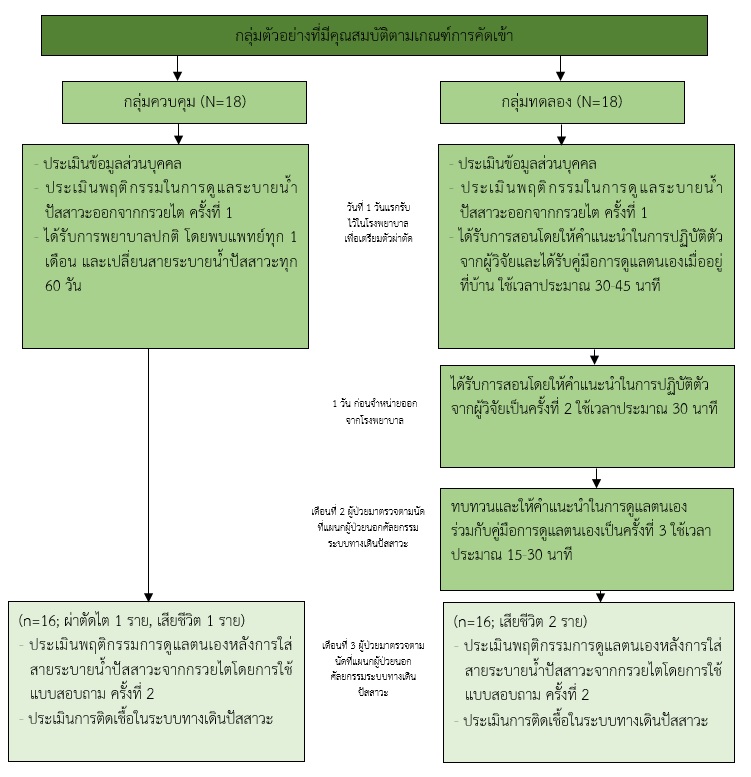
This two-group pretest-posttest design quasi-experimental research aimed to evaluate self-care behavior and infection rate of patients with percutaneous nephrostomy (PCN), after receiving teaching guidance and a self-care booklet compared to regular care. Participants were patients receiving PCN at Chiangrai Prachanukroh Hospital. They were recruited, then assigned to either experimental or control group (16 participants/group). Instruments were composed of a teaching plan on post-PCN self-care, a self-care booklet, a self-care behavior questionnaire, as well as an urinary tract infection (UTI) record form. Outcomes were measured at three months after start of study protocol. Data were analyzed by using descriptive statistics, Wilcoxon sign-ranks test, Mann-Whitney U test, and Fisher’s exact test.
After study completion, participants in the experimental group had higher score on PCN self-care behavior than those in the control group (p<.001), higher mean difference of PCN self-care (p<.01), and 12.5% of UTI infection rate, which was lower than those in the control group (75%) (p<.001).
This study had demonstrated that the teaching guidance and the self-care booklet were effective in improving self-care behavior and reducing UTI rate among patients with PCN.
References
Azer, S. Z., Mohsen, S. A. A.-E., & Sayed, S. Y. (2018). The Effect of Nursing Guidelines on Minimizing Incidence of Complications for Patients with Percutaneous Nephrostomy Tube. American Journal of Nursing Research, 6(5), 327-334.
Cheumthonh, P., Kimsungnoen, N., & Namjuntra, R. (2020). The Effects of Educative Supportive Program on Self Care Behavior and HbA1C in Persons Newly Diagnosed with Type 2 Diabetes. Journal of Nursing Science & Health, 43(1), 78-86. (in Thai)
Chiangraiprachanukhro Hospital. (2015). Statistics of Operative Patients. Retrieved September 13, 2015 from https://www.crhospital.org/home/index1.php?group=12
Dagli, M., & Ramchandani, P. (2011). Percutaneous Nephrostomy: Technical Aspects and Indications. Seminars in interventional radiology, 28(4), 424-437.
El Haddad, H., Viola, G., Jiang, Y., Raad, I., Rolston, K. V., & Szvalb, A. (2017). Percutaneous Nephrostomy Tube-related Infections. Open Forum Infectious Diseases, 4(suppl1), S349-S349.
Fernández-Cacho, L. M., & Ayesa-Arriola, R. (2019). Quality of Life, Pain and Anxiety in Patients with Nephrostomy Yubes. Revista Latino-Americana de Enfermagem, 27. Retrieved November 16, 2019 from http://www.scielo.br/scielo.php?script=sci_arttext&pid=S0104-11692019000100371&nrm=iso
Ganter Ritz, V., Speroni, K. G., & Walbridge, D. (2016). Reducing Complications and Hospitalizations Through an Innovative Catheter Care Clinic for Percutaneous Nephrostomy Catheter Patients. Journal of Radiology Nursing, 35(4), 275-280.
Halle, M. P., Toukep, L. N., Nzuobontane, S. E., Ebana, H. F., Ekane, G. H., & Priso, E. B. (2016). The Profile of Patients with Obstructive Uropathy in Cameroon: Case of the Douala General Hospital. The Pan African medical journal, 23, 67-67.
Huang, S. Y., Philip, A., Richter, M. D., Gupta, S., Lessne, M. L., & Kim, C. Y. (2015). Prevention and Management of Infectious Complications of Percutaneous Interventions. Seminars in interventional radiology, 32(2), 78-88.
Jones, L. F., Meyrick, J., Bath, J., Dunham, O., & McNulty, C. A. M. (2019). Effectiveness of Behavioural Interventions to Reduce Urinary Tract Infections and Escherichia Coli Bacteraemia for Older Adults Across all Care Settings: A Systematic Review. J Hosp Infect, 102(2), 200-218.
Maramara, B., Lob'o, Z., & Psevdos, G. (2018). Epidemiology of Nephrostomy Tube–Related Urinary Tract Infections Among US Veterans. Infectious Diseases in Clinical Practice, 26(6), 344-347.
Orem, D. E., Taylor, S. G., & Renpenning, K. M. (2001). Nursing: Concepts of Practice. St. Louis: Mosby.
Pabon-Ramos, W. M., Dariushnia, S. R., Walker, T. G., d'Othée, B. J., Ganguli, S., Midia, M. et al. (2016). Quality Improvement Guidelines for Percutaneous Nephrostomy. J Vasc Interv Radiol, 27(3), 410-414.
Siddiq, D. M., & Darouiche, R. O. (2012). Infectious Complications Associated with Percutaneous Nephrostomy Catheters: Do We Know Enough? Internation Journal of Artificial Organs, 35(10), 898-907.
Tang, X., & Lieske, J. C. (2014). Acute and Chronic Kidney Injury in Nephrolithiasis. Current Opinion in Nephrology and Hypertension, 23(4), 385-390.
Taylor, E., Miller, S., Chi, T., & Stoller, M. L. (2012). Complications Associated with Percutaneous Nephrolithotomy. Translational Andrology and Urology, 1(4), 223-228.
Thitisak, P., Hunnirun, P., & Ponsuwan, P. (2011). The Effectiveness of Health Education Program Applying the Self-efficacy Theory on Percutaneous Nephrostomy Patients in Bhumiboladulyadej Hospital. Journal of Faculty of Physical Education, 14(1), 203-213. (in Thai)
Tseng, T. Y., & Stoller, M. L. (2009). Obstructive Uropathy. Clinical Geriatric Medicine, 25(3), 437-443.
Turo, R., Horsu, S., Broome, J., Das, S., Gulur, D. M., Pettersson, B. et al. (2018). Complications of Percutaneous Nephrostomy in a District General Hospital. Turkish Journal of Urology, 44(6), 478-483.
Wongngam, W., Sucamvang, K., & Nanasilp, P. (2014). Effect of Educative-Supportive Nursing on Self-care Behaviors of the Elderly with Hip Fracture During Recovery Stage. Nursing Jouranl, 41(2), 72-82. (in Thai)
Downloads
Published
Issue
Section
License
1. บทความหรือข้อคิดเห็นใด ๆ ที่ปรากฏในวารสารเครือข่าย วิทยาลัยพยาบาลและการสาธารณสุขภาคใต้ ที่เป็นวรรณกรรมของผู้เขียน บรรณาธิการหรือเครือข่ายวิทยาลัยพยาบาลและวิทยาลัยการสาธารณสุขภาคใต้ ไม่จำเป็นต้องเห็นด้วย
2. บทความที่ได้รับการตีพิมพ์ถือเป็นลิขสิทธิ์ของ วารสารเครือข่ายวิทยาลัยพยาบาลและการสาธารณสุขภาคใต้