ผลการสอนโดยใช้กรณีศึกษาร่วมกับการเรียนรู้ผ่านแผนที่มโนทัศน์ และการสะท้อนคิดต่อความสามารถในการคิดอย่างมีวิจารณญาณ ของนักศึกษาพยาบาล ในจังหวัดปัตตานี
คำสำคัญ:
กรณีศึกษา, แผนที่มโนทัศน์, การสะท้อนคิด, การคิดอย่างมีวิจารณญาณ, นักศึกษาพยาบาลบทคัดย่อ
การวิจัยกึ่งทดลองแบบกลุ่มเดียววัดก่อนและหลังนี้ เพื่อศึกษา 1) การคิดอย่างมีวิจารณญาณของนักศึกษาพยาบาล มหาวิทยาลัยสงขลานครินทร์ วิทยาเขตปัตตานี 2) ผลของการสอนโดยใช้กรณีศึกษาร่วมกับการเรียนรู้ผ่านแผนที่มโนทัศน์และการสะท้อนคิดต่อความสามารถในการคิดอย่างมีวิจารณญาณของนักศึกษาพยาบาล และ 3) ความคิดเห็นของนักศึกษาพยาบาลเกี่ยวกับนิยาม ประโยชน์ ปัญหาและอุปสรรคของการจัดการเรียนการสอนโดยใช้กรณีศึกษาร่วมกับการเรียนรู้ผ่านแผนที่มโนทัศน์และการสะท้อนคิด กลุ่มตัวอย่างคือ นักศึกษาพยาบาลชั้นปีที่ 3 ที่ลงทะเบียนเรียนรายวิชาการพยาบาลผู้ใหญ่ 2 (993-324) จำนวน 34 คน รวบรวมข้อมูลโดยใช้แบบบันทึกข้อมูลส่วนบุคคล และแบบวัดความสามารถในการคิดอย่างมีวิจารณญาณ ได้ค่าความเชื่อมั่นคูเดอร์ริชาร์ดสัน เท่ากับ .73 วิเคราะห์ข้อมูลโดยใช้สถิติเชิงพรรณนา สถิติ Dependent t-test และวิเคราะห์เชิงเนื้อหา ผลการวิจัยพบว่า
1. นักศึกษาพยาบาลมีคะแนนความสามารถในการคิดอย่างมีวิจารณญาณเฉลี่ยก่อนการเรียนอยู่ในระดับปานกลาง (M = 23.76, SD=2.52) ส่วนหลังเรียนมีคะแนนเฉลี่ยเพิ่มขึ้นแต่ยังอยู่ในระดับปานกลาง (M = 26.23, SD=2.87)
2. หลังการเรียนโดยใช้กรณีศึกษาร่วมกับแผนที่มโนทัศน์และการสะท้อนคิด นักศึกษาพยาบาลมีคะแนนความสามารถในการคิดอย่างมิวิจารณญาณสูงกว่าก่อนเรียนอย่างมีนัยสำคัญทางสถิติ (t= - 4.58, P<.01)
3. นักศึกษาพยาบาลให้ความหมายการคิดอย่างมิวิจารณญาณว่าเป็นกระบวนการคิดเป็นขั้นเป็นตอนไตร่ตรองอย่างรอบคอบก่อนการตัดสินใจ และต้องพิจารณาข้อมูลจากหลาย ๆข้อมูลที่มี จึงจะสรุปผลและตัดสินใจ ผลที่เกิดจากการจัดการเรียนการสอน ต้องกระตือรือร้นและตื่นตัวกับความรู้ใหม่และการทำงานเป็นทีม ส่วนอุปสรรคใช้เวลามากในการรวมทีมระดมความคิด
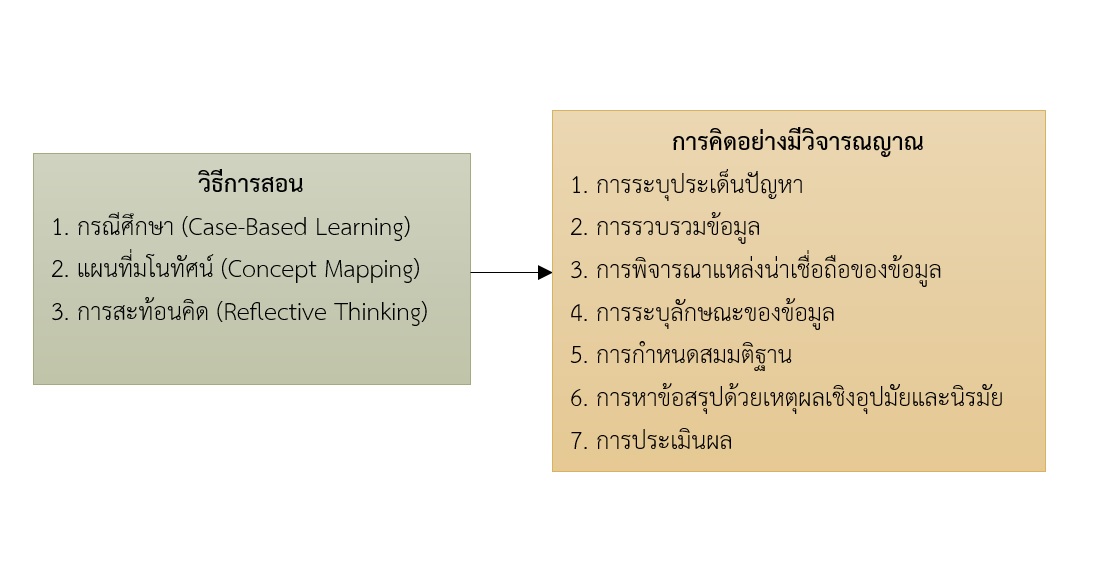
การศึกษาครั้งนี้แสดงให้เห็นว่า การบูรณาการเทคนิคการสอนโดยใช้กรณีศึกษาเป็นฐาน ร่วมกับแผนที่มโนทัศน์ และการสะท้อนคิด ช่วยเพิ่มความสามารถในการคิดอย่างมีวิจารณญาณของผู้เรียนได้
เอกสารอ้างอิง
Amanda, G. C., Debra K. C., & Mary S. (2016). Efficacy of Teaching Methods Used to Develop Critical Thinking in Nursing and Midwifery Undergraduate Students: A Systematic Review of the Literature. Nurse Education Today, 40, 209-218. doi: 0.1016/j.nedt 2016.03.010.
Announce of Thailand Nursing and Midwifery Council. (2018). Core Competencies for Bachelor's, Master's, and Doctorate Degree in Nursing, Advanced Nursing Training Course Certificate, and the Approval Letter of Specific Expertise in Nursing and Midwifery and Specialized of Nursing. Retrieved April 6, 2020. from https://www. tnmc.or.th/images/userfiles/files/004.pdf. (In Thai).
Chantian, P., Nakornchai, T., Jaroenpong, J., Maneerat, S., & Anansupamongkol, D. (2019). The Development of Critical Thinking of Nursing Science Students. Kasem Bundit Journal, 20(2), 168-179. (In Thai).
Chidmongkol, R., Tongphet, P. & Khonyang, W. (2016). Teaching for Enhancing Critical Thinking of Nursing Students in Clinical Practice. The Southern College Network Journal of Nursing and Public Health, 3(3), 233-245 (In Thai).
Daley, B. J., Morgan, S., & Black, S. B. (2016). Concept Maps in Nursing Education: a Historical Literature Review and Research Directions. Journal of Nursing Education, 55(11), 631-639.
Fariborz, R., Eskandar, F. A., Parvin, S., & Raheleh, A. (2020). The Effect of Case-Based Learning with or without Conceptual Mapping Method on Critical Thinking and Academic Self-Efficacy of Nursing Students. Journal of Biochemical Technology, 1(11), 37-44.
Gibbs, G. (2013). Learning by Doing: A Guide to Teaching and Learning Methods. Further Education Unit. Oxford Center for Staff and Learning Development. Oxford Brookes University. Retrieved April 6, 2020. From https://thoughtsmostlyaboutlearning. files.wordpress.com.
Kaddoura, M., VanDyke, O., & Shea-Foisy, K. (2016). Impact of Concept Mapping on the Development of Clinical Judgment Skills in Nursing Students. Teaching and Leaning in Nursing, 11(3), 101-107.
Kaddoura, M., Van-Dyke, O., and Yang, Q. (2016) Impact of a Concept Map Teaching Approach on Nursing Students’ Critical Thinking Skills. Nursing & Health Sciences, 18, 350-354. doi: 10.1111/nhs.12277.
Khorphon, S., Pankeaw, J., Sarobol, T., Choopun, K., Chomchan, S., & Boonlue, N. (2019). Promoting of Critical Thinking Skills in Nursing Students Through Reflective Thinking. Nursing Journal, 46(1), 83-96. (In Thai).
Kosawanon, S., Rungamornrat, S., & Panbangpra, S. (2015). Effect of Case Study Teaching Method on Critical Thinking in Nursing Students. Journal of Nursing Science, 33(3), 99-108. (In Thai).
Kusoom, W., & Tongvichean, S. (2017). Developing Critical Thinking Skill for Nursing Students. The Journal of Faculty of Nursing, Burapha University, 25(3), 1-8. (In Thai).
Leaboontawatchai, O. (2000). Critical Thinking: Learning of Nursing. Bangkok: Tanapreat and Graphic. (In Thai).
Miller, W. L., & Crabtree, B. F., (1992). Primary Care Research: A Multimethod Typology and Qualitative Road Map. In B. F. Crabtree & W. L., Miller (Eds.), Doing Qualitative Research, 3-28. Newbury Park: SAGE.
Mortellaro, C. (2015). Exploring Factors Influencing Critical Thinking Skills in Undergraduate Nursing Students: A Mixed Methods Study. Seton Hall University Dissertations and Theses (ETDs). 2107. Retrieved April 6, 2020. from https://scholarship.shu.edu/ dissertations/2107.
Phaktoop, M., & Khuinak, U. (2018). Critical Thinking in Nursing. Journal of Nursing and Education, 11(2), 1-12. (In Thai).
Popil, I. (2011). Promotion of Critical Thinking by Using Case Studies as Teaching Method. Nurse Education Today, 31(2), 204-7.
Poungjuntaradej, N., & Pleankaew, P. (2016). Factors Related to Nursing Students’ Critical Thinking. Journal of the Police Nurses, 8(1), 125-135. (In Thai).
Praboromaharajchanok Institute. (n.d.). Manual of Quality Assurance in Nursing Colleges: Key Indicator for Evaluation of Nursing Colleges. Bangkok: Ministry of Public Health. (In Thai).
Promnoi, C., Promtape, N., & Tasaneesuwan, S. (2012). Critical Thinking Ability among Senior Nursing Students Faculty of Nursing, Prince of Songkla University. Songklanagarind Journal of Nursing, 32(3), 1-12. (In Thai).
Sirisorm, K., Ampansirirat, A., & Chitviboon, A. (2015). Effect of Case Studies Combined with Concept Mapping Technique on Critical Thinking of Nursing Students. Journal of Nursing Science, 33(Suppl 1), 18-26.
Sirisupluxana, P. (2013). Teaching Nursing Students to Develop Critical Thinking Skills. The Journal of Boromarajonani College of Nursing, Nakhonratchasima, 19(2), 5-19. (In Thai).
Srisawad, K. (2018). Critical Thinking Skill of Nursing Student at Kasembundit University. Humanities and Social Science Research Promotion Network Journal, 1(3), 38-44. (In Thai).
Srisawad, K., & Chaleoykitti, S. (2017). Critical Thinking of Nursing Students. Royal Thai Army Medical Journal. 70(3), 169-174. (In Thai).
Wichainate, K. (2014). Reflective Thinking: Teaching Students to Develop Critical Thinking in Nursing Practice. Journal of the Police Nurses, 6(2), 188-199. (In Thai).
ดาวน์โหลด
เผยแพร่แล้ว
ฉบับ
ประเภทบทความ
สัญญาอนุญาต
1. บทความหรือข้อคิดเห็นใด ๆ ที่ปรากฏในวารสารเครือข่าย วิทยาลัยพยาบาลและการสาธารณสุขภาคใต้ ที่เป็นวรรณกรรมของผู้เขียน บรรณาธิการหรือเครือข่ายวิทยาลัยพยาบาลและวิทยาลัยการสาธารณสุขภาคใต้ ไม่จำเป็นต้องเห็นด้วย
2. บทความที่ได้รับการตีพิมพ์ถือเป็นลิขสิทธิ์ของ วารสารเครือข่ายวิทยาลัยพยาบาลและการสาธารณสุขภาคใต้