The Effects of a Pre-Training Program on Knowledge, Stress, and Nursing Competency among 4th Year Nursing Students in Nursing Care for High-risk Pregnant Women During Labor
Keywords:
Pre-Training Program, Nursing Competency, High-Risk PregnancyAbstract
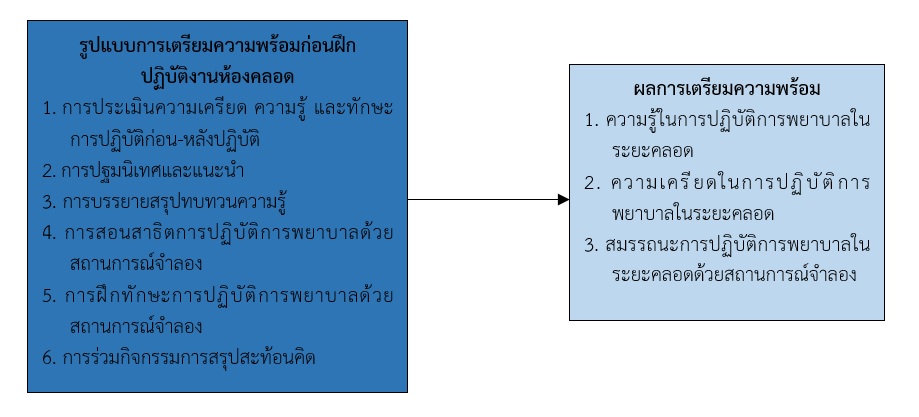
This quasi-experimental research, two - group pretest-posttest design, aimed to examine the effects of a pre-training program in nursing care for high-risk pregnant women during labor on knowledge, stress, and nursing competency. Participants were 60 of the 4th year nursing students, recruited using stratified random sampling according to their academic achievement. They were assigned into either experiment or a comparison group (30 students per group). The research intervention was the Knowledge, Stress, and Practice Program (KSP), consisting of: 1) tutorials, 2) demonstrations, 3) return demonstrations and practices, and 4) reflective practices. Data were collected using: 1) a general-data record form, 2) a knowledge inventory in nursing care during labor, 3) a stress inventory in providing nursing care during labor, and 4) a nursing-competency observation checklist. Content validity of the second to the fourth part of the instrument was confirmed obtaining the index of item objective congruence (IOC) ranged from .60-1.00. Its reliability yielded .70, .96, and .83 for each item, respectively. Data were analyzed using descriptive statistic, as well as paired and independent t-test.
Research results showed that, after implementing KSP, nursing students in the experiment group had significant statistically higher average scores of knowledge and nursing competency, and lower average score of stress than before participating in the program (p<.001). They also had significant statistically higher average scores of knowledge and nursing competency than the lower average scores of students in the comparison group (p<.001).
Therefore, the KSP should be used in preparation for practicum of the 4th year nursing students in Maternal and Newborn Nursing and Midwifery Practicum 2.
References
Bunmak, P. & Bunmak, S. (2013). Medical Simulation the Way to Improve Patient Care. Srinagarin Medical Journal, 28(supplement), 80-85. (in Thai)
Cant, R. P., & Cooper, S. J. (2010). Simulation-Based Learning in Nurse Education: Systematic Review. Journal of Advanced Nursing, 66(1), 3-15.
Henrichs, B., Rule, A., Grady, M., & Ellis, W. (2002). Nurse Anesthesia Students’ Perceptions of the Anesthesia Patient Simulator: A Qualitative Study. American Association of Nurse Anesthetists Journal, 70(3), 219-225.
Jantavat, P. (2018). Academic Articles: Preparation of Nursing Student for Stress Relief During Practice in Delivery Room. Kuakarun Journal of Nursing, 25(1), 184-191. (in Thai)
Kumkong, M., Leejareon, P., Aramrom, U. & Jitviboon, A. (2016). Effects of Simulation-Based Learning on Perceived Self-Efficacy in Providing Nursing Care for Advanced Life Support to Patients with Critical Illness or Emergency Condition among Nursing Students. The Southern College Network Journal of Nursing and Public Health, 3(3), 52-64. (in Thai)
Lertbannaphong, T. (2017). Simulation Based Medical Education. Siriraj Medical Bulletin, 8(1), 39-46. (in Thai)
Lertsakornsiri, M. (2012). Stress and Stress Management During Practice in Labor Room of Nursing Students at Saint Louis College. Bangkok: Saint Louis College. (in Thai)
Limthongkul, M., & Aree-Ue, S. (2009). Sources of Stress, Coping Strategies, and Outcomes among Nursing Students During Their Initial Practice. Rama Nurse Journal, 15(2), 192-205. (in Thai)
Photaworn, P., & Wongpradit, S. (2017). Experience in Breathing Meditation Practicing for Decreases the Tension in Testing Maternal-Newborn and Midwifery 2 Subject of Nurse Student. The Southern College Network Journal of Nursing and Public Health, 4(1), 171-179. (in Thai)
Praboromarajchanok Institute. (2012). Bachelor of Nursing Science Program (Update Program A.D. 2012. Boromarajonani College of Nursing, Nakhon Ratchasima. Bangkok: Ministry of Public Health. (in Thai)
Rungnoei, N., & Seesawang, J. (2016). Effects of Self-Development Supportive for the Pre-Practicum Preparation at Intensive Care Unit on Knowledge and Skills among Nursing Students. Journal of Phrapokklao Nursing College, 27(2), 29-38. (in Thai)
Saetan, C., & Kampun, S., (2014). Stress and Coping Strategies of Nursing Students in Clinical Practice Preparation of Maternal and Child Health Nursing and Midfifery1. Journal of Health and Nursing Research (Journal of Boromarajonani College of Nursing, Bangkok), 30(3), 54-63. (in Thai)
Suwannakeeree, W. O., Jullmusi, O., & Kampun, S., (2016). Simulation-Based Learning Management for Nursing Students. Journal of Nursing Science Chulalongkorn University, 28(2), 1-13. (in Thai)
Vatanasin, S. (2010). Perceived Stress Level and Sourses of Stress among Nursing Students at Faculty of Nursing, Burapha University. The Journal of Faculty of Nursing Burapha University, 18(Supplement), 47-59. (in Thai)
Wiratchai, N. (2012). Stats to use 2nd edition Revised Version. Bangkok: Chulalongkorn University. (in Thai)
Downloads
Published
Issue
Section
License
1. บทความหรือข้อคิดเห็นใด ๆ ที่ปรากฏในวารสารเครือข่าย วิทยาลัยพยาบาลและการสาธารณสุขภาคใต้ ที่เป็นวรรณกรรมของผู้เขียน บรรณาธิการหรือเครือข่ายวิทยาลัยพยาบาลและวิทยาลัยการสาธารณสุขภาคใต้ ไม่จำเป็นต้องเห็นด้วย
2. บทความที่ได้รับการตีพิมพ์ถือเป็นลิขสิทธิ์ของ วารสารเครือข่ายวิทยาลัยพยาบาลและการสาธารณสุขภาคใต้