รูปแบบการบูรณาการพันธกิจ ผ่านกระบวนการเรียนรู้สู่การเปลี่ยนแปลง เพื่อพัฒนาสมรรถนะบัณฑิตและศักยภาพชุมชน ในการรองรับสังคมสูงวัย
คำสำคัญ:
การบูรณาการพันธกิจ, การเรียนรู้สู่เปลี่ยนแปลง, สมรรถนะบัณฑิต, สังคมสูงวัยบทคัดย่อ
การวิจัยและพัฒนานี้มีวัตถุประสงค์เพื่อ 1) วิเคราะห์สมรรถนะบัณฑิตพยาบาลและศักยภาพของชุมชนในการดูแลสุขภาพผู้สูงอายุ 2) พัฒนารูปแบบการบูรณาการพันธกิจผ่านกระบวนการเรียนรู้สู่การเปลี่ยนแปลง และ 3) ประเมินประสิทธิผลของรูปแบบ ดำเนินการวิจัย 4 ขั้นตอน ขั้นตอนที่ 1 ศึกษาสมรรถนะบัณฑิตพยาบาล และศักยภาพชุมชนเกี่ยวกับการดูแลผู้สูงอายุ ขั้นตอนที่ 2 พัฒนารูปแบบ ตรวจสอบคุณภาพรูปแบบ และทดลองใช้รูปแบบ ขั้นตอนที่ 3 ประเมินผลการใช้รูปแบบ กลุ่มตัวอย่างได้แก่ นักศึกษาพยาบาลชั้นปีที่ 2 และชั้นปีที่ 4 จำนวน 208 คน อาจารย์พยาบาลสาขาการพยาบาลผู้ใหญ่และผู้สูงอายุ และอนามัยชุมชน จำนวน 23 คน และผู้สูงอายุในหมู่บ้านแม่ก๋ง จำนวน 144 คน เครื่องมือวิจัยได้แก่ แบบประเมินสมรรถนะบัณฑิต แบบประเมินการจัดการสุขภาพตนเอง และแบบประเมินคุณภาพชีวิตผู้สูงอายุ ตรวจสอบความเชื่อมั่นโดยการหาค่าสัมประสิทธิ์อัลฟ่าของครอนบาค ได้ค่าเท่ากับ .92, .91, .88, .79 และ .86 ตามลำดับ และแนวทางการสนทนากลุ่ม วิเคราะห์ข้อมูลโดยใช้สถิติพรรณนา สถิติทดสอบที และการวิเคราะห์เนื้อหา ผลการวิจัยพบว่า
1. สมรรถนะบัณฑิตพยาบาลในปีการศึกษา 2560 ด้านการดูแลผู้สูงอายุ อยู่ในระดับปานกลาง ด้านการจัดการสุขภาพชุมชนและการดูแลด้วยหัวใจความเป็นมนุษย์ อยู่ในระดับดี ส่วนชุมชนยังไม่มีระบบการบริหารจัดการผู้สูงอายุที่ชัดเจน และพบปัญหาสุขภาพจากความเสื่อมตามวัยและโรคไม่ติดต่อเรื้อรัง
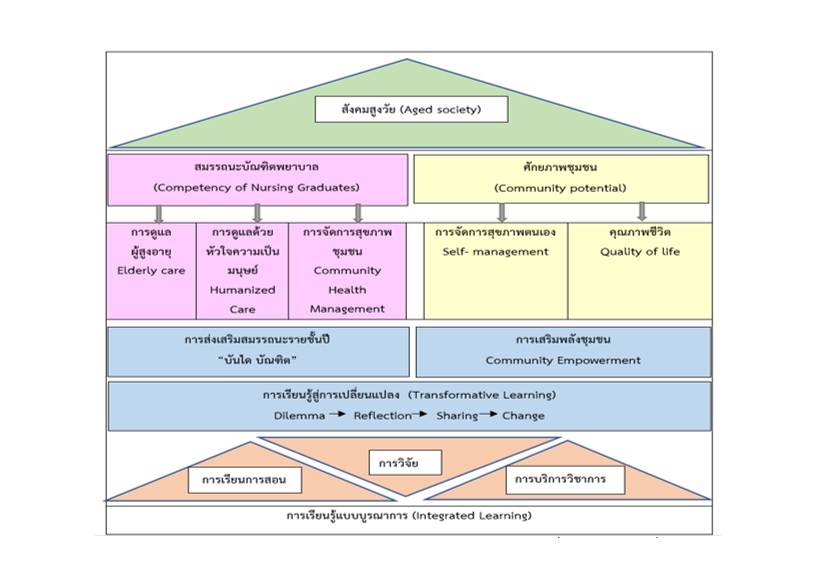
2. รูปแบบที่พัฒนาขึ้นเป็นกระบวนการบูรณาการการเรียนการสอน การบริการวิชาการแก่ชุมชน และการวิจัยเชิงปฏิบัติการแบบมีส่วนร่วม โดยใช้กระบวนการเรียนรู้สู่การเปลี่ยนแปลง เพื่อนำไปสู่การพัฒนาสมรรถนะบัณฑิต ศักยภาพของผู้สูงอายุในการจัดการสุขภาพตนเอง ประกอบด้วย 4 องค์ประกอบ ได้แก่ แนวคิดของรูปแบบ เป้าหมายของรูปแบบ กระบวนการของรูปแบบ และการประเมินผลลัพธ์ของรูปแบบ
3. ผลลัพธ์ของการใช้รูปแบบพบว่า สมรรถนะบัณฑิตในปีการศึกษา 2561 ในด้านการดูแลผู้สูงอายุด้านการดูแลด้วยหัวใจความเป็นมนุษย์ และด้านการจัดการสุขภาพชุมชนอยู่ในระดับดี (M=3.96, SD=0.46, M=4.20, SD=0.39 และ M=4.17, SD=0.41 ตามลำดับ) ผู้สูงอายุในชุมชนมีความสามารถในการจัดการสุขภาพตนเองของผู้สูงอายุอยู่ในระดับดี (M=2.65, SD=0.13) และคุณภาพชีวิตอยู่ในระดับดี คิดเป็นร้อยละ 42.36 ส่วนชุมชนมีระบบบริหารจัดการด้านผู้สูงอายุที่ดำเนินการโดยชุมชน และได้รับคัดเลือกเป็นศูนย์วิจัยชุมชนในปี 2563
การนำแนวคิดการเรียนรู้สู่การเปลี่ยนแปลงมาใช้ในกระบวนการบูรณาการพันธกิจของวิทยาลัย สามารถพัฒนาสมรรถนะบัณฑิตและศักยภาพชุมชนได้ จึงควรนำไปขยายผลในการพัฒนาสมรรถนะบัณฑิตและศักยภาพของชุมชนในด้านอื่นที่จำเป็นในยุคปัจจุบัน
เอกสารอ้างอิง
Bhutta, Z. A., Chen, L., Cohen, J., Crisp, N., Evans, T., Fineberg, H., et al. (2010). Education of Health Professionals for the 21st century: a Global Independent Commission. The Lancet, 375(9721), 1137-1138. Retrieved December 7, 2019 from https://doi.org/10. 1016/S0140-6736(10)60450-3
Bycroft, J. J., & Tracey, J. (2006). Self-Management Support: A Win-Win Solution for the 21st Century. New Zealand Family Practitioner, 33(4), 243-248.
Chaleoykitti, S., Bandansin, J., Kanglee, K., & Kumpraw, P. (2014). The Study of Academic Services Integration with Teaching and Learning of General Education for Human Development Course on Volunteer and Happiness of Study among 1st Year Nursing Students of the Royal Thai Army Nursing College. Journal of The Royal Thai Army Nurses, 15(3), 421–429. (in Thai).
Creer, T. L. (2000). Self-Management of Chronic Illness p. 601-629. In Bockaert, M., Pintrich, P. R., & Zeidner, M., (editors). Handbook of Self-Regulation. San Diego: Academic Press.
Gibson, CHA. (1995). Concept Analysis of Empowerment. Journal of Advance Nursing, 16(3), 354- 361.
Mezirow, J. (2003). Transformative Learning as Discourse. Journal of transformative Education, 1(1), 58-63.
Nawsuwan, P., Singhasem, P., & Naksrisang, W. (2017). Essential Competencies of Registered Nurses for the Care of the Elderly in an Aging Society. Nursing Journal of the Ministry of Public Health, 27(1), 1-11. (in Thai)
Office of the Higher Education Commission. (2017). Manual for the Internal Quality Assurance for Higher Education Institutions 2014: Office of the Higher Education Commission (OHEC). Bangkok: Office of the Higher Education Commission.
Phalasuek R. (2018). Participatory Action Research: Development Process Participating Community Health Promotion. Journal of Nursing College Network and Southern Public Health, 5(1), 211-223. (in Thai)
Public Health Nursing Division, Bureau of Health. (2009). Nursing Practice Standards in the Community. Bangkok: Thammasat University Press. (in Thai)
Puwarawuttipanit, W., Muksikathong, C., Sriprasong, S., Plikbua, W., Kasetkalam, P., & Hanrob, S., et al. (2015). A Systematic Review of Chronic Care Model and Self-Management. Journal of Nursing Science, 34(1), 3-27. (in Thai)
Suwana, P., Panyasaib, A., Teepsawangb, D., & Weonchum, N., S., (2013) Result of Learning Health Management Village Project Through Learning-Teaching Process by Learning Model Concept: Case study of Nguakong Village, Banluem District, Udonthani Province. Naresuan University Journal, Special Issue, 30-37. (in Thai)
Thailand Development Research Institute (TDRI). (2018). The Results of the Public Health Expenditure Estimate in Thailand According to the OECD. Retrieved November 10, 2019 from https://tdri.or.th/2018/01/healthexpenditure15yrs/.
The Joint Committee on Standards for Educational Evaluations. (1994). The Program Evaluation Standards: How to Assess Evaluations of Educational Programs. Newbury Park, CA: Sage.
United Nation. (2015). World Population Ageing 2015. New York: Department of Economic and Social Affairs.
Wangwun, P., & Vibulchai, N., (2017). Effects of Academic Service Integration with Teaching and Learning to Strengthen the Competencies of the Elderly Care in the Community of Nursing Students. Mahasarakham Hospital Journal, 14(3), 57-66. (in Thai)
Watson, J. (1988). Nursing: Human Science and Human Care: A Theory of Nursing. Norwalk: Connecticut, Appletion-Century-Crofts.
Worawong, C., Karbmanee, N., Manasatchakun, PD., & Khueansombat, T., (2019). Development of Community-Based Transformative Learning Model to Enhance Humanized Care Identity of Nursing Students. Journal of Health Science, 28(Special Issue), 53-64 (in Thai)
ดาวน์โหลด
เผยแพร่แล้ว
ฉบับ
ประเภทบทความ
สัญญาอนุญาต
1. บทความหรือข้อคิดเห็นใด ๆ ที่ปรากฏในวารสารเครือข่าย วิทยาลัยพยาบาลและการสาธารณสุขภาคใต้ ที่เป็นวรรณกรรมของผู้เขียน บรรณาธิการหรือเครือข่ายวิทยาลัยพยาบาลและวิทยาลัยการสาธารณสุขภาคใต้ ไม่จำเป็นต้องเห็นด้วย
2. บทความที่ได้รับการตีพิมพ์ถือเป็นลิขสิทธิ์ของ วารสารเครือข่ายวิทยาลัยพยาบาลและการสาธารณสุขภาคใต้