Development of an Interprofessional Education Learning Model for Health Promotion and Disease Prevention, Using the Community-Based Approach
Keywords:
Interprofessional Education Model, IPE, Health Promotion and Disease Prevention, Community Based Learning, Research and DevelopmentAbstract
This research and development aimed to analyze the situation of interprofessional education (IPE), using the community-based learning (CBL) approach for health promotion and disease prevention among health sciences students, and to evaluate the effectiveness of the developed learning model. Research was divided into 4 phases. Situation analysis was firstly performed on IPE (Research-R1: Analysis and Design) by using in-depth interviews and focus groups among First-Year health sciences students. Data were analyzed by using descriptive statistics, while qualitative data were analyzed by content analysis. Secondly, design and development of the IPE Learning model (Development-D1: Development Model) was shaped, including IPE manual, evaluation forms. Questionnaires were developed including knowledge, learning outcomes, skills, leadership, and attitudes towards IPE. These were approved by five experts and applied to 30 health sciences students (Research-R2: Implementation). Samples were selected by using purposive sampling, and they were willing to participate. Data collection was then conducted by using focus groups. IPE model and the IPE manual were duly revised before implementing (Development-D2: Development). Thirdly, the IPE model was implemented (Research-R3: Implement) with health sciences students (n=50), all selected by using purposive sampling. Students were willing to participate by using questionnaire and in-depth interview for data collection. Finally an evaluation of effectiveness of IPE learning model (Development-D3: Evaluation) was done. Data were analyzed by using descriptive statistics, and pair t-test. Qualitative data were analyzed by using content analysis.
The results revealed as follows.
1. There were no specifically contents of IPE model by using CBL approach for health promotion and disease prevention among health sciences students. Knowledge of IPE was at moderate level and so was the learning of IPE. However, the ability of interprofessional working and experience was not sufficient in health care and primary care setting. It was recommended to integrate IPE and CBL.
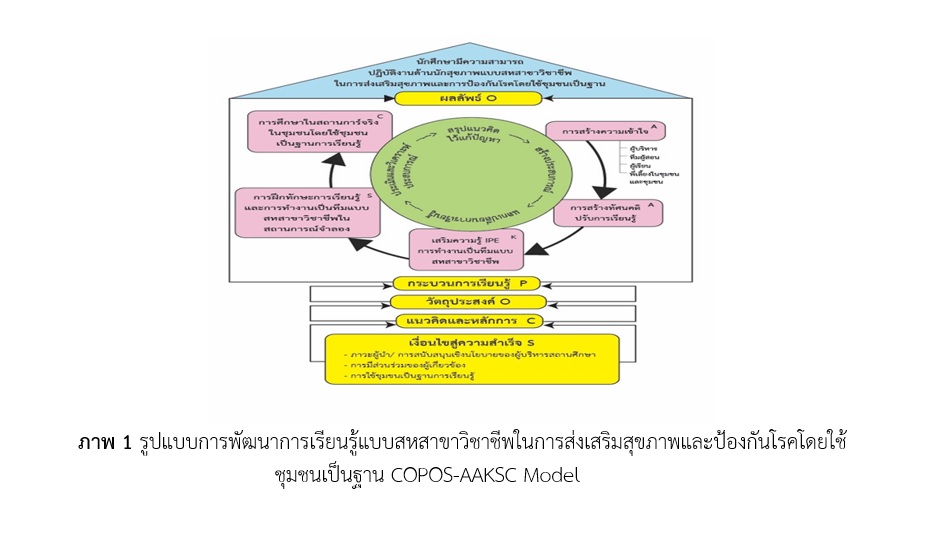
2. The development of IPE leaning model for health promotion and disease prevention by using CBL was successful in 4 main components, including: 1) concept and principles, 2) objectives, 3) processes (awareness, attitude, knowledge, situation, and CBL), 4) outcomes, and 5) key success factors (policy maker by administrator, networking, community engagement and CBL approaching).
3. The efficiency of model evaluation showed a significant difference in terms of knowledge, learning, attitudes, and leadership scores towards IPE working with interprofessional team, between before and after participating in learning model (p<.001). Administrator boards, faculty, mentors, students, and community delegates reflections on the learning model was appropriate and should be implemented for developing, sustaining IPE for enhancing performance practice in CBL.
References
Crabee, B. F., & Miller, W. L. (1992). Doing Qualitative Research. London: SAGE Publications.
Cronbach, L.J. (1951). Coefficient Alpha and the Internet Structure of Tests. Phychometrika, 16(3), 297-334.
Fox, L., Onders, R., Hermansen-Kobulnicky, C. J., Nguyen T. N., Myran L., Linn B., et al, (2018). Teaching Interprofessional Teamwork Skills to Health Professional Students: A Scoping ReviewJournal of Interprofessional Care, 32(2), 127-135.
Hair, F. J., Black, C. W., Babin, J. B., & Anderson, E. R. (2010). Multivariate Data Analysis. (7th ed). New Jersey: Pearson Education.
Hosny, S., Kamel, M. H., El-Wazir, Y., & Gilbert, J. (2013). Integrating Interprofessional Education in Community - Based Learning Activities: Case Study, Suppl(1), S68-S73. doi: 10.3109/0142159X.2013.765550. Retrieved March 4, from https://www.ncbi.nlm. nih.gov/pubmed/23581899
Johns, C. (2000). Becoming a Reflective Practitioner: a Reflective and Holistic Approach to Clinical Nursing, Practice Development and Clinical Supervision. Oxford: Blackwell Science.
Mahajan, R., Mohammed, C. A., Sharma, M., Gupta P., & Singh T. (2018). Interprofessional Education: An Approach to Improve Healthcare Outcomes. Indian Pediatrics, 55, 241–249. Retrieved March 9, from https://doi.org/10.1007/s13312-018-1326-0
Nielsen, A. (2016). Concept-Based Learning in Clinical Experiences: Bringing Theory to Clinical Education for Deep learning, Journal of Nursing Education, 55(7), 365-371.
Praboromarajchanok Institute Strategic Plan, (2020-2024). Praboromarajchanok Institute Strategic Plan. Retrieved March 9, 2020 from http://www.bcnb.ac.th/bcnb/uploads/documents/wg2/20190820_165729_121_4050.pdf
Putthasri, W., & Chuenkongkaew, W. (2017). The Report on 3rd Annual National Health Professional Education Reform Forum: ANHPERF "IPE towards Thai Health Team". Nonthaburi: P.A Living Ltd.; Bangkok,Thailand. (in Thai)
Rajiah, K., & Maharajan, M. (2016). Frammework for Action to Implement Interprofessional Education and Collaborative Practice in Pharmacy and Allied Health Sciences Program in India. India Journal of Phamaceutical Education and Research, 50(2), 238-245.
Reeves, S., Zwarestein, M., Goldman, J., Barr, H., Freeth, D., Hammick, et al. (2008). Interprofessional Education: Effects on Professional Practice and Health Care Outcomes. Coachrane Database of Systemic Reviews. DOI: 10.1002/14651858. CD00213.pub2.
Rittikoop, W. (2018). Community-Based Learning: Effective Pedagogy Strategies for Teachers in the 21st Century. Graduate School Journal, 11(3), 179-191.
Royal Thai Government Gazette. (2019). Royal Thai Government Gazette. Retrieved March 9, 2020 from http://www.ratchakitcha.soc.go.th/DATA/PDF/2561/A/082/T_0001.PDF
Sarakshetrin, A., Sriyasak, A., Ketin, V., & Rongmuang, D., (2019). A Development of Interprofessional Education Learning Model for Health Promotion among the Elderly in the Community. Journal of Health and Nursing Research, 35(2), 140-152.
The Employers Satisfaction for Graduate. (2559-2561). The Employers Satisfaction for Graduate Students from Boromarajonnani College of Nursing, Buddhachinaraj. Annual Report of Academic Affair of Boromarajonnani College of Nursing, Buddhachinaraj.
World Health Organization. (2010). Framework for Action on Interprofessional Education & Collaborative Practice. (WHO/HRH/HPN/10.3)
Zwarestein, Reeves, Barr, Hammick, Koppel, & Atkins. (2000) Interprofessional Education: Effects on Professional Practice and Health Care Outcomes. Retrieved March 4
Downloads
Published
Issue
Section
License
1. บทความหรือข้อคิดเห็นใด ๆ ที่ปรากฏในวารสารเครือข่าย วิทยาลัยพยาบาลและการสาธารณสุขภาคใต้ ที่เป็นวรรณกรรมของผู้เขียน บรรณาธิการหรือเครือข่ายวิทยาลัยพยาบาลและวิทยาลัยการสาธารณสุขภาคใต้ ไม่จำเป็นต้องเห็นด้วย
2. บทความที่ได้รับการตีพิมพ์ถือเป็นลิขสิทธิ์ของ วารสารเครือข่ายวิทยาลัยพยาบาลและการสาธารณสุขภาคใต้