Continuous Home Care: Development of a Documentation Format for Premature Infant Referral and Follow-Up
Keywords:
Documentation, Referral, Follow-Up, Premature Infant, Continuous Home CareAbstract
This research on continuous home care aimed to develop and determine the effectiveness of a documentation format for premature infant follow-up and referral. Study was divided into four steps. First step consisted in an analysis of needs assessment. Focus group discussion were conducted among 35 informants including nurses, village health volunteers, and mothers of preterm infants. Research instrument was a semi-structured interview form. Content analysis was used for data analysis. Second step was the development of a documentation format, which was then validated by experts. Third step included the implementation of documentation format, and testing its level of effectiveness. Sample was 30 mothers and their preterm infants. Purposive sampling was used to recruit the participants. They were randomly assigned into an experimental and control group (15 mothers and their infants/group). Research instruments consisted of: 1) demographic questionnaire, 2) the record form for infant’s body weight, and 3) the infant’s developmental assessment form. Data were analyzed by using frequency, percentage, chi-square, Fisher’s exact test and Mann-Whitney U test. Fourth step was evaluation and revision of the format. Focus group discussions were conducted among 12 mothers in the experimental group. Research instruments were a semi-structured interview form, and a satisfaction assessment form. Content analysis method was used for data analysis. Findings were as follows.
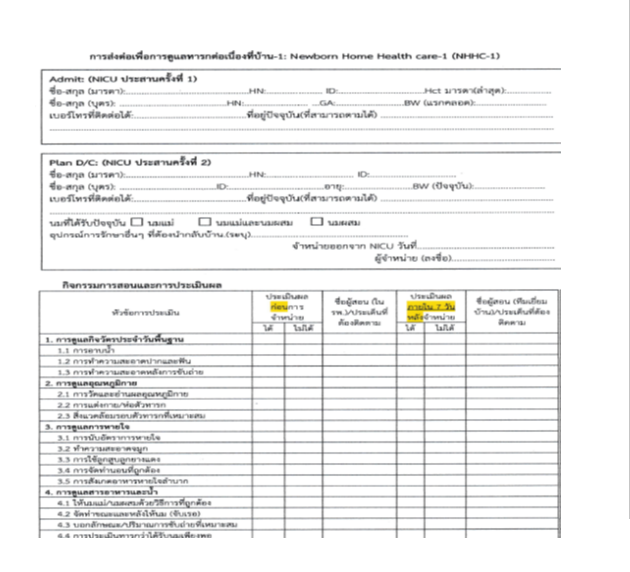
1. The new documentation format for continuous care and follow-up for premature infant at home was divided in 2 periods: the first period was when premature infants were receiving care at the Neonatal Intensive Care Unit (NICU), and the second period was from the discharge from hospitals until the infants reached the age of 12 months.
2. The premature infants’ body weight at the age of 6 and 12 months in the experimental group was significantly higher than in the control group (Z=-4.57, p<0.00, and Z=-4.63, P<0.00, respectively). However, the premature infants’ development at age of 1-2 months, 3-4 months, 7-8 months, and 10-12 months in the experimental and control group were not significantly different (p>0.05).
This research suggests that nurses and caregivers of preterm infants should use the developed documentation format for continuous care and follow-up for preterm infants.
References
Awindaogo, F., Smith, V., C., & Litt. J., S. (2015). Predictors of Caregiver Satisfaction with Visiting Nurse Home Visit After NICU Discharge. Journal of Perinatology, 36(4), 325-328.
Bureau of Polity and Strategy. (2018). Public Health Statistics A.D.2018. [Database on the Internet]. Retrieved Jan 26, from http://bps.ops.moph.go.th/. (In Thai)
Chookhampaeng, C. (2018). Curriculum Research and Development Concept and Process. Bangkok: Chulalongkorn University Press.
Clark-Gambelunghe, M. B., & Clark, D. A. (2015). Sensory Development. Pediatrics Clinics, 62(2), 367-384.
Colaizy, T. T., Bartick, M. C., jegier, B. J., Green, B. D., Reinhold, A. G., Schaefer, A., J., et al. (2016). Impact of Optimized Breastfeeding on the Costs of Necrotizing Enterocolitis in Extremely Low Birth Weight Infant. The Journal of Pediatric, 175, 100-1016.
Crabtree, B. F., & Miller, W. L. (1992). Doing Qualitative Research. London: SAGE.
Gardner, S. L., & Goldson, E. (2011). The Neonate and the Environment: Impact on Development. In S. Gardner, B. Carter, M. Enzmam-Hines, & J. Hernandez, (Eds.), Handbook of Neonatal Intensive Care (7th ed.). (pp. 270-331). St. Louis: Mosby.
Hayeese, W., Sap-In, N., Wangsawat, T., & Chaimongkol, N. (2015) Quality of Life of Muslim Preterm Infant in Three Southernmost Provinces of Thailand. Princess of Naradhiwas University Journal, 7(1), 1-14. (In Thai)
Hayeese, W., Wangsawat, T., Damklia, W., & Chaimongkol, N. (2019). Effects of the Perceived Self-Efficacy Promotion Program of Village Health Volunteers in Caring and Follow-Up Preterm Infants After Discharge from Hospitals. The Journal of Faculty of Nursing Burapha University, 27(2), 30-39. (In Thai)
Hines, D. (2012). Culture Competence: Assessment and Education Resources for Home Care and Hospice Clinicians. Home Healthcare Nurse, 30(1), 38-45.
Lee, J-H., Kim, J-M., Kim, Y-D., Lee. S-M., Song, E-S, Ahn, S-Y., & et al. (2014). The Readmission of Preterm Infants of 30-33 Weeks Gestational Age Within 1 Year Following Discharge from Neonatal Intensive Care Unit in Korea. Neonatal Medicine, 21(4), 224-232.
Ministry of Public Health. (2015). Developmental Assessment for Intervention Manual (DAIM). Bangkok: National Health Security Office (NHSO).
Nyquist, K., Haggkvis, A., & Hansen, M. (2013). Expansion of the Baby-Friendly Hospital Initiative ten Steps to Successful Breastfeeding Into Neonatal Intensive Care. Journal of Human Lactation, 29(3), 300-309.
Office of the National Economics and Social Development Council. (2019). National strategy 20 years A.D.2018-2038. [Database on the Internet]. Retrieved Jan 26, from http://www.thailibrary.in.th/wp-content/uploads/2019/08/national-strategy-20yrs.pdf.
Pezzati, M. (2014). Hospital Readmissions in Late Preterm Infants. Italian Journal of Pediatrics, 40(2), 29-32.
Salaeh, T., & Doloh, H. (2014). Islamic Jurisprudence on Breastfeeding: A Case Study of Muslim Families in Baget Village, Khokkhian Sub-District, Mueang District, Narathiwat Province, Princess of Naradhiwas University Journal of Humanitics and Social Sciences, 1(2), 20-29. (In Thai)
Sivichai, A. (2014). Obstacles and Problem in Breastfeeding for Mothers with Preterm Infants. Journal of Preventive Medicine Association of Thailand, 4(1), 51-58. (In Thai)
Srimala, S., Yenbut, J., & Urharmnuay, M. (2013). Discharge Planning Practices for Preterm Infants in Neonatal Intensive Care Unit, One of Tertiary Hospitals, Northern Region, Nursing Journal, 40(3), 21-29. (In Thai)
Wamback, K., & Riorden, J. (Eds.). (2015). Breastfeeding and Human Lactation (5th ed.). Burlington, MA: Jones & Bartlett.
Downloads
Published
Issue
Section
License
1. บทความหรือข้อคิดเห็นใด ๆ ที่ปรากฏในวารสารเครือข่าย วิทยาลัยพยาบาลและการสาธารณสุขภาคใต้ ที่เป็นวรรณกรรมของผู้เขียน บรรณาธิการหรือเครือข่ายวิทยาลัยพยาบาลและวิทยาลัยการสาธารณสุขภาคใต้ ไม่จำเป็นต้องเห็นด้วย
2. บทความที่ได้รับการตีพิมพ์ถือเป็นลิขสิทธิ์ของ วารสารเครือข่ายวิทยาลัยพยาบาลและการสาธารณสุขภาคใต้