Effects of Supporting System and Formal Education on Knowledge and Self-care Behavior of School-aged Children with Thalassemia
Keywords:
School Age Children, Thalassemia, Formal EducationAbstract
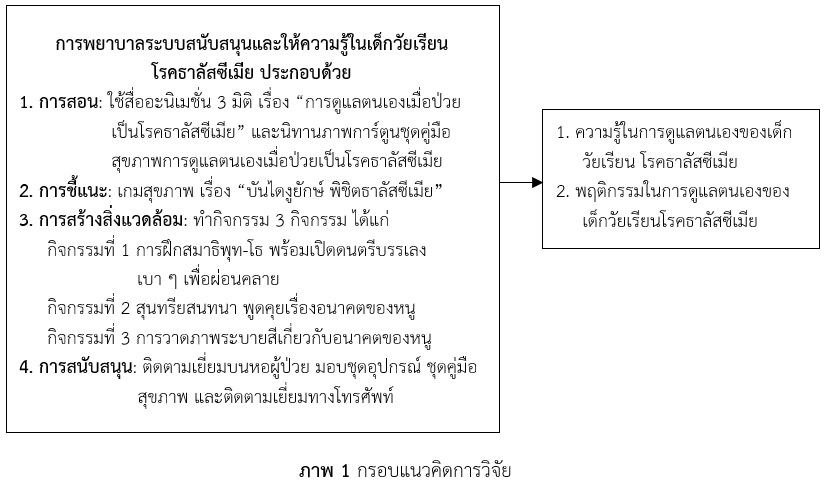
This quasi-experimental research was a one-group pretest-posttest design. The samples were school-aged children who had been diagnosed with thalassemia. They were admitted to the pediatric ward at a tertiary hospital in the northeast of Thailand. The sample consisting of 30 individuals were obtained using a purposive sampling. The tools used were a supporting system and formal education. The tools used in the study was a questionnaire on interview forms about knowledge and self-care behavior of school-age children with Thalassemia. The quality of instruments for content validity was examined by 5 experts. While the reliabilities of the interview form about Knowledge of self-care of school-aged with Thalassemia were determined by Kuder Richardson KR-20 formula obtained the reliability of 0.84. The interview form about the self-care behavior of school-age children with Thalassemia was determined for the reliability coefficient, using Cronbach’s Alpha Coefficient at 0.93. The data were analyzed by descriptive statistics. The mean difference score of knowledge and self-care behavior of school-age children with Thalassemia was compared using paired t-test.
The result of the study after experimentation were as followed: The post-experimental average score of knowledge of self-care school-age children with Thalassemia was at a higher level than before the experiment at 0.01 significance level. The post-experimental average score of self-care behavior of school-age children with Thalassemia was at a higher level than before the experiment at 0.01 significance level. This research is a guideline for creating a program to develop a self-care ability of school-aged children and other children who are ill with thalassemia. To take care of oneself when in the future illness
References
Kasonbua, P., Nabkasorn, C., & Hengudomsub, P. (2014). Effect of Humor Media Program on Fear of School-Age Children Receiving Intravenous Infusion. The Journal of Faculty of Nursing Burapha University, 24(2), 61-72. (in Thai)
Khumnonghee, P. (2014). The Effects of Cartoon Animation and Cartoon Story Book on Self Care Behavior in School Age with Thalassemia. [Thesis]. Khon Kaen: Khon Kaen University. (in Thai)
Mapoloon, P., Rutchangul, P., & Muensa, W. (2016). Impact of a Self-Care Development Programme for School-Age Thalassemic Children and Their Caregivers’ Ability on the Children’s Self-Care Behaviour. Thai Journal of Nursing Council, 31(2), 52-68. (in Thai)
Medical Records and Statistics Unit, Siriraj Hospital. (2018). Statistic of Children with Thalassemia in Department of Hematology and Oncology. Bangkok: Siriraj Hospital. (in Thai)
Mukrod, S. (2008). Effectof Supportive Nursing System on Maternal Care Behavior and Selfcare Behaviorsof School Age Children with Thalassemia [Master’s Thesis]. Bangkok: Chulalongkorn University (in Thai)
Ngokwong, C., & Tangvoraphonkchai, J. (2009). The Effect of Learning Program Through a Group Process and Cartoon Storybook on Self Care Behavior in School Age Children with Thalassemia. Nursing Science and Health, 32(3), 39-46. (in Thai)
Orem, D. E. (2001). Nursing: Concept of Practice. (6thed). St Louis: Mosby Year Book.
Phuphaibul, R., Kerddonfeg, P., Areeyanuchitkul, S., & Chantarachote, J. (2014). Comparison of the Effects of Life Skills Training Programs Using Cartoon Books and Using Animation Movie on Life Skills of School-Agers. Rama Nursing Journal, 20(2), 71-87. (in Thai)
Phuphaibul, R., Kerddonfeg, P., Areeyanuchitkul, S., & Chantarachote, J. (2014). Comparison of the Effects of Life Skills Training Programs Using Cartoon Books and Using Animation Movies on Life Skills of School-Agers. Rama Nursing Journal, 20(2), 271-87. (in Thai)
Prabmeechai, S., & Rueangworaboon, S. (2017). The Effect of Animation Media on Knowledge and Self-Care Behavior of School-Age Children with Thalassemia. Nursing Journal of The Ministry of Public Health, 27(2), 96-109. (in Thai)
Sirithai N. (2011). Effectof Animationon Knowledge and Self Care Behaviorof Caregiver for Pre-School Asthmatic Children [Master’s Thesis]. Khon Kaen: Khon Kaen University. (in Thai)
Sitthikhungaew, M., Chintanadilok, N., Sangperm, P., & Au-Yeong, P. A. (2012). Relationship Between Perceived Stressors and Depressive Symptoms in Adolescents with Thalassemia. J. Nursing Sciences-Faculty of Nursing: Mahidol University, 30(3), 25-35. (in Thai)
Srichantaranit, A., Chungsomprasong, P., Vijarnsorn, C., Sukthongsa, W., Nuanchan Udomponglukana, N., & Jaturachaidech, C. (2014). Comparing the Effects of Teaching with VCD and Teaching with Flipchart on Knowledge and Anxiety of Mothers in Caring for Children Undergoing Cardiac Catheterization. J. Nursing Science, 32(2), 41-51. (in Thai)
Torcharus, K. (2012). Diagnosis of Thalassemia. Royal Thai Army Medical Journal, 65(2), 127-132. (in Thai)
Wonkompa, S., kayapart, S., & Arreerard, W. (2012). A Development of 2D Animation Cartoon on Overweight Children Problem Campaign. J. Science and Technology Mahasarakham University, 31(2), 155-63. (in Thai)
Downloads
Published
Issue
Section
License
1. บทความหรือข้อคิดเห็นใด ๆ ที่ปรากฏในวารสารเครือข่าย วิทยาลัยพยาบาลและการสาธารณสุขภาคใต้ ที่เป็นวรรณกรรมของผู้เขียน บรรณาธิการหรือเครือข่ายวิทยาลัยพยาบาลและวิทยาลัยการสาธารณสุขภาคใต้ ไม่จำเป็นต้องเห็นด้วย
2. บทความที่ได้รับการตีพิมพ์ถือเป็นลิขสิทธิ์ของ วารสารเครือข่ายวิทยาลัยพยาบาลและการสาธารณสุขภาคใต้