Relationship Between Knowledge and Attitude, and Pain Management of Nurses in Pediatric Intensive Care Units, Southern Part of Thailand
Keywords:
Knowledge, Attitudes, Pain Management, Pediatric Intensive Care Units, Pediatric Intensive Care Units, Southern ThailandAbstract
This correlational research aimed to study the relationships between knowledge and attitude, and pain management of nurses into Pediatric Intensive Care Units (PICU) in Southern Thailand. Sample was 88 nurses working in PICU. Purposive sampling was applied. Data were collected using a questionnaire, which had three parts: 1) demographic data, 2) knowledge and attitude, and 3) pain management. Reliability of the questionnaire for the knowledge part was tested using Kuder Richardson method (KR-20), yielding a value of .81. Reliability of questionnaire for attitude and pain management was tested using Cronbach’s alpha coefficient, yielding values of 0.86 and 0.79, respectively. Data were analyzed using mean, standard deviation, and Pearson’s product moment correlation. And results showed the following.
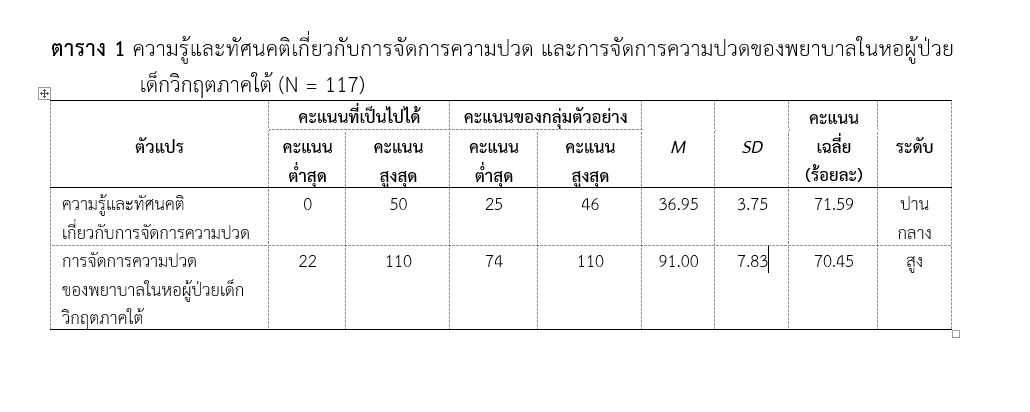
1. Mean score of knowledge and attitude regarding pain management among nurses in Southern PICU was at a moderate level (M=36.95, SD=3.75).
2. Mean score of pain management among nurses in in Southern PICU was at a high level (M=91.00, SD=7.83).
3. Knowledge and attitudes did not correlate with pain management (r = .058; p = .59) of nurses in Southern Pediatric Intensive Care Units.
Therefore, our findings suggest that training should be provided for nurses working in Southern Pediatric Intensive Care Units, in order to increase their knowledge, especially the knowledge about pain assessment and pain relief, using pharmacological and non-pharmacological therapy.
References
Chen, Y. Y., Chi, N. H., & Lai, Y.H. (2011). The Chinese Behavior Pain Scale for Critically Ill Patients: Translation and Psychometric Testing. Intermational Journal of Nursing Studies, 48, 438-448.
Chollada, T., Panuwat, P., & Chomnad, W. (2016). Multicultural Nursing: Competencies Necessary for Future Thai Nurses. Research Journal Health Sciences, 10(1), 8-15.
Czarnecki, M. L., Simon, K., Thompson, J. J., Armus, C. L., Hanson, T. C, Berg, K. A., et al. (2011). Barriers to Pediatric Pain Management: A Nursing Perspective. Pain Management Nurse, 12(3), 54-62.
Derond, M. E. J., Campen, B. M., & Klievink, R. M. A. (2000). A Pain Monitoring Program for Nurses: Effects on Nurses, Pain Knowledge and Attitude. Journal of Pain and Symptom Management, 19(6), 457-465.
Fowler, L., & Marmo, S. (2010). Pain Assessment Tool in the Critically III Post Open Heart Surgery Patient Population. The American Society of Pain Management Nursing, 11(3), 134-140.
Hossain, S. (2010). Nurses’ Knowledge and Attitudes, and Pain Management Practice of Post-Operative Children in Bangladesh. Master of Nursing Science Prince of Songkla University, Songkla.
Jantaveemuang, W., & Thongmeekhwan, T. (2016). Nursing Students and Spiritual Health. The Southern College Network Journal of Nursing and Public Health, 3(3), 208-219. (in Thai)
Johansson, M., & Eva, K., (2009). The COMFORT Behavioral Scale and the Modified FLACC Scale in Paediatric Intensive Care. Nursing in Critical Care, 14(3), 122–130.
Jonphajong, P., Ratchanee, U., & Wongchan, P. (2003). Research Report of Knowledge and Attitude of Nurses about Pain and Pain Management. Alumni Association the Thai Red Cross College of Nursing.
Kannika, R., Phaibun, S., & Suchart, S. (2014). Satisfaction in Practice of Nurses from Professional Nursing Production Projects to Resolve in Provincial Areas Southern. Journal of the Ministry of Public Health, 24(1), 15-20.
Katakorn, P., Autchareeya, P., & Renu, P. (2018). Nurses’ Knowledge, Attitude, and Nursing Practices for Pain Management for Postoperative Children. Ramathibodi Nursing Journal, 24(1), 37-50.
Launiala, A. (2009). How Much Can a KAP Survey Tell Us about People’s Knowledge, Attitudes and Practices? Some Observations from Medical Anthropology Research on Malaria inPregnancy in Malawi. Anthropology Matters Journal, 11, 1-13.
Mathew, P. J. (2011). Knowledge Attitude and Practice of Pediatric Critical Care Nurses Towards Pain: Survey in a Developing Country Setting. Journal of Postgraduate Medicine, 57(3), 196-200.
Monitto, C. L., & Kost-Byerly, S. (2011). The Optimal Dose of Prophylactic Intravenous Naloxone in Ameliorating Opioidinduced Side Effects in Children Receiving Intravenous Patient-Controlled Analgesia Morphine for Moderate to Severe Pain: a Dose Finding Study. Anesth Analg, 113(4), 34-42.
Narayan, M. C. (2010). Culture’s Effects on Pain Assessment and Management. Journal Am Nurse, 110(4), 38-47.
Petovello, K. (2012). Pediatric Procedural Pain Management a Review. International Journal of Child, 3(4), 10-29.
Phanarat, R., Wimolrat, S, Malinee, W., Fangam, C., Sutanee, S., Sasiwimol, C., et al. (2016). Suspension Quality Assessment Pain Chronic Pain Patients in Srinagarind Hospital. Journal of Srinakarin, 31(2), 151-158.
Polit, D. F., & Beck, C. T. (2008). Nursing Research: Generating and Assessing Evidence for Nursing Practice. (8th ed.). New York: Lippincott Williams & Wilkins.
Srisuda, N., Rungnapa, K., & Orphan, B. (2014). Knowledge and Attitude about Assessment and Pain Management of Professional Nurses Who Have Just Graduated. Journal of Phrapokklao Nursing College, 25(2), 65-72.
Suprana, B. (2010). Knowledge and Attitudes of Nurse and their Practices Regardind Post-Operative Children in Bangladesh. Master of Nursing Science Prince of Songkla University, Songkla.
Thai Association for the Study of Pain. (2018). Guidelines for the Development of Pain Management Acute in Children. Bangkok: Noppachai Printing.
Twycross A. (2010). Managing Pain in Children: Where to from Here?. Journal Clinical Nursing, 19, (15-16).
Vincent, C. V. H. (2010). Nurses’ Knowledge, Attitudes, and Practices Regarding Children’s Pain. Journal of Maternal and Child Nursing, 30, 177-183.
Vincent, C. V. H., & Denyes, M. J. (2004). Relieving Children’s Pain: Nurses’ Abilities and Analgesic Administration Practices. Journal of Pediatric Nursing, 19, 40-50.
Wantanee, W. (2018). Nursing Pain Management in Pediatric Have Surgery and are Restricted to Communication with Endotracheal Tubes. Bangkok: Sahamit Phatthanakan.
Warangkhana, A. (2013). Effectiveness of the Use of Clinical Practice Guidelines for Pain Management in Critically ill Patient Surgery Chiang Rai Hospital. Graduate School, Mae Fah Luang University, Chiang Rai. (in Thai).
Wilai, T. (2012). Operational Handbook for Assessment and Pain Management in Critical Pediatric. Nursing Service Department Songkhla Nakarin Hospital. Reproduce.
Downloads
Published
Issue
Section
License
1. บทความหรือข้อคิดเห็นใด ๆ ที่ปรากฏในวารสารเครือข่าย วิทยาลัยพยาบาลและการสาธารณสุขภาคใต้ ที่เป็นวรรณกรรมของผู้เขียน บรรณาธิการหรือเครือข่ายวิทยาลัยพยาบาลและวิทยาลัยการสาธารณสุขภาคใต้ ไม่จำเป็นต้องเห็นด้วย
2. บทความที่ได้รับการตีพิมพ์ถือเป็นลิขสิทธิ์ของ วารสารเครือข่ายวิทยาลัยพยาบาลและการสาธารณสุขภาคใต้