Homebound Older Adults Health Promoting Behaviors and Related Factors in a Muslim Cultural Context: A Case Study in Yala Province
Keywords:
Health Promoting Behaviors, Homebound Elderly, MuslimAbstract
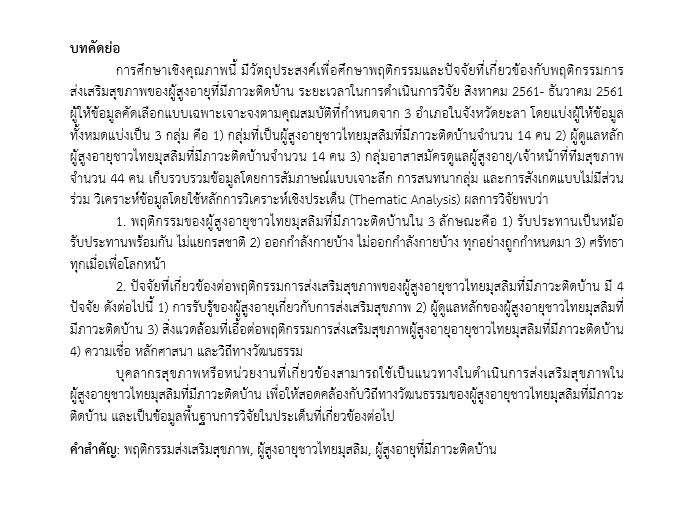
This qualitative study aimed to study health promoting behaviors, and factors related to health promotion behaviors among homebound older adults in a Muslim cultural context. Participants were selected from 3 districts of Yala province, using purposive sampling. They were divided into 3 groups: 1) fourteen (14) Muslim older adults with homebound condition, 2) the primary caregivers of those elderly, 3) forty-four (44) volunteers /health personnel. Data were collected by in-depth interviews, focus group discussion, and observation without participation in the period between August 2018 and December 2018. Data were analyzed using thematic analysis.
Results suggest that health behaviors among Muslim older adults with homebound condition included: 1) eating the same food (same taste) as their relatives, 2) lack of regular exercise, as well as life was destined by God, and 3) belief in the next world. Factor related to the health promoting behaviors of the elderly were: 1) perception about health promotion, 2) the primary caregivers, 3) supportive environment to health promoting behaviors, 4) beliefs, religion, and culture.
Health personnel or related agencies should use the research findings to promote health among homebound older adults in accordance with Muslim cultural context.
References
Amirzadeh Iranagh, J., Abdul-Rahman, H., & Ameneh-Motalebi, S. (2016). Health Blief Model-Based Intervention to Improve Nutritional Behavior among Elderly Women. Nutr Res Pract, 10(3), 352-358.
Chayovan, N. (2015). Vulnerable Elderly in Thailand. Journal of Demography, 21, 1-23. (in Thai)
Gray, R., & Thapsuwan, S. (2014). Factors Affecting on Stress of Caregivers to Older Persons. Songklanakarin Journal of Social Sciences and Humanities, 20(1), 203-224.
Healthy Aging and the Environment: A Pocket Guide. (2019). A Project of the Collaborative on Health and the Environment (CHE). Retrieved January 20, 2019. From www.healthan denvironment.org.
Je Arong, A. (2019). World Barsak. Retrieved January 20, 2019. From http://openaccess. hacettepe.edu.tr:8080/xmlui/bitstream/handle/11655/677/db7c0e92-db07-4ad8-84c1-4a22f00bb3bc.pdf?sequence=1
Komjakraphan, P. (2013). Family and Health Promoting Behavior of the Elders. Songklanakarin Journal of Social Sciences and Humanities, 19(3), 231-253. (in Thai)
Kongwattana, S. (2007). Heath Status Factors of the Elderly in Changwat Pattani: Case Study of Tambon Piyamumung, Amphoe Yaring, Changwat Pattani. Prince of Songkla University, Pattani Campus.
Koonnarong, O., Thaniwatananont, P., & Kitrungrote, L. (2012). Caregiving Preparedness, Family Relationships and Role Strain among Caregivers of Muslim Stroke Patients. Princcss of Naradhiwas University Journal, 4(1), 14-27. (in Thai)
Lillahkul, N., & Supanakul, P. (2018). Way of Life of Muslim People in Thailand’s Southern Provinces, and Health Promoting Lifestyle. The Southern College Network Journal of Nursing and Public Health, 5(2), 302-312. (in Thai)
Ministry of Social Development and Human Security. (2016). ASEAN Elderly Population. Retrieved October 22, 2017, from https://www.msociety.go.th/article_attach/ 17404/19808.pdf.
Nawnpenyai, P. (2018). HR Update: Million Generation Population. OCSC E-Journal, 60(4), 2-4.
Nima, Y., & Hasuwannakit, S (2008). Medical and Patient Care That is Consistent with the Muslim way. Songkla: Health Systems Research Institute.
Niyo, M. (2006). Muslim Lifestyle. Bangkok: In Institute of Islamic Studies.
Pattaradech, C. (2016). Predictors of Exercise Behavior among Older Adults in Songkhla Province. The Southern College Network Journal of Nursing and Public Health, 3(2), 17-38. (in Thai)
Pender, N. J., Murdaugh, C. L., & Parson, M. A. (2006). Health Promotion in Nursing Practice. 4th ed. Upper Saddle River, N.J.: Prentia Hall.
Phalasuek, R., & Thanomchayathawatch, B. (2017). A Family Model for Older People Care. The Southern College Network Journal of Nursing and Public Health, 4(3), 135-150. (in Thai)
Prachuamoh, W. (2014). Health Promotion and International Year on the Elderly in 1999. Retrieved October 22, 2017, from new-release/detail/5535.
Prakobchan, S., Srimanta, S., Boonsu S., & Maleelai, K. (n.d.). Factors Related to Health Promotion Behaviors Among Elderly in Tambon That, Warinchumrab District, Ubon Ratchathani Province. The 12th Mahasarakham University Research Conference, 543-552. (in Thai)
Prathumsin, W., Wanprasert, C., Piemmongkol, S., Jitphusa, M., & Tongtha, P. (1986). Food Habits of Population in Southern Thailand. Prince of Songkla University, Pattani Campus. Retrieved Febuary 22, 2019. From https://soreda.oas.psu.ac.th/ showdetail.php? research_id=128
Sihapark, S., Chuengsatiansup, K., & Tengrang, K. (2013). Research Report the Impact and Burden of Long-Term Care for the Elderly Under Thai Culture. Retrieved January 5, 2017. from https://www.hsri.or.th/researcher/research/. (in Thai)
Skulpunyawat, S. (2014). Health Promotion Behaviors of Muslim Elders in case of Okarak District Nakornnayork Province. Journal of The Royal Thai Army Nurses, 15(3), 353-360.
Tawa, N., & Chaiwisit, P. (2016). The Environmental Management and Housing for the Elderly in Muang District, Nakhon Si Thammarat. Apheit Journals, 5(1), 31-39. (in Thai)
Thammikbawon, S. (n.d.). The Theory of Health Promotion of Panders. Retrieved October 22, 2017 From http://www.nurse.ubu.ac.th/sub/knowledgedetail/PD.pdf.
Thanakwang, K, Kespichayawattana, J., & Jitpanya, C. (2010). Factors Related to Health Promoting Behaviors Among Older Adults: A Meta-Analysis. Journal of Nursing Science, 28(3), 60-68. (in Thai)
Vanaleesin, S., & Mamah, P. (2015). Self-Care of Nurse Based on Islamic Scripture. Thai Journal Online, 29(2), 1-11. (in Thai)
World Health Organization. (2017). Aging USA. Retrieved November 10, 2016 from http://www.who.int/topics/ageing/en/.
Yeerae, N. (2010). Promoting Islamic Exercise In Pattani Housewives Group. Master of Science Health System Research and Development. Prine of Songkla University. (in Thai)
Yosef, A. (2008). Health Beliefs, Practice, and Priorities for Health Care of Arab Muslims in the United States: Implications for Nursing Care. Journal of Transcultural Nursing, 19(3), 284-291.
Downloads
Published
Issue
Section
License
1. บทความหรือข้อคิดเห็นใด ๆ ที่ปรากฏในวารสารเครือข่าย วิทยาลัยพยาบาลและการสาธารณสุขภาคใต้ ที่เป็นวรรณกรรมของผู้เขียน บรรณาธิการหรือเครือข่ายวิทยาลัยพยาบาลและวิทยาลัยการสาธารณสุขภาคใต้ ไม่จำเป็นต้องเห็นด้วย
2. บทความที่ได้รับการตีพิมพ์ถือเป็นลิขสิทธิ์ของ วารสารเครือข่ายวิทยาลัยพยาบาลและการสาธารณสุขภาคใต้