
The 3Cs Model: A New Model of Nursing Care for Pregnant Women
Keywords:
Health guidance for pregnant women, Health literacy, 3Cs Model, Digital health coach, CyberchondriaAbstract
The digital era enables pregnant women to access health information rapidly but exposes them to information overload. Meanwhile, the traditional nursing model, functioning merely as a one-way "educator" and lacking personalized feedback, cannot effectively manage this issue. Consequently, pregnant women experience anxiety, lack health literacy in the dimension of information evaluation, and make inaccurate health decisions.
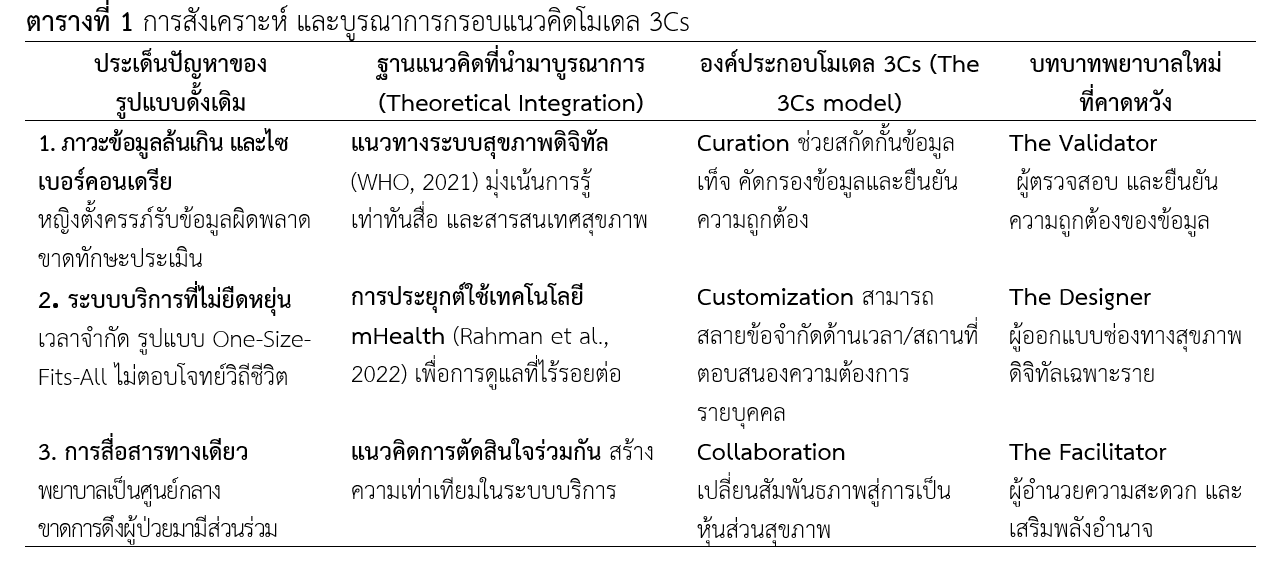
This article aims to analyze the impact of the "Cyberchondria" phenomenon–defined as heightened health anxiety resulting from excessive internet searching–on the anxiety and health behaviors of pregnant women. This highlights the urgent need to transition the nursing role to a "Digital Health Coach" by utilizing the 3Cs Model. Synthesized by the researcher from relevant knowledge, the model comprises: 1) Curation (smart information screening), 2) Customization (flexible and personalized services), and 3) Collaboration (health partnerships building). Implementing this model in health guidance services helps alleviate anxiety and enhance health literacy, ultimately leading to safety and a better quality of life for both the pregnant women and their fetuses.
References
งามเอก ลำมะนา, ชะไมพร ธรรมวาสี, และจารุณี เทียบโพธิ์. (2565). การดูแลวิถีใหม่ (New Normal) สำหรับหญิงตั้งครรภ์ในวิกฤติการแพร่ระบาดของเชื้อไวรัสโควิด-19. วารสารพยาบาลศาสตร์ มหาวิทยาลัยสยาม, 23(45), 112-125.
พิชาภรณ์ จันทนกุล, สมฤดี ชื่นกิติญานนท์, สุกฤตา ตะการีย์, และศิริพร สามสี. (2565). ปัจจัยที่เกี่ยวข้องกับการตั้งครรภ์ที่ไม่พึงประสงค์ของสตรีวัยรุ่นที่มาฝากครรภ์ โรงพยาบาลกระทุ่มแบน จ.สมุทรสาคร. วารสารพยาบาลศาสตร์ มหาวิทยาลัยสยาม, 22(43), 62-76.
รัตนาภรณ์ ธนศิริจิรานนท์, รัชนีกร สันติธรรม, ดลลักษณ์ โรจน์นวเสรี, มินตรา อุทัยรังษี, และนันทวดี วงค์บุตร. (2568). ประสิทธิผลของการใช้แอพพลิเคชันไลน์ต่อความรู้ ทัศนคติ และการปฏิบัติของหญิงตั้งครรภ์ครรภ์แรกในการป้องกันอุบัติเหตุระหว่างตั้งครรภ์. วารสารพยาบาลและสุขภาพ สสอท, 7(1), e3682.
อรวรรณ พึ่งประสพ และสุกฤตา ตะการีย์. (2567). ผลลัพธ์การใช้นวัตกรรมคู่มือยุคใหม่ ใส่ใจคุณแม่หัวใจ New normal ห้องคลอดโรงพยาบาลสามพราน. วารสารพยาบาลศาสตร์ มหาวิทยาลัยสยาม, 25(48), 69–79.
Fryer, K., Delgado, A., Foti, T., Reid, C. N., & Marshall, J. (2020). Implementation of obstetric telehealth during COVID-19 and beyond. Maternal and Child Health Journal, 24(9), 1104–1110. https://doi.org/10.1007/s10995-020-02967-7
Mishra, M., Parida, D., Murmu, J., Singh, D., Rehman, T., Kshatri, J. S., & Pati, S. (2023). Effectiveness of mHealth interventions for monitoring antenatal care among pregnant women in low- and middle-income countries: A systematic review and meta-analysis. Healthcare, 11(19), 2635. https://doi.org/10.3390/healthcare11192635
Nawabi, F., Krebs, F., Vennedey, V., Johann, E., Burghardt, J., & Stock, S. (2021). Health literacy in pregnant women: A systematic review. International Journal of Environmental Research and Public Health, 18(7), 3847. https://doi.org/10.3390/ijerph18073847
Peahl, A. F., Smith, R. D., & Moniz, M. H. (2020). Prenatal care redesign: Creating flexible maternity care models through virtual care. American Journal of Obstetrics and Gynecology, 223(3), 389.e1-389.e10. https://doi.org/10.1016/j.ajog.2020.05.029
Rahman, M. O., Yamaji, N., Nagamatsu, Y., & Ota, E. (2022). Effects of mHealth interventions on improving antenatal care visits and skilled delivery care in low- and middle-income countries: Systematic review and meta-analysis. Journal of Medical Internet Research, 24(4), e34061. https://doi.org/10.2196/34061
Şatır, D. G., & Bakır, S. (2024). The relationship between cyberchondria and health anxiety in pregnant women. Journal of Consumer Health on the Internet, 28(2), 1-13. https://doi.org/10.1080/15398285.2024.2355608
Šoštarić, M., Mikac, U., & Jokić-Begić, N. (2023). Understanding cyberchondria in pregnant women: Longitudinal assessment of risk factors, triggers, and outcomes. Journal of Psychosomatic Obstetrics & Gynecology, 44(1), 2265050. https://doi.org/10.1080/0167482X. .2265050
World Health Organization. (2021). Digital interventions for health system strengthening. World Health Organization. https://www.who.int/publications/i/item/9789240026214
Downloads
Published
How to Cite
Issue
Section
License
Copyright (c) 2026 Journal of Nursing, Siam University

This work is licensed under a Creative Commons Attribution-NonCommercial-NoDerivatives 4.0 International License.
Content and information published in the Journal of Nursing, Siam University is the comment and responsibility of the authors.
Articles, information, images, etc. published in the Journal of Nursing. Siam University is the copyright of the Journal of Nursing, Siam University. If any person or entity wants to take all or part of it for publication for any purposes, please reference the Journal of Nursing, Siam University.

