
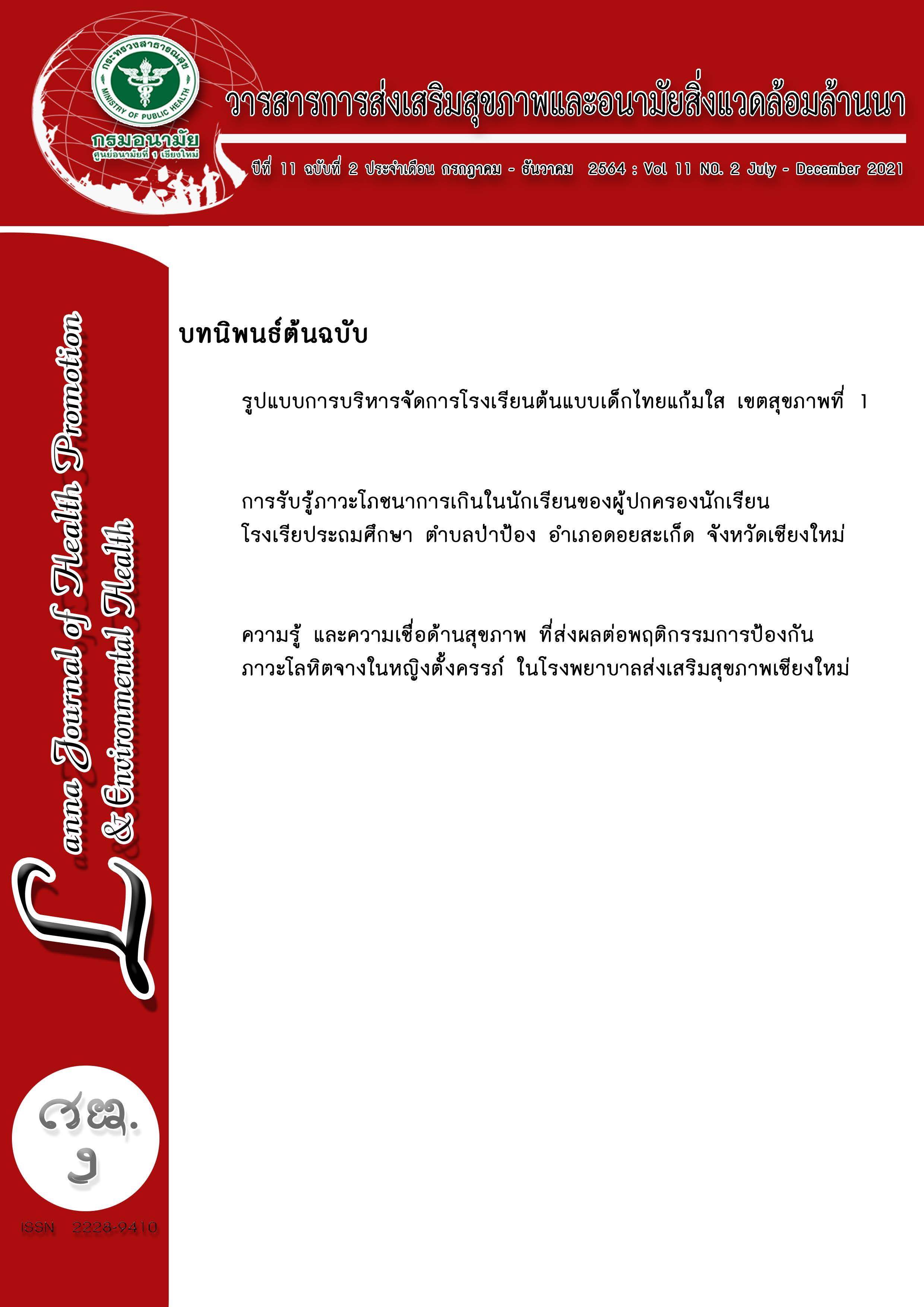
Parental Perception of Over-nutrition Among Students in Primary Schools, Pa Pong Subdistrict, Doi Saket District, Chiang Mai Province
Keywords:
Over-nutrition, Students' Parents, Students, Primary School, Over-nutrition, Students' Parents, Students, Primary SchoolAbstract
This study was a cross-sectional study that posed an objective to study the perception of overnutrition among students of parents of grade 1 to 6 students at Ban Pa Pong School and Ban Pa Mai Daeng School, Pa Pong Subdistrict, Doi Saket District. Chiang Mai, semester 2, academic year 2020, totaling 191 students. Questionnaires were a tool created from a literature review to study the degree of perception of overnutrition in students' parents, consisting of two parts: perception of physical signals; and perception of environmental/behavioral signals. The data were analyzed by frequency distribution, percentage, mean, standard deviation, and Chi-square statistics that were used to find correlation.
The results showed that most of the students' parents who took the questionnaire were female, aged between 31 – 40 years. Most of them did not go to school and were engaged in employment. The family had a monthly income of 5,001 – 10,000 baht. Family characteristics were mostly single families. Most of the students in their parents were female, aged between 10-12 years old, and most of their nutritional status was normal.
The cognition study found that the majority of parents and students had a low level of visual perception including physical signal perception and environmental/behavior signal perception at a low level. The study compared parents' personal factors with perceived levels of overnutrition among students' students by gender, age range, educational level, occupation, and congenital disease. It was found that gender, age, occupation and comorbid factors of the students' parents found no difference in the level of perceived overnutrition among the students. As for the difference in parents' educational level factor, it was found that there were different in perception of overnutrition among students with statistically significant at the 0.05 level. In addition to a comparative study of information on the level of perception of overnutrition among students of parents of students with normal nutrition with the level of awareness of overnutrition among students of parents of students with overnutrition, it found no difference. The results of this study can be used in educational planning and building an understanding of the promotion of nutritional status and healthy food consumption among students, as well as to increase participation in nutrition among parent’s students with overnutrition.
References
2. González-Álvarez, M. A., Lázaro-Alquézar, A., & Simón-Fernández, M. B.. Global Trends in Child Obesity: Are Figures Converging?. International Journal of Environmental Research and Public Health.2020;17(24).
3. World Health Organization[Internet]. Obesity and overweight; 2020 [cited 2020 Apr 18]. Retrieved from: https://www.who.int/en/news-room/fact-sheets/detail/obesity-and-overweight
4. Wungrath J. Obesity among Preschool-aged Children in Thailand. Journal of Public Health. 2018;48(3):356-70.
5. สำนักงานกองทุนสนับสนุนการส่งเสริมสุขภาพ[อินเตอร์เน๊ต]. องค์การอนามัยโลกแนะเร่งแก้ปัญหาโรคอ้วนในเด็ก; 2563 [เข้าถึงเมื่อ 20 ตุลาคม 2563]. เข้าถึงได้จาก: https://is.gd/JEUUlf
6. Sabharwal S, Root M. Impact of Obesity on Orthopaedics. The Journal of bone and joint surgery American volume. 2012;94:1045-52.
7. สำนักโภชนาการ กรมอนามัย กระทรวงสาธารณสุข. แนวทางการควบคุมป้องกันภาวะอ้วนในเด็กนักเรียน. กรุงเทพฯ: สำนักงานกิจการโรงพิมพ์องค์การสงเคราะห์ทหารผ่านศึก; 2557.
8. กัลยานณี โนอินทร์. ภาวะน้ำหนักเกินและโรคอ้วนในวัยเรียนและวัยรุ่นไทย. วารสารพยาบาลทหารบก 2560;18(2):1-8.
9. สำนักงานปลัดกระทรวงสาธารณสุข. ระบบรายงานโรงพยาบาลส่งเสริมสุขภาพตำบลและศูนย์สุขภาพชุมชน(JHCIS). [โปรแกรมคอมพิวเตอร์]. นนทบุรี: ศูนย์เทคโนโลยีสารสนเทศและการสื่อสารสื่อสาร สำนักงานปลัดกระทรวงสาธารณสุข; 2562.
10. Fazio, R. H., Olson, J. M., Zanna, M. P., & Herman, C. P.. Self-perception theory: A current perspective. In Social Influency: The Ontario Symposium 1987; 5:129-5.
11. Bem, D. J. (1972). Self-perception theory. In Advances in experimental social psychology 1972;6:1-62.
12. สารภี จันทร์มุณ, และสุชาดา นวนทอง. ปัจจัยที่มีความสัมพันธ์กับภาวะโภชนาการเกิน ของเด็กนักเรียนชั้นประถมศึกษา ปีที่ 5 และ 6 ในอำเภอป่าบอน จังหวัดพัทลุง; 2560.
13. สุกัญญา บัวศรี, กมลทิพย์ ทิพย์สังวาล, และอนงค์ สุนทรานนท์. ภาวะโภชนาการและกิจกรรมทางกายของนักเรียนอายุ 6-12 ปี จังหวัดเชียงราย. วารสาร มจร นครน่านปริทรรศน์ 2562;3(2):81-94.
14. Aljunaibi, A., Abdulle, A., & Nagelkerke, N. Parental weight perceptions: a cause for concern in the prevention and management of childhood obesity in the United Arab Emirates 2013;8(3):e59923.
15. Aparajita Dasgupta, Aritra Bhattacharyya, Bobby Paul, Lina Bandyopadhayay. Influencers of childhood Over-nutrition: a cross sectional study among primary school children in Kolkata, International Journal of Contemporary Pediatrics 2017;4(4):1434-1438.
Downloads
Published
How to Cite
Issue
Section
License
Copyright (c) 2022 Lanna Journal of Health Promotion and Environmental Health

This work is licensed under a Creative Commons Attribution 4.0 International License.


