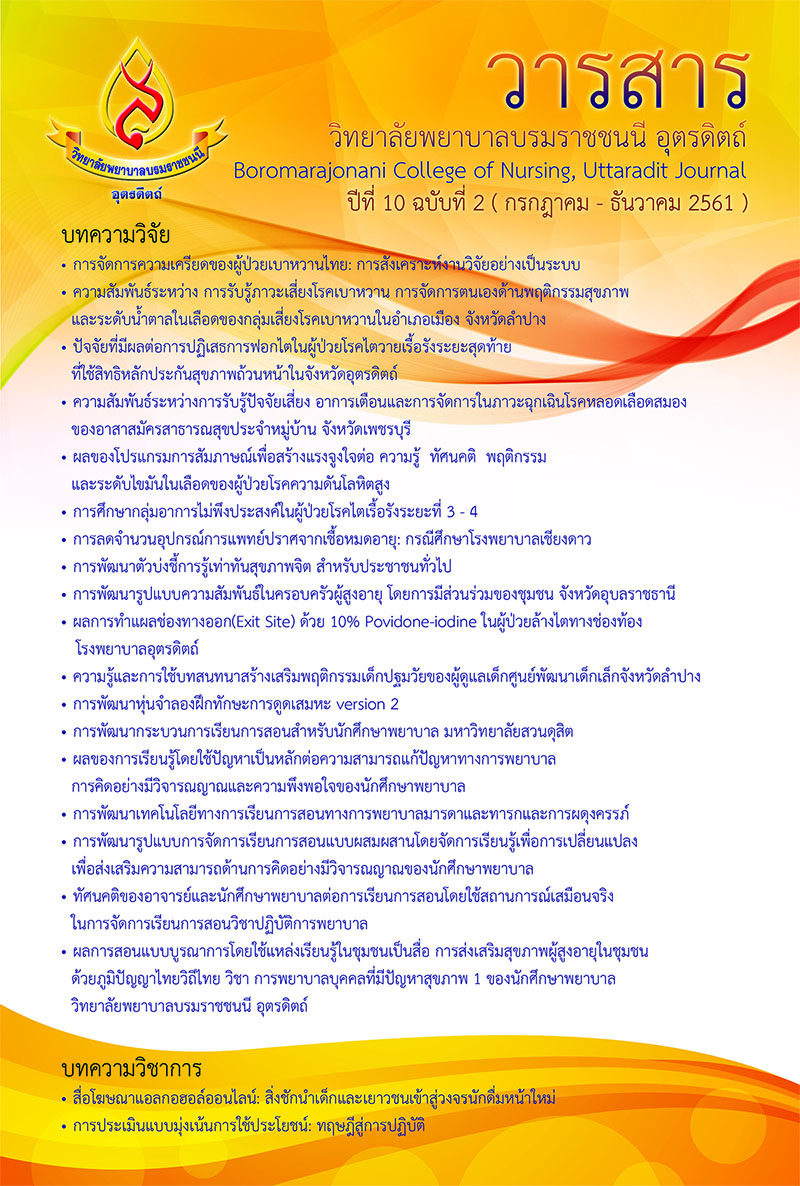
Factors Affecting Rejection of Dialysis in End-Stage Renal Disease Patients Under Universal Health Coverage in Uttaradit Province
Article Sidebar
Main Article Content
Abstract
Rejection of dialysis has been a barrier to end-stage renal disease treatment. This study aims to identify factors affecting rejection of dialysis in patients under universal coverage scheme in Uttaradit province. This is a retrospective cross-sectional analytical study. Patient’s data were collected from outpatient medical records and screening forms for dialysis planning patients (stage 4-5 chronic kidney disease) at Uttaradit Hospital from October 2015 to September 2017. The factors were analyzed using univariable and multivariable logistic regression.
One hundred and thirty eight (40.12%) ESRD patients (out of 344 included patients) under universal health coverage scheme who received counseling by the multidisciplinary team during the study period reported dialysis rejection. Factors affecting the increase of dialysis rejection were age: over 65 years of age (AOR = 3.00; 95% CI; 1.67-5.39; p ≤.001) and glomerular filtration rate over 6 ml/min/1.73m2 (AOR = 1.72; 95% CI; 1.03 - 2.85; p ≤.037). Furthermore, having caregivers decreased rejection of dialysis had an AOR of 0.16 (95%CI; 0.07-0.38; p ≤.001).
Dialysis counseling should emphasize the patients and caregivers’ understanding. Caregivers should be educated and participate in the multidisciplinary team discussions in order to follow the treatment plan. Given that elderly patients are more likely to reject dialysis, the multidisciplinary team should have a well-organized palliative care system for this sub-set of patients.
Article Details
Journal of Nursing and Health Science Research attribution-non-commercial 4.0 international (CC BY-NC 4.0). For more detail please visit https://creativecommons.org/licenses/by-nc/4.0/ . The ideas and opinions expressed in the Journal of Nursing and Health Science Research are those of the authors and not necessarily those of the editor .
References
2. Chanouzas, D., Ng, K. P., Fallouh, B., & Baharani, J. (2012). What influences patient choice of treatment modality at the pre-dialysis stage? Nephrol Dial Transplant, 27(4), 1542-1547. doi:10.1093/ndt/gfr452
3. Chiang, P. C., Hou, J. J., Jong, I. C., Hung, P. H., Hsiao, C. Y., Ma, T. L., & Hsu, Y. H. (2016). Factors associated with the choice of peritoneal dialysis in patients with end-stage renal disease. BioMed Research International, 2016, 5314719. doi:10.1155/2016/5314719
4. Cruz, D. N., Troidle, L., Danguilan, R., Padilla, B., Frando, L., Sebastian, E., . . . Finkelstein, F. (2011). Factors influencing dialysis modality for end-stage renal disease in developing countries: a survey of Filipino nephrologists. Blood Purification, 32(2),117-123. doi:10.1159/000324396
5. Dahlerus, C., Quinn, M., Messersmith, E., Lachance, L., Subramanian, L., Perry, E., . . . Tentori, F. (2016). Patient perspectives on the choice of dialysis modality: Results from the empowering patients on choices for renal replacement therapy (EPOCH-RRT) study. American Journal of Kidney Diseases, 68(6), 901-910. doi:10.1053/j.ajkd.2016.05.010
6. Department of Medical Service, Ministry of Public Health.(2018, April 24). Inspection guildeline of Ministry of Public Health 2018. Retrieved form https://inspection.dms.moph.go.th/bmss/wp-content/uploads/2017/11/InspectionGuidelineSP%E0%B8%AA%E0%B8%B2%E0%B8%82%E0%B8%B2%E0%B9%84%E0%B8%95.pdf (in Thai)
7. Fung, E., Slesnick, N., Kurella Tamura, M., & Schiller, B. (2016). A survey of views and practice patterns of dialysis medical directors toward end - of - life decision making for patients with end-stage renal disease. Journal of Palliative Medicine , 30(7), 653-660. doi:10.1177/0269216315625856
8. Harwood, L., & Clark, A. M. (2014). Dialysis modality decision-making for older adults with chronic kidney disease. The Journal of Clinical Nursing, 23(23-24), 3378-3390. doi:10.1111/jocn.12582
9. Johnston, S., & Noble, H. (2012). Factors influencing patients with stage 5 chronic kidney disease to opt for conservative management: a practitioner research study. The Journal of Clinical Nursing, 21(9-10),1215-1222. doi:10.1111/j.1365-2702.2011.04001.x
10. Just, P. M., de Charro, F. T., Tschosik, E. A., Noe, L. L., Bhattacharyya, S. K., & Riella, M. C. (2008). Reimbursement and economic factors influencing dialysis modality choice around the world. Nephrology Dialysis transplantation, 23(7), 2365-2373. doi:10.1093/ndt/gfm939
11. Kantachuwetsiri, S., Janjarerntana, V., Chailimpamontri, V., Trakarnwanit, T., Chodsenee, P., Yusabuy, A., Kingwattanakun, P. (2016). Textbook of chronic kidney disease. Bangkok: Tex and journal publication. (in Thai)
12. Kwok, W.-H., Yong, S.-P., & Kwok, O.-L. (2016). Outcomes in elderly patients with end-stage renal disease: Comparison of renal replacement therapy and conservative management. Hong Kong Journal of Nephrology, 19, 42-56. doi:https://dx.doi.org/10.1016/j.hkjn.2016.04.002
13. Liebman, S. E., Bushinsky, D. A., Dolan, J. G., & Veazie, P. (2012). Differences between dialysis modality selection and initiation. American Journal of Kidney Diseases, 59(4), 550-557. doi:10.1053/j.ajkd.2011.11.040
14. Lo, W. K., Li, F. K., Choy, C. B., Cheng, S. W., Chu, W. L., Ng, S. Y., . . . Lui, S. L. (2001). A retrospective survey of attitudes toward acceptance of peritoneal dialysis in Chinese end-stage renal failure patients in Hong Kong--from a cultural point of view. Peritoneal Dialysis International, 21 Suppl 3, S318-321.
15. Mahajan, S., Tiwari, S. C., Kalra, V., Bhowmik, D. M., & Agarwal, S. K. (2004). Factors affecting the use of peritoneal dialysis among the ESRD population in India: a single-center study. Peritoneal Dialysis International, 24(6), 538-541.
16. Moist, L. M., & Al-Jaishi, A. A. (2016). Preparation of the dialysis access in stages 4 and 5 CKD. Advances in Chronic Kidney Disease, 23(4), 270-275. doi:10.1053/j.ackd.2016.04.001
17. Morton, R. L., Snelling, P., Webster, A. C., Rose, J., Masterson, R., Johnson, D. W., & Howard, K. (2012). Dialysis modality preference of patients with CKD and family caregivers: a discrete-choice study. Advances in Chronic Kidney Disease, 60(1), 102-111. doi:10.1053/j.ajkd.2011.12.030
18. Park, J. I., Kim, M., Kim, H., An, J. N., Lee, J., Yang, S. H., . . . Lee, J. P. (2015). Not early referral but planned dialysis improves quality of life and depression in newly diagnosed end stage renal disease patients: a prospective cohort study in Korea. PLoS One, 10(2), e0117582. doi:10.1371/journal.pone.0117582
19. Ziolkowski, S., & Liebman, S. (2016). A Qualitative Assessment of Mismatch Between Dialysis Modality Selection and Initiation. Peritoneal Dialysis International, 36(4), 463-466. doi:10.3747/pdi.2015.00047
