
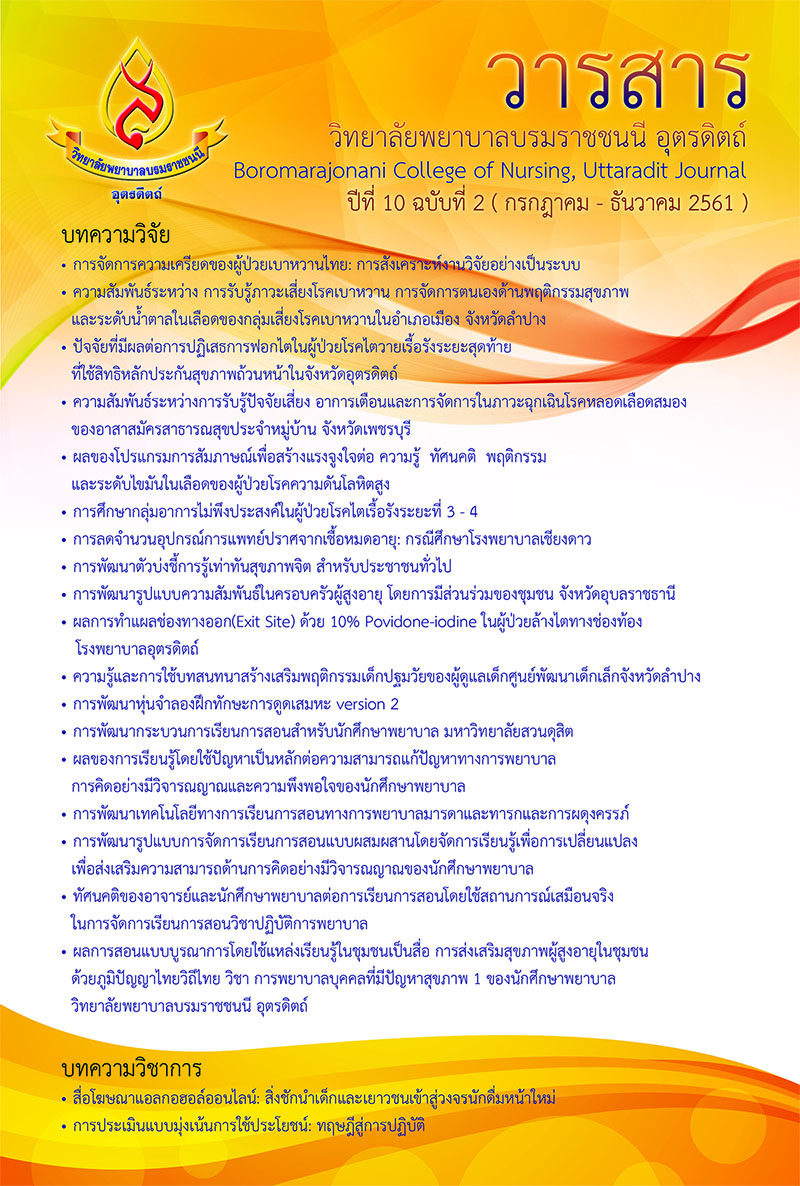
Relationship between Risk Perceptions, Health Behavior Self-management and Blood Sugar Level among Diabetic High Risk Population in Muang, Lampang Province
Article Sidebar
Main Article Content
Abstract
This descriptive correlation design aimed to study the relationship between risk perceptions, health behavior self-management and blood sugar level among diabetic high risk population in Muang, Lampang province. 380 samples were diabetic high risk who had blood sugar level 100 – 125 mg% using cluster random sampling method. The instruments consisted of personal information, risk perceptions and health behavior self-management questionnaires and record of blood sugar test. The IOC content validity were between .66 and 1. The reliability coefficients were .78 and .82. The data analysis using descriptive statistics: percentage, mean, standard deviation and Pearson’s coefficient for correlation. The results showed 1) health belief had a positive relationship with eating control behavior, exercise, and emotional management; 2) Perceived benefit was positively associated with exercise and emotional management; 3) Perceived barrier had a negative relationship with eating control behavior and emotional management. In contrast, perceived barrier was positively correlated to health risk behavior; and 4) Blood sugar level was negatively associated with perceived susceptibility, eating control behavior and exercise. The suggestion would be the development of promotion guideline for diabetic high risk population to maintain health behaviors by enhancing perceptions of susceptibility and benefits as well as an in-depth study to find out the barriers that effect on performing health behavior.
Article Details
Journal of Nursing and Health Science Research attribution-non-commercial 4.0 international (CC BY-NC 4.0). For more detail please visit https://creativecommons.org/licenses/by-nc/4.0/ . The ideas and opinions expressed in the Journal of Nursing and Health Science Research are those of the authors and not necessarily those of the editor .
References
2. Bunloet, A., Premgamone, A., & Kessomboon, P. (2018). Prevalence and associated factors of I-sarn syndrome among the diabetic patients and hypertensive patients in rural communities, public health region 7, Thailand. Srinagarind Medical Journal, 33(2), 122 – 128. (in Thai)
3. Chaimin, U. (2007). Health behavior of people at risk for diabetes and hypertension in Mueang District, Chiang Rai Province. (Master’s thesis, Chiang Mai University). (in Thai)
4. Diabetes Association of Thailand. (2016). World Diabetes Statistics. Retrieved from https://www.dmthai.org/statistic/1558. (in Thai)
5. Doungkaew, N. (2008). Health belief and preventive of risk group diabetes mellitus in Ko Kha District, Lumpang Province. Master’s thesis, Chiang Mai University, Chiang Mai, Thailand. (in Thai)
6. Jangwang S., Pittayapinune, T.,& Chutipattana, N. (2016). Factors related to self-care behavior for prevention of diabetes mellitus and hypertension among population groups atrisk. The Southern College Network Journal of Nursing and Public Health, 3(1), 110 - 128. (in Thai)
7. Lampang Provincial Health Office. (2016). Lampang Health Data Center. Retrieved from https://lpg.hdc.moph.go.th/hdc/reports/page.php?cat_id=6a1fdf282fd28180eed7d1cfe0155e11 (in Thai).
8. Stretcher, V., & Rosenstock, I. M. (1997). The Health belief model. In Glanz, K. Lewis, F, M., & Rimer. B. K., (Eds). Health Behavior and Health Education: Theory, Research and Practice. San Francisco: Josey-Bass.
9. Intarawichian, S. (2012). Changing health behavior by participate to sustainable, in the diabetes mellitus risk group, Kasetwisai district: Roi-et province. Khon Kaen Provincial Disease Control Office 6, 29(2), 65 – 75. (in Thai)
10. The International Diabetes Federation. (2017). IDF diabetes atlas 87 th edition: Key message. Retrieved from https://www.diabetesatlas.org/key-messages.html
11. World health Organization [WHO]. (2015). World Diabetes Day 2015. Retrieved from https://www.who.int/diabetes/wdd_2015/en/
12. Yamane, T. (1973). Statistic: An Introductory Analysis. 3rd Eds. New York: Harper & row
