Development of a Holistic Long-Term Care Model for Dependent Older Adults through Network Participation in Phayao Province
Keywords:
Dependent Older Adults, Holistic Care, Long-Term Care, Network ParticipationAbstract
This research and development study aimed to develop and evaluate a holistic long-term care model for dependent older adults through network participation in Phayao Province. The study was conducted in four phases. Phase 1 examined the situation, context, and long-term care needs of dependent older adults across nine districts, involving 400 participants. Phase 2 focused on model development through a participatory process involving 30 stakeholders. Phase 3 implemented the developed model using a one-group pretest-posttest design over a six-month period in nine pilot areas. Phase 4 evaluated and validated the model with 16 experts and relevant stakeholders. Quantitative data were analyzed using descriptive statistics and the paired t-test, while qualitative data were analyzed using content analysis. The findings revealed that:
1. Most dependent older adults received care from their families in collaboration with village health volunteers and primary care units. They expressed a need for holistic care encompassing physical, psychological, social, spiritual, and environmental dimensions, with the environmental dimension being the area of greatest need.
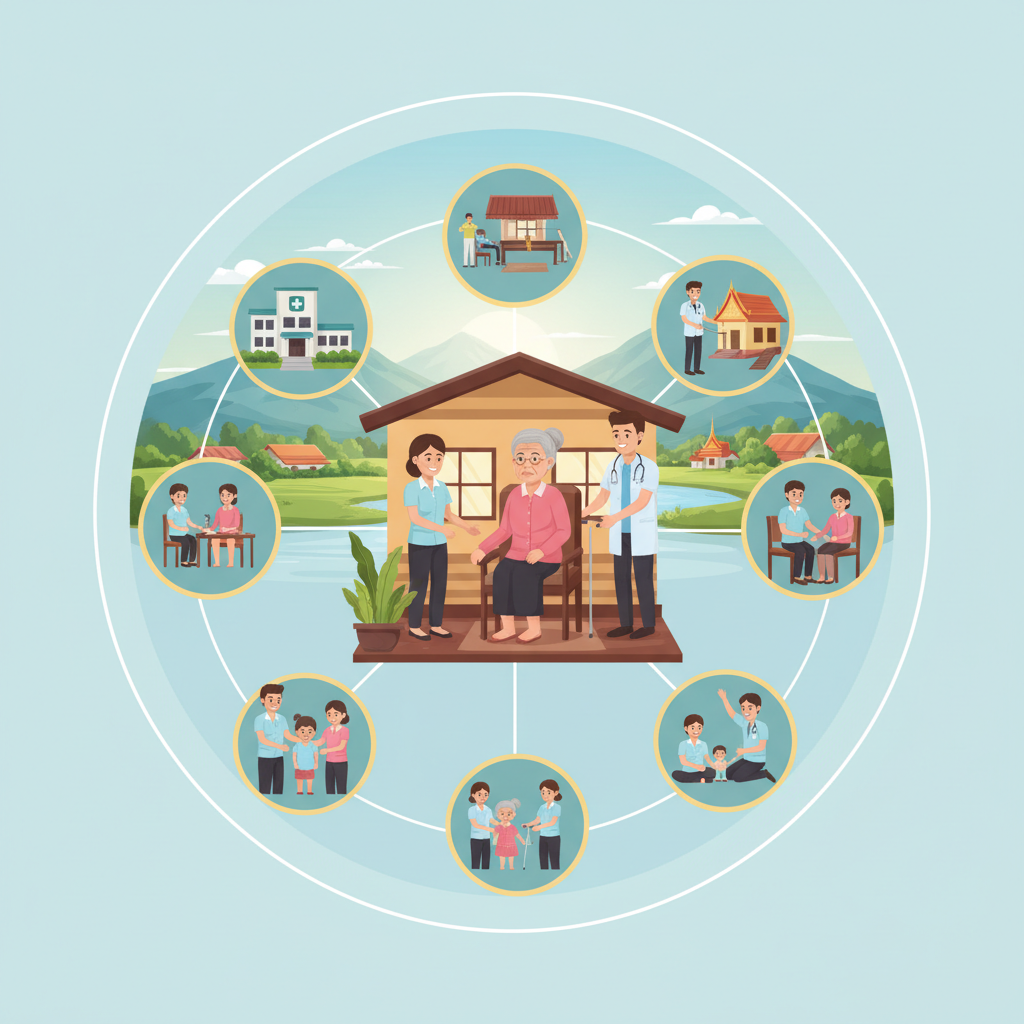
2.The developed model, termed P-CARE Impact Loop with Area-Based Adaptation, comprised four components: inputs, processes, outcomes, and feedback. It integrated knowledge, community participation, and policy mechanisms as driving forces, with operational adjustments tailored to local contexts.
3. The implementation of the model demonstrated that, following the intervention, older adults showed improved ability to perform activities of daily living (ADL) and a significantly reduced risk of falls within the home across all types of areas (p-value < .001). Quality of life and mental health significantly improved specifically in urban and semi-urban areas (p-value < .001), whereas no statistically significant differences were observed in rural and mountainous/remote areas.
System-level recommendations for developing context-appropriate care models include an Active Aging approach for urban and semi-urban areas, Community Participation for rural areas, and Community Outreach combined with Telecare for mountainous and remote areas. These approaches aim to sustainably enhance the quality of life of older adults.
References
กรมกิจการผู้สูงอายุ. (2563). บ้านปลอดภัย ไม่เสี่ยงล้ม. กรุงเทพมหานคร: กรมกิจการผู้สูงอายุ.
กรมควบคุมโรค. (2564). คู่มือการคัดกรองและประเมินสุขภาพผู้สูงอายุ พ.ศ. 2564. กรุงเทพมหานคร: ณจันตาครีเอชั่น.
กรมโยธาธิการและผังเมือง. (2565). เกณฑ์การจำแนกชุมชนเมืองและชนบทเพื่อการวางแผนพัฒนาพื้นที่. กรุงเทพมหานคร: กระทรวงมหาดไทย.
กรมสุขภาพจิต. (2545). เครื่องชี้วัดคุณภาพชีวิตขององค์การอนามัยโลกชุดย่อ ฉบับภาษาไทย (WHOQOL-BREF-THAI). นนทบุรี: กรมสุขภาพจิต.
กรมอนามัย. (2564). คู่มือการดูแลสุขภาพผู้สูงอายุระยะยาว. นนทบุรี: กรมอนามัย กระทรวงสาธารณสุข.
คณะกรรมการสุขภาพแห่งชาติ. (2562). แนวทางการขับเคลื่อนนโยบายสาธารณะแบบมีส่วนร่วม. นนทบุรี: สำนักงานคณะกรรมการสุขภาพแห่งชาติ.
ชาลี เอี่ยมมา และรัชนีวัลย์ ปาณธูป. (2563). การศึกษารูปแบบการพัฒนาการดำเนินงานระบบดูแลระยะยาวด้านสาธารณสุขสำหรับผู้สูงอายุที่มีภาวะพึ่งพิง ภายใต้หลักประกันสุขภาพแห่งชาติ เขตสุขภาพที่ 1. วารสารวิจัยและพัฒนาระบบสุขภาพ, 13(1), 128–135. https://he02.tci-thaijo.org/index.php/RDHSJ/article/view/254823/173111
ญาณพัฒน์ ทรงเย็น. (2568). การพัฒนารูปแบบการดูแลสุขภาพแบบบูรณาการ สำหรับผู้สูงอายุที่มีภาวะพึ่งพิงในพื้นที่ตำบลบักได อำเภอพนมดงรัก จังหวัดสุรินทร์. วารสารอนามัยสิ่งแวดล้อมและสุขภาพชุมชน, 10(6), 262–270. https://he03.tci-thaijo.org/index.php/ech/article/view/5197/3911
ประเวศ วะสี. (2551). สามเหลี่ยมเขยื้อนภูเขาและทุนทางสังคมกับการพัฒนาสุขภาพ. กรุงเทพฯ: หมอชาวบ้าน.
วุฒิฌาน ห้วยทราย และศรายุทธ ชูสุทน. (2566). ปัจจัยทำนายคุณภาพชีวิตของผู้สูงอายุในชมรมผู้สูงอายุ ตำบลบางนกแขวก อำเภอบางคนที จังหวัดสมุทรสงคราม. วารสารวิชาการสาธารณสุข, 32(1), 65–69. https://www.thaidj.org/index.php/JHS/article/view/13292/10865
สำนักงานคณะกรรมการพัฒนาการเศรษฐกิจและสังคมแห่งชาติ. (2566). แผนพัฒนาภาคเหนือ พ.ศ. 2566–2570. กรุงเทพมหานคร: สำนักงานสภาพพัฒนาการเศรษฐกิจและสังคมแห่งชาติ.
สำนักงานสถิติแห่งชาติ. (2567). การสำรวจประชากรสูงอายุในประเทศไทย พ.ศ. 2567. กรุงเทพมหานคร: สำนักงานสถิติแห่งชาติ.
สำนักงานสาธารณสุขจังหวัดพะเยา. (2568). รายงานสถิติและฐานข้อมูลการดูแลผู้สูงอายุที่มีภาวะพึ่งพิง จังหวัดพะเยา. พะเยา: กลุ่มงานส่งเสริมสุขภาพ สำนักงานสาธารณสุขจังหวัดพะเยา.
สำนักงานหลักประกันสุขภาพแห่งชาติ. (2567). แนวทางการดำเนินงานระบบการดูแลระยะยาวด้านสาธารณสุขสำหรับผู้สูงอายุที่มีภาวะพึ่งพิง (Long Term Care). นนทบุรี: สำนักงานหลักประกันสุขภาพแห่งชาติ.
อรทัย ก๊กผล. (2552). การมีส่วนร่วมของประชาชน. นนทบุรี: สถาบันพระปกเกล้า.
Bertalanffy, L. von. (1968). General System Theory: Foundations, Development, Applications. New York, NY: George Braziller.
Best, J. W. (1981). Research in education (4th ed.). Prentice-Hall.
Cohen, J. M., & Uphoff, N. T. (1980). Participation's place in rural development: Seeking clarity through specificity. World Development, 8(3), 213–235. doi.org/10.1016/0305-750X(80)90011-0
Cohen, J. (1988). Statistical Power Analysis for the Behavioral Sciences (2nd ed.). Hillsdale, NJ: Lawrence Erlbaum Associates.
Conway, M. (2019). Theory of Change: A Practical Tool for Action, Results and Learning. New York, NY: ActKnowledge.
Krejcie, R. V., & Morgan, D. W. (1970). Determining sample size for research activities. Educational and Psychological Measurement, 30(3), 607–610. https://doi.org/10.1177/001316447003000308
Krueger, R. A. (1998). Developing questions for focus groups (Focus Group Kit 3). Sage Publications.
Leichsenring, K. (2004). Developing integrated health and social care services for older persons in Europe. International Journal of Integrated Care, 4, e10. https://doi.org/10.5334/ijic.91
World Health Organization. (2015). World Report on Ageing and Health. Geneva, Switzerland: World Health Organization.
Downloads
Published
Issue
Section
License
Copyright (c) 2026 The Southern College Network Journal of Nursing and Public Health

This work is licensed under a Creative Commons Attribution-NonCommercial-NoDerivatives 4.0 International License.
1. บทความหรือข้อคิดเห็นใด ๆ ที่ปรากฏในวารสารเครือข่าย วิทยาลัยพยาบาลและการสาธารณสุขภาคใต้ ที่เป็นวรรณกรรมของผู้เขียน บรรณาธิการหรือเครือข่ายวิทยาลัยพยาบาลและวิทยาลัยการสาธารณสุขภาคใต้ ไม่จำเป็นต้องเห็นด้วย
2. บทความที่ได้รับการตีพิมพ์ถือเป็นลิขสิทธิ์ของ วารสารเครือข่ายวิทยาลัยพยาบาลและการสาธารณสุขภาคใต้