Development of a Participatory Network-Driven Operational Model for Rabies-Free Districts in Subdistricts within Andaman Coastal Tourism Areas, Health District 11
Keywords:
Rabies-Free Districts, Participation, Andaman Coastal Tourism Area, Health District 11Abstract
This research and development study aimed to examine the current situation, problems, and needs, so to develop a participatory network-driven model for achieving rabies-free districts in the Andaman coastal tourism areas of Health Region 11. The study was conducted in three phases. First, the situational context, problems, and needs for rabies-free district were assessed through a document analysis, a questionnaire survey of 354 personnel, and in-depth interviews with 15 participants per district across five districts. Second, the model was developed and validated by three experts. Third, the effectiveness of the model was evaluated using a one-group pretest–posttest quasi-experimental design with 135 participants involved. Data were analyzed using descriptive statistics and Wilcoxon signed ranks test. results were as follows.
1. During fiscal years 2022 – 2024, the number of vaccinations and sterilizations among dogs and cats increased, while the number of animals tested for rabies decreased. Key needs for implementation included the use of technology (e.g., GPS) for outbreak monitoring. Major challenges were the increasing population of stray animals and the lack of appropriate animal shelters. There was also a need for government-supported, sustainable shelter facilities and improved regulatory frameworks.
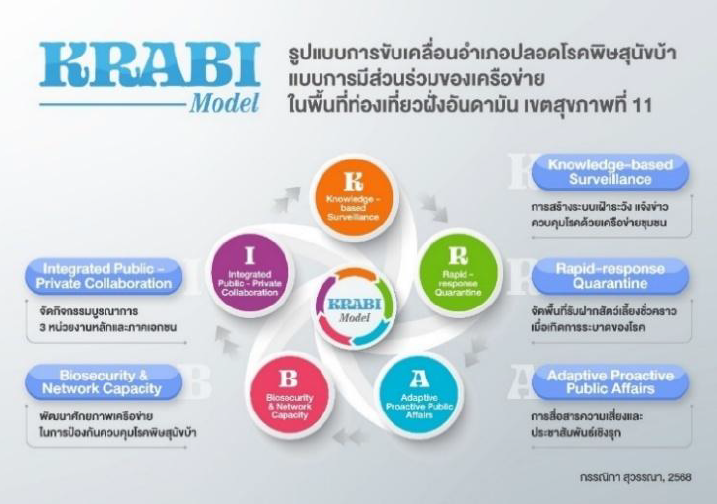
2. The developed model, named the KRABI Model, consists of five components: Establishing surveillance systems, Providing temporary animal shelter areas, Proactive communication and public relations, Capacity building of network partners, Integrated activity management.
3. After implementation, participants demonstrated statistically significant improvements in knowledge, rabies prevention behaviors, participation, and satisfaction at the .01 and .001 levels. No cases of rabies, exposures, or rabies-related deaths were reported. A total of 10 animal samples were submitted for rabies testing.
In conclusion, the model might be implemented through integrated community networks, including the establishment of temporary animal shelters, sterilization and vaccination campaigns, the application of technology for outbreak monitoring, and proactive communication strategies to enhance community participation.
References
กรมควบคุมโรค. (2562). แผนยุทธศาสตร์การกำจัดโรคพิษสุนัขบ้าให้หมดไปภายใน พ.ศ. 2563 (ค.ศ.2020). กรุงเทพมหานคร: โรงพิมพ์ชุมชนสหกรณ์การเกษตรแห่งประเทศไทย.
กรมปศุสัตว์. (2568). ระบบสารสนเทศเพื่อการเฝ้าระวังโรคพิษสุนัขบ้า. สืบค้นเมื่อ 1 มกราคม 2568 จาก http://www.thairabies.net/trn/
กองระบาดวิทยา. (2568). ระบบเฝ้าระวัง Digital 506. สืบค้นเมื่อ 1 มกราคม 2568 จาก https://d506portal.ddc.moph.go.th/
กรมควบคุมโรค กรมปศุสัตว์ กรมส่งเสริมการปกครองท้องถิ่น. (2565). คู่มือการสร้างและประเมินพื้นที่ปลอดโรคพิษสุนัขบ้า. กรุงเทพมหานคร: สำนักพิมพ์อักษรกราฟฟิคแอนด์ดีไซน์.
ชบาไพร เสาร์สุวรรณ, บุญรักษา วิทยาคม และศิวัช ฐิตมงคล. (2567). การพัฒนารูปแบบการดำเนินงานสร้างเขตปลอดโรคพิษสุนัขบ้าแบบมีส่วนร่วม “RABIES EAST ZONE MODEL” ในพื้นที่เขตสุขภาพที่ 6. วารสารสาธารณสุขมูลฐานภาคกลาง, 38(2), 38-48. https://he05.tci-thaijo.org/index.php/Hss6/article/view/3984
ชูศรี วงศ์รัตนะ. (2553). เทคนิคการใช้สถิติเพื่อการวิจัย (พิมพ์ครั้งที่ 12). นนทบุรี: ไทเนรมิตกิจ อินเตอร์โปรเกรสซิฟ.
ดารุณี บุญเต็ม. (2562). การเปรียบเทียบพฤติกรรมการมารับวัคซีนพิษสุนัขบ้าครบชุดของผู้สัมผัสโรคพิษสุนัขบ้าหลังจากการได้รับความรู้. วารสารสังคมและมนุษยศาสตร์, 7(2), 66–90. https://so04.tci-thaijo.org/index.php/wh/article/ view/232226
ธวัชชัย เหลืองศิริ, สุรชัย กิจติกาล และฑภณ เตียวศิริชัยสกุล. (2567). การพัฒนารูปแบบการดำเนินงานการสร้างเขตพื้นที่ปลอดโรคพิษสุนัขบ้า ในพื้นที่ท่องเที่ยวระหว่างชายแดนจังหวัดหนองคาย กับเมืองไซเสดถา นครหลวงเวียงจันทน์ (สปป.ลาว). วารสารวิจัยสุขภาพโรงพยาบาลและชุมชน, 2(1), 55-69. https://he03.tci-thaijo.org/index.php/ pthjo/article/view/1734
ธัญญามาศ ทีงาม และพรนภา ศุกรเวทย์ศิริ. (2563). วิทยาการระบาดผู้สัมผัสโรคพิษสุนัขบ้า อำเภอยางสีสุราช จังหวัดมหาสารคาม. วารสารสำนักงานป้องกันควบคุมโรคที่ 7 ขอนแก่น, 7(1), 96-105. https://he01.tci-thaijo.org/index. php/jdpc7kk/article/view/207034
ธีรวัฒน์ วลัยเสถียร, บุญทนากร พรมภักดี, จุฬาลักษณ์ หินจุฬา, คณยศ ชัยราช และกิตติศักดิ์ สีสด. (2563). รูปแบบการพัฒนาพื้นที่ปลอดโรคพิษสุนัขบ้าแบบบูรณาการการมีส่วนร่วมของชุมชนกับโมเดลเชิงตรรกะตามนโยบายคณะกรรมการพัฒนาคุณภาพชีวิตระดับพื้นที่ (พช.): องค์การบริหารส่วนตำบลเมืองพล อำเภอพล จังหวัดขอนแก่น. วารสารสำนักงานป้องกันควบคุมโรคที่ 7 ขอนแก่น, 27(3), 111–132. https://he01.tci-thaijo.org/index.php/jdpc7kk/article/ view/246738
นพราชย์ อินทองคำ และอิงอร ปรีชาญวินิจ. (2564). การควบคุมสุนัขและโรคพิษสุนัขบ้าในพื้นที่เทศบาลเมืองกระบี่. วารสารควบคุมโรค, 47(4), 1083–1095. doi.org/10.14456/dcj.2021.94
บัญชา ดวงจิตร. (2567). การพัฒนารูปแบบการสร้างพื้นที่ปลอดโรคพิษสุนัขบ้าระดับพื้นที่ในกรุงเทพ ประเทศไทย. Wisdom Journal of Humanities and Social Sciences, 1(3), 41–48. https://so19.tci-thaijo.org/index. php/WJHS/article/view/814
วรางคณา ศรีภูวงษ์, ชาญยุทธ ศรีภูวงษ์, มยุรา นาสีเคน, เอมอร สุทธิสา, สมชาติบุตราช, ศุภธิดา ภิเศก และคณะ (2561). การดำเนินงานสร้าพื้นที่ปลอดโรคพิษสุนัขบ้าทั้งในคนและในสัตว์โดยการมีส่วนร่วมของชุมชน อำเภอกันทรวิชัย จังหวัดมหาสารคาม. วารสารสำนักงานป้องกันควบคุมโรคที่ 10, 16(1), 1-15. https://he02.tci-thaijo.org/index.php/ odpc10ubon/article/view/250446
ศุภมาส พันธ์เชย. (2561). โรคพิษสุนัขบ้า. วารสารกระบี่เวชสาร, 1(2), 49-61. https://thaidj.org/index.php/kmj/ article/view/6603
สาโรจน์ ธีระกุล. (2567). ความรอบรู้ด้านสุขภาพกับการป้องกันควบคุมโรคพิษสุนัขบ้าของประชาชนจังหวัดนครศรีธรรมราช. มหาราชนครศรีธรรมราชเวชสาร, 7(2), 83-102. https://he01.tci-thaijo.org/index.php/MNSTMedJ/article/ view/267989
สุวิมล ว่องวานิช. (2562). การวิจัยประเมินความต้องการจำเป็น (พิมพ์ครั้งที่ 4). กรุงเทพฯ: สำนักพิมพ์แห่งจุฬาลงกรณ์มหาวิทยาลัย.
หทัยกาญจน์ ยางศรี, สงครามชัย ลีทองดี และจมาภรณ์ ใจภักดี. (2560). รูปแบบการดำเนินงานและการเฝ้าระวังโรคพิษสุนัขบ้าในชุมชนเพื่อให้เป็นเขตพื้นที่ปลอดโรค อำเภอเมืองบึงกาฬ จังหวัดบึงกาฬ. วารสารสาธารณสุขมหาวิทยาลัยบูรพา, 12(2), 86-95. https://he02.tci-thaijo.org/index.php/phjbuu/article/view/81004
Bandura, A. (1997). Self-efficacy: The exercise of control. W. H. Freeman.
Cohen, J. (1988). Statistical Power Analysis for the Behavioral Sciences. (2nd). Lawrence Erlbaum Associates, Publishers.
Cohen, J. M., & Uphoff, N. T. (1981). Rural Development Participation: Concept and Measure for Project Design Implementation and Evaluation: Rural Development Committee Center for international Studies. New York: Cornell University Press.
Crabtree, B. F., & Miller, W. L. (Eds.). (1992). Doing Qualitative Research. Sage Publications, Inc.
Faul, F., Erdfelder, E., Lang, A. G., & Buchner, A. (2007). G*Power 3: A flexible statistical power analysis program for the social, behavioral, and biomedical sciences. Behavior Research Methods, 39(2), 175-191.
Hair, J. F., Jr., Black, W. C., Babin, B. J., & Anderson, R. E. (2019). Multivariate data analysis (8th ed.). Boston, MA: Cengage.
The Joanna Briggs Institute. (2008). JBI Level of Evidence and Grading of Recommendations. Retrieved July 14, 2025 from http://www.Jbiconnect.org/connect/info/about/jbi_ebhc_ Approach.php
Downloads
Published
Issue
Section
License
Copyright (c) 2026 The Southern College Network Journal of Nursing and Public Health

This work is licensed under a Creative Commons Attribution-NonCommercial-NoDerivatives 4.0 International License.
1. บทความหรือข้อคิดเห็นใด ๆ ที่ปรากฏในวารสารเครือข่าย วิทยาลัยพยาบาลและการสาธารณสุขภาคใต้ ที่เป็นวรรณกรรมของผู้เขียน บรรณาธิการหรือเครือข่ายวิทยาลัยพยาบาลและวิทยาลัยการสาธารณสุขภาคใต้ ไม่จำเป็นต้องเห็นด้วย
2. บทความที่ได้รับการตีพิมพ์ถือเป็นลิขสิทธิ์ของ วารสารเครือข่ายวิทยาลัยพยาบาลและการสาธารณสุขภาคใต้