Enhancing Gestational Diabetes Mellitus Prediction Efficacy with a Combined Model of Inverse Neutrophil-to-Lymphocyte Ratio, Hemoglobin, and Maternal Age in Southern Thai Women
Keywords:
Gestational Diabetes Mellitus, Neutrophil-to-Lymphocyte Ratio, Hemoglobin Level, Maternal Age, Combined Predictive ModelAbstract
This retrospective study aimed to evaluate factors such as the neutrophil-to-lymphocyte ratio (NLR), hemoglobin level, and maternal age, in order to develop a new combined predictive model for screening gestational diabetes mellitus (GDM) among pregnant women in Southern Thailand. A total of 180 participants were included (62 with GDM and 118 controls). General characteristics and hematological parameters were analyzed using descriptive statistics, multivariate logistic regression, and receiver operating characteristic (ROC) curve analysis. The results were as follows.
1. Compared to controls, hemoglobin levels were significantly higher in the GDM group, while NLR values were significantly lower (p-value < .05).
2. Multivariate analysis identified maternal age ≥ 30 years (aOR = 1.090; 95% CI: 1.028–1.156), hemoglobin ≥ 11.8 g/dL (aOR = 1.710; 95% CI: 1.218–2.400), and NLR < 3.15 (aOR = 0.632; 95% CI: 0.454–0.880) as independent risk factors for GDM (p-value < .05).
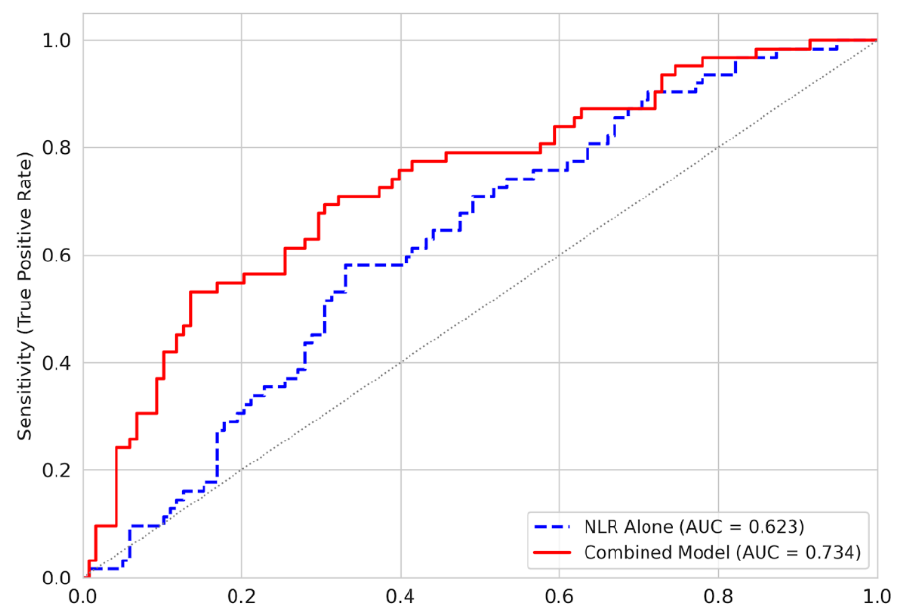
3. The combined predictive model (AUC = 0.734) demonstrated greater discriminatory ability than NLR alone (AUC = 0.623). A simple risk score ranging from 0–5 was developed; pregnant women with the maximum score of 5 had a 61.1% probability of GDM compared to 20.8% in the lowest-risk group (score = 0).
The combined model incorporating NLR, hemoglobin level, and maternal age significantly improved the accuracy of GDM prediction. The developed simple risk assessment tool is practical, cost-effective, and non-invasive, making it particularly valuable in resource-limited settings for early screening of high-risk pregnant women, therefore facilitating timely confirmatory diagnosis.
References
Abu-Raya, B., Michalski, C., Sadarangani, M., & Lavoie, P. M. (2020). Maternal immunological adaptation during normal pregnancy. Frontiers in Immunology, 11, 575197. doi.org/10.3389/fimmu.2020.575197
American Diabetes Association. (2020). 2. Classification and diagnosis of diabetes: Standards of Medical Care in Diabetes 2020. Diabetes Care, 43(Supplement 1), S14-S31. doi.org/10.2337/dc20-S002
Bozbay, N., Medinaeva, A., Akyürek, F., & Orgul, G. (2024). The role of first-trimester systemic immune-inflammation index for the prediction of gestational diabetes mellitus. Revista da Associação Médica Brasileira, 70, e20240532. doi.org/10.1590/1806-9282.20240532
Duo, Y., Song, S., Qiao, X., Zhang, Y., Xu, J., Zhang, J., et al., (2024). The association of hematological parameters in early and middle pregnancy with the risk of gestational diabetes mellitus. Diabetes, Metabolic Syndrome and Obesity: Targets and Therapy, 17, 633-646. doi:org/10.2147/DMSO.S445927
Fagninou, A. M., Nekoua, M. P., Fiogbe, S. E. M., Moutairou, K., & Yessoufou, A. (2022). Predictive value of immune cells in the risk of gestational diabetes mellitus: A pilot study. Frontiers in Clinical Diabetes and Healthcare, 3, 10012146. doi.org/10.3389/fcdhc.2022.819164
Georgieff, M. K. (2020). Iron deficiency in pregnancy. American Journal of Obstetrics and Gynecology, 223(4), 516–524. doi.org/10.1016/j.ajog.2020.03.006
Kampmann, U., Madsen, L. R., Skajaa, G. O., Iversen, D. S., Moeller, N., & Ovesen, P. (2015). Gestational diabetes: a clinical update. World Journal of Diabetes, 6(8), 1065. doi:10.4239/wjd.v6.i8.1065
Kanthiya, K., Luangdansakul, W., Wacharasint, P., Prommas, S., & Smanchat, B. (2013). Prevalence of gestational diabetes mellitus and pregnancy outcomes in women with risk factors diagnosed by IADPSG criteria at Bhumibol Adulyadej Hospital. Thai Journal of Obstetrics and Gynaecology, 21(4), 141-149.
Lao, T. T., Ho, L. F., Chan, P. L., & So, L. F. (2002). Maternal hemoglobin and risk of gestational diabetes mellitus in Chinese women. Obstetrics & Gynecology, 99(5), 807-812. doi.org/10.1016/S0029-7844(02)01941-5
Li, Y., Ren, X., He, L., Li, J., Zhang, S., & Chen, W. (2020). Maternal age and the risk of gestational diabetes mellitus: A systematic review and meta-analysis of over 120 million participants. Diabetes Research and Clinical Practice, 162, 108044. doi.org/10.1016/j.diabres.2020.108044
Metzger, B. E., Gabbe, S. G., Persson, B., Lowe, L. P., Dyer, A. R., Oats, J. J., et al., (2010). International association of diabetes and pregnancy study groups recommendations on the diagnosis and classification of hyperglycemia in pregnancy: response to Weinert. Diabetes Care, 33(7), e98-e98. doi:org/10.2337/dc09-1848
Moon, J. H., Jang, H. C., & Kim, H. (2022). Gestational diabetes mellitus: Diagnostic approaches and maternal-offspring complications. Diabetes & Metabolism Journal, 46(1), 3-14. doi.org/10.4093/dmj.2021.0335
Ogurtsova, K., Guariguata, L., Barengo, N. C., Ruiz, P. L. D., Sacre, J. W., Karuranga, S., et al. (2022). IDF diabetes Atlas: Global estimates of undiagnosed diabetes in adults for 2021. Diabetes Research and Clinical Practice, 183, 109118. doi:org/10.1016/j.diabres.2021.109118
Phaloprakarn, C., & Tangjitgamol, S. (2008). Impact of high maternal hemoglobin at first antenatal visit on pregnancy outcomes. Journal of Perinatal Medicine, 36(2), 115-119. doi:10.1515/JPM.2008.018
Plows, J. F., Stanley, J. L., Baker, P. N., Reynolds, C. M., & Vickers, M. H. (2018). The pathophysiology of gestational diabetes mellitus. International Journal of Molecular Sciences, 19(11), 3342. doi:org/10.3390/ijms19113342
Sahin, M., Oguz, A., Tüzün, D., Işiktaş, O., Işiktaş, S., Ülgen, C., et al., (2022). A new marker predicting gestational diabetes mellitus: First trimester neutrophil/lymphocyte ratio. Medicine, 101(36), e30514. doi:10.1097/MD.0000000000030511
Sirirat, S., Boriboonhirunsarn, D., Ruangvutilert, P., & Yapan, P. (2022). Prevalence of gestational diabetes mellitus among women with lower risk for gestational diabetes in Siriraj Hospital. Thai Journal of Obstetrics and Gynaecology, 30(5), 313-320. doi:org/10.14456/tjog.2022.37
Tiongco, R. E., Arceo, E., Clemente, B., & Pineda-Cortel, M. R. (2019). Association of maternal iron deficiency anemia with the risk of gestational diabetes mellitus: a meta-analysis. Archives of Gynecology and Obstetrics, 299(1), 89-95. doi.org/10.1007/s00404-018-4932-0
Yang, K., Yang, Y., Pan, B., Fu, S., Cheng, J., & Liu, J. (2022). Relationship between iron metabolism and gestational diabetes mellitus: A systemic review and meta-analysis. Asia Pacific Journal of Clinical Nutrition, 31(2), 242-254. doi:10.6133/apjcn.202206_31(2).0010.
Yilmaz, H., Celik, H. T., Namuslu, M., Inan, O., Onrat, E., Bilgic, M. A., et al. (2014). Benefits of the neutrophil-to-lymphocyte ratio for the prediction of gestational diabetes mellitus in pregnant women. Experimental and Clinical Endocrinology & Diabetes, 122(01), 39-43. doi: 10.1055/s-0033-1361087
Zhang, C., & Catalano, P. (2021). Screening for gestational diabetes. JAMA, 326(6), 487–489. doi.org/10.1001/jama.2021.12190
Downloads
Published
Issue
Section
License
Copyright (c) 2026 The Southern College Network Journal of Nursing and Public Health

This work is licensed under a Creative Commons Attribution-NonCommercial-NoDerivatives 4.0 International License.
1. บทความหรือข้อคิดเห็นใด ๆ ที่ปรากฏในวารสารเครือข่าย วิทยาลัยพยาบาลและการสาธารณสุขภาคใต้ ที่เป็นวรรณกรรมของผู้เขียน บรรณาธิการหรือเครือข่ายวิทยาลัยพยาบาลและวิทยาลัยการสาธารณสุขภาคใต้ ไม่จำเป็นต้องเห็นด้วย
2. บทความที่ได้รับการตีพิมพ์ถือเป็นลิขสิทธิ์ของ วารสารเครือข่ายวิทยาลัยพยาบาลและการสาธารณสุขภาคใต้