Competencies of Nurse Assistants under the Supervision of Registered Nurses in Caring for Psychiatric Patients and Patients with Substance Abuse in a Multicultural Context
Keywords:
Nurse Assistant, Competency, Substance Abuser, Psychiatric Patient, MulticulturalAbstract
This qualitative research aimed to study the competencies of nurse assistants in caring for psychiatric patients and patients with substance abuse under the supervision of professional nurses in Thailand’s southern border provinces. A total of 30 participants were purposively selected, including 10 professional nurses, 10 nurse assistants, and 10 lecturers in mental health and psychiatry. Data were collected through interviews using a semi-structured interview guide, and then analyzed using thematic content analysis.
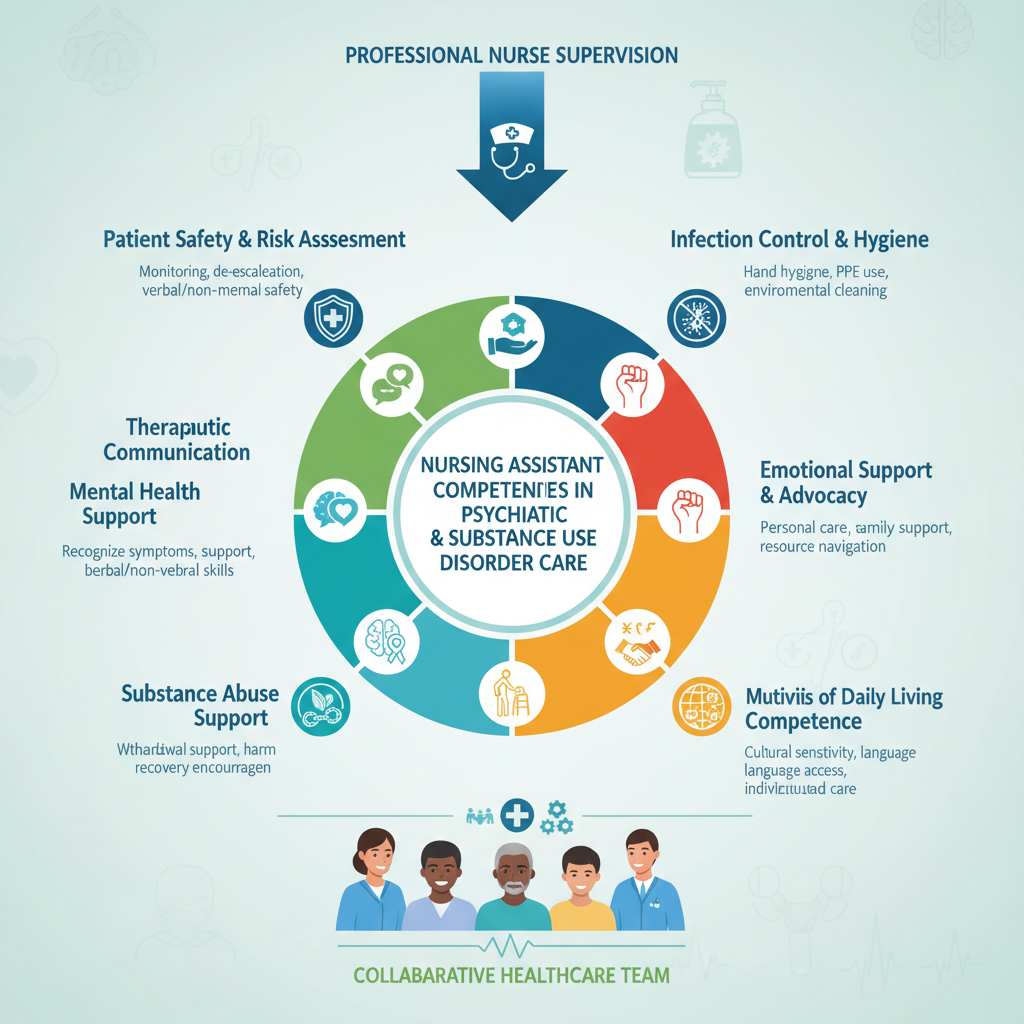
Competencies of nursing assistants were divided into seven domains: 1) providing care for dependent patients in terms of hygiene and environment, including skills in observation, basic physical assessment, assistance with personal hygiene, and identifying environmental risks to ensure safety, 2) performing non-complex nursing tasks in daily routines, encompassing activities of daily living (ADL) assessment, personal hygiene care, food and medication management, accident prevention, and support for cultural and religious practices in a multicultural setting, 3) preventing complications and monitoring symptoms, notably observing adverse effects of substance use, withdrawal symptoms, early warning signs of aggression, as well as measuring vital signs, and providing basic emergency assistance, 4) documenting symptoms and essential information, including monitoring changes in condition, identifying risk behaviors, supervising medication adherence, and collaborating with nurses in documentation for physician reporting, 5) assisting physicians and nurses in examination and treatment, including patient preparation, specimen collection, acting as language mediators, assessing psychological readiness, applying safe restraint when necessary, communicating with relatives, and managing emergency situations, as well as coordinating with families and supporting family therapy activities, 6) preparing emergency equipment, managing the environment, and assisting in emotional regulation of patients, and 7) supporting rehabilitation according to treatment plans, including leading group activities, promoting physical and psychological recovery, life skills development, vocational therapy, enhancing critical thinking, and advancing competencies through continuing education.
Nursing organizations can use the results from this research to inform workforce development planning and to design targeted training programs to strengthen nurse assistants’ competencies in caring for psychiatric patients and patients with substance abuse in the multicultural context of Southern Thailand.
References
ปรารถนา ลังการ์พินธุ์. (2563). การดูแลสุขภาพแบบข้ามวัฒนธรรมในยุคดิจิทัลดิสรัปชั่น, วารสารสมาคมพยาบาลแห่งประเทศไทยฯ สาขาภาคเหนือ, 26(2), 67-77. https://he01.tci-thaijo.org/index.php/jnorthnurse/article/view/ 40460/167474
มหาวิทยาลัยนราธิวาสราชนครินทร์ คณะพยาบาลศาสตร์. (2567). ข้อมูลความต้องการบุคลากรผู้ช่วยพยาบาลในมินิธัญญารักษ์. นราธิวาส
สภาการพยาบาล. (2561). นโยบายสภาการพยาบาลเกี่ยวกับกำลังคนในทีมการพยาบาล. สืบค้นเมื่อ 18 มิถุนายน 2568, จาก https://www.tnmc.or.th/images/userfiles/files/003(1).pdf
สภาการพยาบาล. (2567). สภาการพยาบาล เสนอแนวทางการแก้ไขปัญหาการพยาบาลในประเทศไทยอย่างเป็นระบบต่อรัฐมนตรีว่าการกระทรวงฯ ผ่านปลัดกระทรวงสาธารณสุข. สืบค้นเมื่อ 25 มิถุนายน 2568, จาก https://www.tnmc.or.th/news/1155.
โสภณ ลือดัง และชยาภรณ์ จตุรพรประสิทธิ์. (2567). การจัดการศึกษาเพื่อการพัฒนาที่ยั่งยืน:จากความคาดหวัง
สู่อนาคต. วารสารด้านการบริหารรัฐกิจและการเมือง, 13(1), 76-93. https://so03.tci-thaijo.org/index.php/ papojournal/article/view/276520/184030
อินทร์ทิพย์ อินทรสุข. (2556). บทบาทของครอบครัวในการดูแลผู้ป่วยยาเสพติด หลังการบำบัดรักษาในกลุ่มเสพซ้ำ. วารสารวิชาการเสพติด, 1(1), 32-43. https://he01.tci-thaijo.org/index.php/pmnidat/article/view/248917/ 168518
Addiction Technology Transfer Center Network. (2022). Addiction Nursing Competencies: Foundation, Assessment, and Skills Checklist. Retrieved June 23, 2025 from https://attcnetwork.org/
American Psychiatric Nurses Association. (2022). APNA Position: The Use of Seclusion and Restraint. Retrieved June 23, 2025 from https://www.apna.org/apna-position-the-use-of-seclusion-and-restraint/
Amore, J. D., McCrary, L. K., Denson, J., Li, C., Vitale, C. J., Tokachichu, P., et al. (2021). Clinical data sharing improves quality measurement and patient safety. Journal of the American Medical Informatics Association : JAMIA, 28(7), 1534–1542. https://pubmed.ncbi.nlm.nih.gov/33712850/
Bhui, K., Warfa, N., Edonya, P., McKenzie, K., & Bhugra, D. (2007). Cultural competence in mental health care: a review of model evaluations. BMC Health Services Research, 7(15), 1-10. https://pmc.ncbi.nlm.nih.gov/articles/PMC1800843/
Braun, V., & Clarke, V. (2006). Using thematic analysis in psychology. Qualitative Research in Psychology, 3(2), 77–101. https://doi.org/10.1191/1478088706qp063oa
Center for Substance Abuse Treatment. (1999). Group Leadership, Concepts, and Techniques
(TIP27). Retrieved 1 October 2025 from https://www.ncbi.nlm.nih.gov/books/NBK64211/
Hogue, A., Becker, S. J., Wenzel, K., Henderson, C. E., Bobek, M., Levy, S., et al. (2021). Family involvement in treatment and recovery for substance use disorders among transition-age youth: Research bedrocks and opportunities. Journal of substance abuse treatment, 129, 1-24. https://pmc.ncbi.nlm.nih.gov/articles/PMC8380649/
Joint Commission International. (2024). International Patient Safety Goals: Goal 5 – Reduce the Risk of Healthcare-Associated Infections. Retrieved 2 October 2025 from https://www.jointcommission.org/en/standards/international-patient-safety-goals
Kaur, J., & McNamara, S. (2025). Patient Restraint and Seclusion. In StatPearls [Internet]. Treasure Island, FL: StatPearls Publishing. Retrieved 1 October 2025 from https://www.ncbi.nlm.nih.gov/books/ NBK565873/
Lincoln, Y. S., & Guba, E. G. (1985). Naturalistic Inquiry. Beverly Hills, CA: Sage Publications.
Mate, K. & Arora, A. (2023). Religion's Role in Mental Health Spirituality has known benefits to an
individual's mental health and well-being. Retrieved 1 October 2025 from https://www.thinkglobalhealth.org/article/religions-role-mental-health
Miller, W. R., & Rollnick, S. (2017). Motivational Interviewing in Health Care (2nd ed.). New York : Guilford Press.
Physioinq. (2025). Occupational Therapy for Managing Stress. Retrieved 2 October 2025 from https://www.physioinq.com.au/blog/occupational-therapy-for-managing-stress
Roche, M. A., Glover, S., Luo, X., Joyce, M., & Rossiter, C. (2021). Extending the role of nursing assistants in mental health inpatient settings: A multi-method study. International journal of mental health nursing, 30(5), 1070–1079. https://pubmed.ncbi.nlm.nih.gov/33742529/
Downloads
Published
Issue
Section
License
Copyright (c) 2026 The Southern College Network Journal of Nursing and Public Health

This work is licensed under a Creative Commons Attribution-NonCommercial-NoDerivatives 4.0 International License.
1. บทความหรือข้อคิดเห็นใด ๆ ที่ปรากฏในวารสารเครือข่าย วิทยาลัยพยาบาลและการสาธารณสุขภาคใต้ ที่เป็นวรรณกรรมของผู้เขียน บรรณาธิการหรือเครือข่ายวิทยาลัยพยาบาลและวิทยาลัยการสาธารณสุขภาคใต้ ไม่จำเป็นต้องเห็นด้วย
2. บทความที่ได้รับการตีพิมพ์ถือเป็นลิขสิทธิ์ของ วารสารเครือข่ายวิทยาลัยพยาบาลและการสาธารณสุขภาคใต้