การพัฒนารถเข็นเครื่องเอกซเรย์เคลื่อนที่ด้วยมอเตอร์ไฟฟ้า โรงพยาบาลมะเร็งสุราษฎร์ธานี
คำสำคัญ:
รถเข็นเครื่องเอกซเรย์เคลื่อนที่ , มอเตอร์ไฟฟ้า , ประสิทธิภาพการทำงาน , นักรังสีการแพทย์บทคัดย่อ
การวิจัยและพัฒนานวัตกรรมนี้มีวัตถุประสงค์การวิจัยเพื่อพัฒนาและประเมินผลการใช้รถเข็นเครื่อง เอกซเรย์เคลื่อนที่ด้วยมอเตอร์ไฟฟ้าที่มีประสิทธิภาพเหมาะสมต่อการใช้งาน ประเมินประสิทธิภาพการทำงาน และความพึงพอใจของผู้ใช้งาน กลุ่มตัวอย่างเป็นนักรังสีการแพทย์ จำนวน 12 คน โดยการคัดเลือกแบบเจาะจงตามคุณสมบัติที่กำหนด ดำเนินการวิจัยเป็น 2 ขั้นตอน ประกอบด้วย ขั้นตอนที่ 1 สร้างรถเข็นเครื่องเอกซเรย์เคลื่อนที่ด้วยมอเตอร์ไฟฟ้า มี 3 ระยะ ดังนี้ การศึกษาและวิเคราะห์ การออกแบบและเขียนแบบ การทดสอบเบื้องต้นและปรับปรุง ขั้นตอนที่ 2 ประเมินประสิทธิภาพและความพึงพอใจการใช้งาน เครื่องมือวิจัยประกอบด้วย 1) รถเข็นเครื่องเอกซเรย์ 2) แบบประเมินประสิทธิภาพและความพึงพอใจ ผลการประเมินของผู้ทรงคุณวุฒิได้ค่าความสอดคล้อง (IOC) เท่ากับ .86 เก็บรวบรวมข้อมูลระหว่างเดือนธันวาคม พ.ศ. 2567 ถึงมีนาคม พ.ศ. 2568 วิเคราะห์ข้อมูลโดยความถี่ ร้อยละ ค่าเฉลี่ย และส่วนเบี่ยงเบนมาตรฐาน และสถิติทดสอบที่อิสระ และกำหนดระดับความมีนัยสำคัญที่ .05 ผลการวิจัยพบว่า
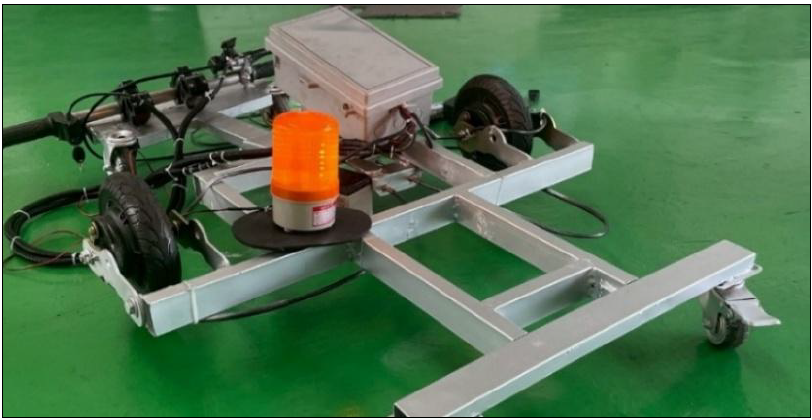
1. รถเข็นต้นแบบที่ได้ มีขนาด 70×80×11 เซนติเมตร น้ำหนัก 20.70 กิโลกรัม รับน้ำหนักได้สูงสุด 250 กิโลกรัม โครงสร้างทำจากเหล็กกัลวาไนส์ชุบกันสนิม ติดตั้งมอเตอร์ไฟฟ้ากระแสตรงแบบไร้แปรงถ่านขนาด 350 วัตต์ 36 โวลต์ จำนวน 2 ชุด ใช้แบตเตอรี่ลิเทียมไอออน 36 โวลต์ 8 แอมแปร์ชั่วโมง ชาร์จเต็มภายใน 2 ชั่วโมง ใช้งานต่อเนื่องได้ 7 ชั่วโมง หรือระยะทาง 15 กิโลเมตร ควบคุมความเร็วด้วยคันเร่งมือในช่วง 1–5 กิโลเมตรต่อชั่วโมง และสามารถขึ้นทางลาดชันได้สูงสุด 10 องศา
2. ประเมินประสิทธิภาพหลังการพัฒนา (M = 3.91, SD = 0.61) สูงกว่าก่อนการพัฒนา (M = 2.51, SD= 0.44) อย่างมีนัยสำคัญทางสถิติ (t = -5.57, p-value < .001) โดยด้านที่ได้คะแนนสูงสุดคือความสะดวกในการเคลื่อนย้ายและการใช้งาน (M = 4.25, SD = 0.75) คะแนนความพึงพอใจหลังการพัฒนา (M = 4.18, SD = 0.34) สูงกว่าก่อนการพัฒนา (M = 2.00, SD = 0.23) อย่างมีนัยสำคัญทางสถิติ (t = -14.57, p-value < .001) ด้านที่มีความพึงพอใจสูงสุดคือความเร็วในการเคลื่อนที่ (M = 4.58, SD = 0.67)
สรุปได้ว่ารถเข็นเครื่องเอกซเรย์เคลื่อนที่ด้วยมอเตอร์ไฟฟ้าที่พัฒนาขึ้นมีประสิทธิภาพและความพึงพอใจสูงกว่าการใช้งานแบบเดิม สามารถนำไปใช้งานเพื่อลดภาระงาน เพิ่มความปลอดภัย และเพิ่มประสิทธิภาพการให้บริการทางการแพทย์ได้อย่างมีประสิทธิผลในโรงพยาบาลมะเร็งสุราษฎร์ธานี
เอกสารอ้างอิง
กรมการแพทย์. (2562). แผนปฏิบัติราชการนวัตกรรมทางการแพทย์ พ.ศ. 2562-2570 กระทรวงสาธารณสุข. สืบค้นเมื่อ 25 ตุลาคม 25689 จาก https://www.dms.go.th/
เกียรติสุดา สิงห์โตทอง. (2552). ระเบียบวิธีวิจัย (พิมพ์ครั้งที่ 3). เชียงใหม่: ก้องช้าง.
ธนันต์ ศรีสกุล, พูนศักดิ์ บุญประสิทธิ์, วรวุฒิ แก้ววิชิต, วิษณุ อักขยาภุนดุ และสรวิศ ตรีเพ็ญมาศ. (2552). การพัฒนาสเก็ตบร์ดไฟฟ้า. WHAT THAI Electronics, 4(41), 114-119. https://ph03.tci-thaijo.org/index.php/trusci/article/view/515
ปลื้มทรัพย์ สงวนประเสริฐ, ปาหุมันโต้ อับดุลรอฮิม, แก้ววิชิต อรุณ, อักขยาภุนดุ วิษณุ และตรีเพ็ญมาศ สรวิศ. (2559). การวิจัยและพัฒนารถเข็นอาหารผู้ป่วยที่ขับเคลื่อนด้วยมอเตอร์ไฟฟ้าสำหรับใช้ในโรงพยาบาล. วารสารวิชชา, 35(2), 16-32. https://li01.tci-thaijo.org/index.php/wichcha/article/view/93411/0?utm_source=chatgpt.com
วสัน บุตรพา. (2564). การวิเคราะห์รังสีกระจายและการป้องกันรังสีระหว่างการเอกซเรย์เคลื่อนที่. วารสารวิทยาศาสตร์การแพทย์ไทย, 63(3), 660-674. https://he02.tci-thaijo.org/index.php/dmsc/article/view/246945
Best, J. W. (1970). Research in Education (2nd ed.). Englewood Cliffs, NJ: Prentice-Hall.
Creswell, J. W. (2015). Educational Research: Planning, Conducting, and Evaluating Quantitative and Qualitative Research (5th ed.). Boston, MA: Pearson Education.
Designing Tolley. (2019). Hospital Trolley Design Guidelines. Retrieved October 23, 2025 from https://designingtrolley.com/hospital-trolley-design-guidelines/
Desouza, E. J., & Maslanyj, M. (2021). Quality control of mobile X-ray equipment: A 5-year analysis. The British Journal of Radiology, 94(1117), 20200906. doi.org/10.1259/bjr.20200906
George, J., & Kamath, V. R. (2020). Speed control of BLDC motor using the PWM technique. International Journal of Electrical Engineering & Technology, 11(6), 30-38.
Justin, S. (2021, March 15). Types of Electric Vehicle Batteries. Virta Global. Retrieved October 23, 2025 from https://www.virta.global/blog/ev-battery-types
Khadka, K., & Maharjan, S. (2017). Customer Satisfaction and Customer Loyalty: Case Trivsel städtjänster (Trivsel siivouspalvelut) (Master’s thesis). Retrieved November 5, 2025 from https://www.theseus.fi/handle/10024/139650
Manouchehri, N., Nguyen, H., Kowal, P., McArthur, A., & Vengalasetti, Y. S. (2017). Pediatric chest radiography: Optimization of technique and reduction of dose. Pediatric Radiology, 47(11), 1447-1456. doi.org/10.1007/s00247-017-3911-8
Morse, N. C. (1955). Satisfaction in the White Collar Job. Ann Arbor, MI: University of Michigan Press.
Nayak, M., Kamath, K., Karunakara, R. L. J., Anchan, S. S., & Saikrishna, U. (2015). Fabrication of Automated electronic trolley. IOSR Journal of Mechanical and Civil Engineering, 12(3), 72-84.
Pan, F., Ye, T., Sun, P., Gui, S., Liang, B., Li, L., et al. (2020). Time course of lung changes at chest CT during recovery from coronavirus disease 2019 (COVID-19). Radiology, 295(3), 715-721. https://doi.org/10.1148/radiol.2020200370
Tagliaferri, S., Miller, C. T., Ford, J. J., Hahne, A. J., Main, L. C., Rantalainen, T., et al. (2018). Randomized trial of general strength and conditioning versus motor control and manual therapy for chronic low back pain on physical and self-report outcomes. Journal of Clinical Medicine, 7(11), 430. doi.org/10.3390/jcm7110430
Zhang, L., Diraneyya, M. M., Ryu, J., Haas, C. T., & Abdel-Rahman, E. (2018). Automated monitoring of physical fatigue using jerk. Advanced Engineering Informatics, 38, 45-55. doi.org/10.1016/j.aei.2018.05.004
ดาวน์โหลด
เผยแพร่แล้ว
ฉบับ
ประเภทบทความ
สัญญาอนุญาต
ลิขสิทธิ์ (c) 2026 วารสารเครือข่ายวิทยาลัยพยาบาลและการสาธารณสุขภาคใต้

อนุญาตภายใต้เงื่อนไข Creative Commons Attribution-NonCommercial-NoDerivatives 4.0 International License.
1. บทความหรือข้อคิดเห็นใด ๆ ที่ปรากฏในวารสารเครือข่าย วิทยาลัยพยาบาลและการสาธารณสุขภาคใต้ ที่เป็นวรรณกรรมของผู้เขียน บรรณาธิการหรือเครือข่ายวิทยาลัยพยาบาลและวิทยาลัยการสาธารณสุขภาคใต้ ไม่จำเป็นต้องเห็นด้วย
2. บทความที่ได้รับการตีพิมพ์ถือเป็นลิขสิทธิ์ของ วารสารเครือข่ายวิทยาลัยพยาบาลและการสาธารณสุขภาคใต้