The Effects of an Aggressive Behavior Prevention Program on Self-Control and Aggressive Behavior among Patients with Schizophrenia
Keywords:
Aggressive Behavior Prevention Program, Self-control, Aggressive Behavior, Patients with SchizophreniaAbstract
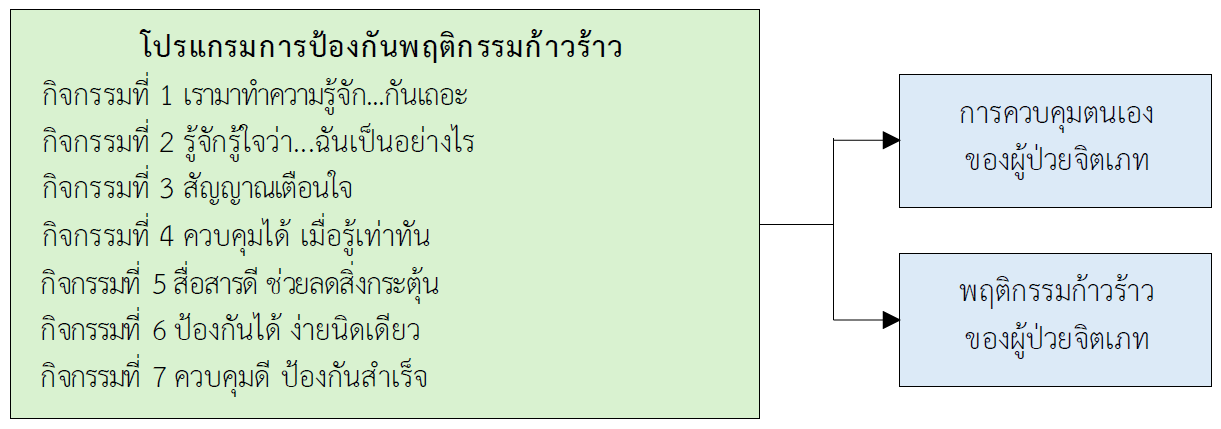
This quasi-experimental study, two-group pretest–posttest design, aimed to examine the effects of an aggressive behavior prevention program on self-control and aggressive behavior among patients with schizophrenia. The sample consisted of 50 patients with schizophrenia aged 20 – 59 years who were admitted to the psychiatric ward of Yala Hospital. Participants were equally assigned to an experimental group (n = 25) and a control group (n = 25). The research instruments included: (1) data collection tools comprising a demographic questionnaire, a self-control assessment scale (Cronbach’s alpha = .85), and an aggressive behavior assessment scale (Cohen’s kappa = 1.00); and (2) the intervention instrument, namely the Aggressive Behavior Prevention Program. The program was developed by the researcher based on Rosenbaum’s self-control theory and an extensive literature review. It consisted of seven sessions, each lasting 60 minutes, conducted over a two-week period. Content validity was evaluated by three experts, yielding a content validity index (CVI) of 1.00. Data were analyzed using descriptive statistics, paired t-tests, and independent t-tests. The results revealed as follows.
1. After the intervention, the experimental group demonstrated significantly higher mean self-control scores and significantly lower mean aggressive behavior scores compared to their pre-intervention scores (p-value < .001).
2. Post-intervention, the experimental group had significantly higher mean self-control scores and significantly lower mean aggressive behavior scores than the control group (p-value < .05).
These findings indicate that the Aggressive Behavior Prevention Program effectively enhanced self-control and reduced aggressive behavior among patients with schizophrenia. The program should therefore be considered as a guideline for nursing care of patients with schizophrenia.
References
กรมสุขภาพจิต. (2563). คู่มือระบบการดูแลผู้ป่วยจิตเวชที่มีความเสี่ยงสูงต่อการก่อความรุนแรงสำหรับสถาบัน/โรงพยาบาล สังกัดกรมสุขภาพจิต. กรุงเทพมหานคร: พรอสเพอรัสพลัส จำกัด.
กรมสุขภาพจิต. (2568). มาตรฐานการให้บริการปรึกษาด้านสุขภาพจิต. นนทบุรี: กรมสุขภาพจิต.
เจนวิทย์ ณาคะโร, วินีกาญจน์ คงสุวรรณ, และอรวรรณ หนูแก้ว. (2566). ปัจจัยทำนายพฤติกรรมการดูแลตนเองของผู้ต้องขังโรคจิตเภท. วารสารเครือข่ายวิทยาลัยพยาบาลและการสาธารณสุขภาคใต้, 10(3), e258203.
https://he01.tci-thaijo.org/index.php/scnet/article/view/258203/179688
ชมพูนุท กาบคำบา. (2567). กลุ่มโรคจิตเภทและกระบวนการพยาบาล. ใน เนตรชนก แก้วจันทา และชมพูนุท
กาบคำบา (บรรณาธิการ). การพยาบาลจิตเวช (Psychiatric nursing) (พิมพ์ครั้งที่ 2). กรุงเทพมหานคร: สำนักพิมพ์จุฬาลงกรณ์มหาวิทยาลัย.
น้ำจิต กุลอ่อน, จำเนียร สุรวรางกูร, และธนิสร มหานัด. (2564). ผลของโปรแกรมการปรับตัวของบุคคลในภาวะเสี่ยงต่อการควบคุมพฤติกรรมรุนแรงด้วยตนเองในผู้ป่วยจิตเภท. วารสารการพยาบาลจิตเวชและสุขภาพจิต, 35(3), 23-41. https://he02.tci-thaijo.org/index.php/JPNMH/article/view/253833/174058
บูคอรี มะมิง และวินีกาญจน์ คงสุวรรณ. (2566). รูปแบบการจัดการพฤติกรรมก้าวร้าวในผู้ป่วยจิตเภท: การทบทวนวรรณกรรมอย่างเป็นระบบ. วารสารมหาวิทยาลัยนราธิวาสราชนครินทร์, 15(1), 62-97.
https://li01.tci-thaijo.org/index.php/pnujr/article/view/254159?utm_source=chatgpt.com
พยุงศักดิ์ ฝางแก้ว และเพ็ญนภา แดงด้อมยุทธ์. (2562). ผลของการจัดการความโกรธที่เน้นการปรับความคิดต่อพฤติกรรมก้าวร้าวของผู้ป่วยจิตเภท. วารสารการพยาบาลจิตเวชและสุขภาพจิต, 33(1), 53-69.
https://he02.tci-thaijo.org/index.php/JPNMH/article/view/185658/130519
เพชรี คันธสายบัว และวัฒนาภรณ์ พิบูลอาลักษณ์. (2563). การพัฒนาการบำบัดทางการพยาบาลแบบบูรณาการในผู้ป่วยจิตเภทที่มีพฤติกรรมรุนแรง. วารสารสถาบันจิตเวชศาสตร์สมเด็จเจ้าพระยา, 14(1), 55-69.
https://he01.tci-thaijo.org/index.php/journalsomdetchaopraya/article/view/241210/165220
วรรณี ศิรินทรางกูร, นพรัตน์ ไชยชำนิ, และเสาวลักษณ์ ยิ้มเยื้อน. (2562). การพัฒนาโปรแกรมจัดการความโกรธด้วยสติบำบัดสำหรับผู้ป่วยจิตเภทที่มีพฤติกรรมรุนแรง. วารสารการพยาบาลจิตเวชและสุขภาพจิต, 33(3), 68-85.
https://he02.tci-thaijo.org/index.php/JPNMH/article/view/232442/158818
วินีกาญจน์ คงสุวรรณ. (2567). การพยาบาลจิตเวช: ภาวะวิกฤตสุขภาพจิต และจิตเวชฉุกเฉิน. สงขลา: สยามพริ้นติ้ง.
เวชระเบียนหอผู้ป่วยจิตเวช โรงพยาบาลยะลา. (2568). สถิติผู้ป่วยหอผู้ป่วยจิตเวช ปีงบประมาณ พ.ศ. 2565-2568 [เวชระเบียนที่ไม่ตีพิมพ์]. โรงพยาบาลยะลา.
ศิริญพร บุสหงส์, เกษราภรณ์ เคนบุปผา, โปรยทิพย์ สันตะพันธุ์, และปาลิดา พละศักดิ์. (2568). ผลของโปรแกรมการจัดการพฤติกรรมก้าวร้าวต่อความเสี่ยงการก่อความรุนแรงในผู้ป่วยจิตเภทชาย. วารสารสภาการพยาบาล, 40(2), 268-284. https://he02.tci-thaijo.org/index.php/TJONC/article/view/271700
ศิริพรรณ ธนันชัย และจินตนา ยูนิพันธ์. (2562). ปัจจัยคัดสรรที่มีความสัมพันธ์กับพฤติกรรมรุนแรงในชุมชนของผู้ป่วยจิตเภท. วารสารแพทย์นาวี, 46(3), 536-551.
https://he01.tci-thaijo.org/index.php/nmdjournal/article/view/185617
สาลินี พุ่มพวง, จริญญา แก้วสกุลทอง, และธีรนาถ บุญญาธิการ. (2568). ผลของโปรแกรมการกํากับตนเองต่อ
การรับรู้ความสามารถแห่งตนในการควบคุมพฤติกรรมก้าวร้าวของผู้ป่วยจิตเภท. วารสารวิจัยและนวัตกรรมทางสุขภาพ, 8(2), e276907. https://he02.tci-thaijo.org/index.php/jhri/article/view/276907/188864
สำนักงานปลัดกระทรวงสาธารณสุข. (2566). ข้อมูลผู้ป่วยจิตเวชที่มีความเสี่ยงสูงต่อการก่อความรุนแรงจากระบบบริการสุขภาพจิต. นนทบุรี: กระทรวงสาธารณสุข.
อดิศร รักสกุล. (2558). ผลของโปรแกรมกำกับอารมณ์ต่อพฤติกรรมรุนแรงของผู้ป่วยจิตเภทที่ติดสุราในชุมชน. วิทยานิพนธ์พยาบาลศาสตรมหาบัณฑิต, มหาวิทยาลัยธรรมศาสตร์.
อัญชลี วิจิตรปัญญา, ณัฏฐพัชร สุนโรวิทย์, มยุรี กลับวงษ์, และพัชรินทร์ นินทจันทร์. (2565). การพัฒนาโปรแกรมการบำบัดทางความคิดและพฤติกรรมร่วมกับการฝึกการควบคุมตนเองในผู้ป่วยจิตเวชที่มีพฤติกรรมรุนแรง. วารสารการพยาบาลจิตเวชและสุขภาพจิต, 36(1), 68-85. https://he02.tci-thaijo.org/index.php/JPNMH/article/view/249064/175303
Ali, A. M., Abed, G. A., & Elmalky, M. E. (2024). Effect of problem-solving skills training on positive symptoms and suicidal thoughts among patients with schizophrenia. Menoufia Nursing Journal, 9(4), 155–170.
Cohen, J. (1988). Statistical Power Analysis for the Behavioral Sciences (2nd ed.). Hillsdale, NJ: Lawrence Erlbaum Associates.
Gao, L., Liu, Y., Yang, J., Wei, Y., & Wang, Y. (2023). Correlation between aggressive behavior and impulsive and aggressive personality traits in stable patients with schizophrenia. Neuropsychiatric Disease and Treatment, 19, 801–809. https://doi.org/10.2147/NDT.S404176
González-Rodríguez, A., & Seeman, M. V. (2020). Addressing delusions in women and men with delusional disorder: Key points for clinical management. International Journal of Environmental Research and Public Health, 17(12), 4583. https://doi.org/10.3390/ijerph17124583
Gray, J. R., Grove, S. K., & Sutherland, S. (2017). Burns and Grove's the Practice of Nursing Research (8th ed.). Missouri: Elsevier.
Jeyagurunathan, A., Lau, J. H., Abdin, E., Shafie, S., Chang, S., Samari, E., et al. (2022). Aggression amongst outpatients with schizophrenia and related psychoses in a tertiary mental health institution. Frontiers in Psychiatry, 12, 777388. https://doi.org/10.3389/fpsyt.2021.777388
Keltner, L. N., & Steele, D. (2019). Psychiatric Nursing (8th ed.). St. Louis, MO: Elsevier.
Li, W., Yang, Y., Hong, L., An, F. R., Ungvari, G. S., Ng, C. H., et al. (2020). Prevalence of aggression in patients with schizophrenia: A systematic review and meta-analysis of observational studies. Asian Journal of Psychiatry, 47, 101846. https://doi.org/10.1016/j.ajp.2019.101846
McCutcheon, R. A., Marques, T. R., & Howes, O. D. (2020). Schizophrenia: An overview. JAMA Psychiatry, 77(2), 201-210. https://doi.org/10.1001/jamapsychiatry.2019.3360
Mei, C. H., & Wen, C. O. (2021). Effects of integrated violence intervention on alexithymia, cognitive, and neurocognitive features of violence in schizophrenia: A randomized controlled trial. Brain Sciences, 11(7), 837-856.
Ronen, T., & Rosenbaum, M. (2010). Developing learned resourcefulness in adolescents to help them reduce their aggressive behavior: Preliminary findings. Research on Social Work Practice, 20(4), 410–426.
Rosenbaum, M. (1990). Learned Resourcefulness: On Coping Skills, Self-control, and Adaptive Behavior. Springer Publishing.
Townsend, M. C., & Morgan, K. I. (2020). Psychiatric Mental Health Nursing: Concepts of Care in Evidence-based Practice (8th ed.). Philadelphia, PA: F.A. Davis Company.
Varcarolis, E. M., Carson, V. B., & Shoemaker, N. C. (2018). Foundations of Psychiatric Mental Health Nursing: A Clinical Approach (8th ed.). Saunders Elsevier.
Videbeck, S. L. (2020). Psychiatric-mental Health Nursing (8th ed.). Wolters Kluwer.
Weltens, I., Bak, M., Verhagen, S., Vandenberk, E., & Domen, P. (2021). Aggression on the psychiatric ward: Prevalence and risk factors: A systematic review of the literature. PLOS ONE, 16(10), e0258346. https://doi.org/10.1371/journal.pone.0258346
World Health Organization. (2025). Schizophrenia. Retrieved November 20, 2025
from https://www.who.int/news-room/fact-sheets/detail/schizophrenia
Yudofsky, S. C., Silver, J. M., Jackson, W., Endicott, J., & Williams, D. (1986). The overt aggression scale for the objective rating of verbal and physical aggression. The American Journal of Psychiatry, 143(1), 35-39.
Downloads
Published
Issue
Section
License
Copyright (c) 2026 The Southern College Network Journal of Nursing and Public Health

This work is licensed under a Creative Commons Attribution-NonCommercial-NoDerivatives 4.0 International License.
1. บทความหรือข้อคิดเห็นใด ๆ ที่ปรากฏในวารสารเครือข่าย วิทยาลัยพยาบาลและการสาธารณสุขภาคใต้ ที่เป็นวรรณกรรมของผู้เขียน บรรณาธิการหรือเครือข่ายวิทยาลัยพยาบาลและวิทยาลัยการสาธารณสุขภาคใต้ ไม่จำเป็นต้องเห็นด้วย
2. บทความที่ได้รับการตีพิมพ์ถือเป็นลิขสิทธิ์ของ วารสารเครือข่ายวิทยาลัยพยาบาลและการสาธารณสุขภาคใต้