The Effectiveness of a Growth Mindset Promotion Program on Reducing Stress among Undergraduate Students at Kamphaeng Phet Rajabhat University
Keywords:
Growth Mindset, Stress, Undergraduate StudentsAbstract
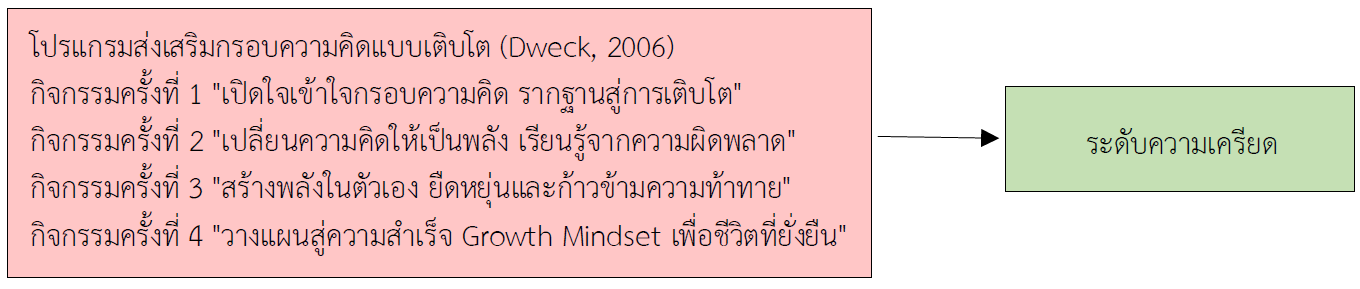
This one-group repeated measures quasi-experimental design study aimed to compare the stress levels of undergraduate students before, after, and one week following participation in a "growth mindset promotion program". The study also examined pairwise differences in stress levels across the three time points. The participants were 30 undergraduate students at Kamphaeng Phet Rajabhat University who had moderate or higher stress levels and voluntarily participated in the study. The research instruments included: 1) the program, which demonstrated content validity indices ranging from 0.67 to 1.00, and 2) the Perceived stress scale questionnaire with a Cronbach’s alpha coefficient of .82. The total possible scores ranged from 0 to 40, interpreted as low (0–13), moderate (14–26), and high (27–40) stress levels. Data were collected at three time points: before the intervention, immediately after, and one week after program completion. Data were analyzed using descriptive statistics (frequency, percentage, mean, standard deviation, and median), the Friedman test, and the Wilcoxon signed-rank test. Results showed that :
1. Stress scores across the three measurement points differed significantly (c 2 = 20.157, df = 2, p-value < .001), with a moderate effect size (Kendall’s W = 0.34). The median stress score decreased from 30.00 (IQR = 10.00) before the intervention to 24.50 (IQR = 9.00) immediately after, and further to 21.00 (IQR = 9.00) at the one-week follow-up.
2. Pairwise comparisons using the Wilcoxon signed-rank test indicated statistically significant reductions in stress across all time points (p-value < .05), with moderate to large effect sizes (r = .39 – .72).
The results indicate that the promotion program was effective in reducing students’ stress levels and that the effect persisted after program completion. The program can be applied to preventive mental health promotion activities for university students and adapted for students in other faculties to broaden its impact.
References
กรมสุขภาพจิต. (2567). ระบบรายงานสุขภาพจิต (Mental Health Check In Dashboard). สืบค้นเมื่อ 1 ตุลาคม 2568 จาก https://checkin.dmh.go.th/dashboards/dash_university
กรมสุขภาพจิต. (2567). รายงานสถานการณ์สุขภาพจิตของประชากรวัยเรียนและวัยทำงานในประเทศไทย พ.ศ. 2567. กรุงเทพมหานคร: กระทรวงสาธารณสุข.
จารุศรี จิรวิสิฐกุล และศรันย์ พิมพ์ทอง. (2566). ประสิทธิผลของโปรแกรมเสริมสร้างกรอบความคิดแบบเติบโตของพนักงานองค์การพัฒนาเอกชนในกรุงเทพมหานคร. วารสารพฤติกรรมศาสตร์เพื่อการพัฒนา, 15(2), 17-34.
ธนะดี สุริยะจันทร์หอม. (2561). การพัฒนารูปแบบการเสริมสร้างกรอบความคิดแบบเติบโตสำหรับนักศึกษาหลักสูตรวิชาชีพครู. วิทยานิพนธ์ปริญญาดุษฎีบัณฑิต มหาวิทยาลัยมหาสารคาม, มหาสารคาม.
ณหทัย วงศ์ปการันย์ และทินกร วงศ์ปการันย์. (2553). แบบวัดความรู้สึกเครียด 10 ข้อ ฉบับภาษาไทย:
การตรวจสอบคุณสมบัติทางจิตวิทยาการวัด. วารสาร Bio Psycho Social Medicine, 4(1), 6.
นุชนภา วรุณวุฒิ. (2564). ผลของโปรแกรมการปรึกษาร่วมกับแนวคิดการเติบโตที่ส่งผลต่อการฟื้นคืนได้ทางจิตวิทยาของนักศึกษามหาวิทยาลัย. วิทยานิพนธ์ปริญญามหาบัณฑิต มหาวิทยาลัยศรีนครินทรวิโรฒ, กรุงเทพมหานคร.
ปฐมามาศ โชติบัณ และกิตติพร เนาว์สุวรรณ. (2563). ผลของการจัดการเรียนโดยใช้เทคนิคผ่อนคลายเพื่อเพิ่มความสุขในการเรียนของนักศึกษาพยาบาล วิทยาลัยพยาบาลบรมราชชนนี สงขลา. วารสารสารคาม, 11(2), 47–59.
ปฐมพร โพธิ์ถาวร และ สาวิตรี วงค์ประดิษฐ (2560).ประสบการณ์การปฏิบัติสมาธิด้วยการหายใจ เพื่อลดความเครียดในการสอบวิชาปฏิบัติการพยาบาลมารดาทารกและการผดุงครรภ์ 2 ของนักศึกษาพยาบาล.วารสารเครือข่ายวิทยาลัยพยาบาลและการสาธารณสุขภาคใต้, 4(1),171-179.
ปิยะวัฒน์ พลจันทึก. (2564). ผลของโปรแกรมสร้างเสริมความเข้มแข็งทางใจโดยใช้แนวคิดกรอบความคิดแบบเติบโตที่มีต่อความเครียดของนักศึกษาปริญญาตรี. วิทยานิพนธ์ปริญญามหาบัณฑิต. มหาวิทยาลัยราชภัฏนครราชสีมา, นครราชสีมา.
ภาวดี เหมทานนท์, เบญจวรรณ ละหุการ, อุษา จันทร์แย้ม, นิศารัตน์ นรสิงห์, นิสากร จันทวี, เบญจวรรณ ถนอมชยธวัช และคณะ. (2562). การพัฒนาโปรแกรมการให้คำปรึกษากลุ่มบูรณาการเพื่อเสริมสร้างกลวิธีการเผชิญปัญหาสำหรับนักศึกษาพยาบาลรับใหม่. วารสารเครือข่ายวิทยาลัยพยาบาลและการสาธารณสุขภาคใต้, 6 (ฉบับพิเศษ),106-115.
มหาวิทยาลัยราชภัฏกำแพงเพชร. (2568). รายงานสถิติประจำปี 2568. กองพัฒนานักศึกษา .
สุนันทา ศรีสวัสดิ์. (2564). ความเครียดและภาวะหมดไฟทางการศึกษาในนักศึกษามหาวิทยาลัย. วารสารจิตวิทยาการศึกษา, 12(1), 45–58.
สุภาพร จันทร์เจริญ. (2565). ความแตกต่างของลักษณะทางเศรษฐกิจและสังคมของนักศึกษาในมหาวิทยาลัยราชภัฏกับมหาวิทยาลัยอื่น. วารสารวิจัยและพัฒนาระบบสุขภาพ, 15(1), 23–34.
Chu, T., Liu, X., Takayanagi, S., Matsushita, T., & Kishimoto, H. (2022). Association between mental health and academic performance among university undergraduates: The interacting role of lifestyle behaviors. Frontiers in Public Health, 10, 9976597. doi:10.3389/fpubh.2022.9976597
Cohen, J. (1988). Statistical Power Analysis for the Behavioral Sciences (2Nd Ed.). Hillsdale, NJ: Lawrence Erlbaum Associates.
Cohen, S., Kamarck, T., & Mermelstein, R. (1983). A global measure of perceived stress. Journal of Health and Social Behavior, 24(4), 385-396. doi.org/10.2307/2136404
Department of Mental Health. (2022). Report on Mental Health Situation of Thai People. Nonthaburi, Thailand: Ministry of Public Health.
Dweck, C. S. (2006). Mindset: The New Psychology of Success. New York, NY: Random House.
Faul, F., Erdfelder, E., Lang, A.-G., & Buchner, A. (2007). G*Power 3: A flexible statistical power analysis program for the social, behavioral, and biomedical sciences. Behavior Research Methods, 39(2), 175–191. doi.org/10.3758/BF03193146
Field, A. (2018). Discovering Statistics Using IBM SPSS Statistics (5th ed.). Sage Publications.
Lazarus, R. S., & Folkman, S. (1984). Stress, Appraisal, and Coping. New York: Springer.
Lotrakul, M., & Sukanich, P. (2015). Psychiatry (4th ed.). Bangkok: Department of Psychiatry, Faculty of Medicine Ramathibodi Hospital, Mahidol University.
Meyer, H. H., & Stutts, L. A. (2024). The effect of mindset interventions on stress and academic motivation in college students. Innovative Higher Education, 49(4), 783–798. doi:10.1007/s10755-024-09706-8
Nunnally, J. C., & Bernstein, I. H. (1994). Psychometric Theory (3rd ed.). McGraw-Hill.
Polit, D. F., & Beck, C. T. (2017). Nursing Research: Generating and Assessing Evidence for Nursing Practice (10th ed.). Wolters Kluwer.
Schleider, J., & Weisz, J. (2016). Mental health and implicit theories of thoughts, feelings, and behavior in early adolescents: Are girls at greater risk?. Journal of Social and Clinical Psychology, 35(2), 130-151.
Shapiro, S. S., & Wilk, M. B. (1965). An analysis of variance test for normality (complete samples). Biometrika, 52(3–4), 591–611.
Tao, W., Zhao, D., Yue, H., Horton, I., Tian, X., Xu, Z., et al. (2022). The influence of growth mindset on the mental health and life events of college students. Frontiers in Psychology, 13, 1-12.
Thai PBS. (2024). สุขภาพจิตเยาวชนไทยเสี่ยงสูง เครียด-ซึมเศร้า-ฆ่าตัวตายพุ่ง. สืบค้นเมื่อ 1 ตุลาคม 2568 จาก https://www.thaipbs.or.th/news/content/338472
Yeager, D. S., Bryan, C. J., Gross, J. J., Murray, J. S., Krettek Cobb, D., Santos, P. H. F., et al. (2022). A synergistic mindsets intervention protects adolescents from stress. Nature, 607, 512–520. doi:10.1038/s41586-022-04934-3
Zarinabadi, N., Rezazadeh, M., Karimi, M., & Lou, N. (2021). Why do growth mindsets make you feel better about learning and your selves? The mediating role of adaptability. Innovation in Language Learning and Teaching, 17(1), 1-16.
Downloads
Published
Issue
Section
License
Copyright (c) 2025 The Southern College Network Journal of Nursing and Public Health

This work is licensed under a Creative Commons Attribution-NonCommercial-NoDerivatives 4.0 International License.
1. บทความหรือข้อคิดเห็นใด ๆ ที่ปรากฏในวารสารเครือข่าย วิทยาลัยพยาบาลและการสาธารณสุขภาคใต้ ที่เป็นวรรณกรรมของผู้เขียน บรรณาธิการหรือเครือข่ายวิทยาลัยพยาบาลและวิทยาลัยการสาธารณสุขภาคใต้ ไม่จำเป็นต้องเห็นด้วย
2. บทความที่ได้รับการตีพิมพ์ถือเป็นลิขสิทธิ์ของ วารสารเครือข่ายวิทยาลัยพยาบาลและการสาธารณสุขภาคใต้