Effects of a Self-Efficacy Promotion Program on Stroke Prevention Behaviors in Urban Hypertensive Patients with Uncontrolled Blood Pressure at Vajira Hospital
Keywords:
Self-efficacy Promotion Program, Stroke Prevention Behavior, Uncontrolled Hypertension, Urban AreaAbstract
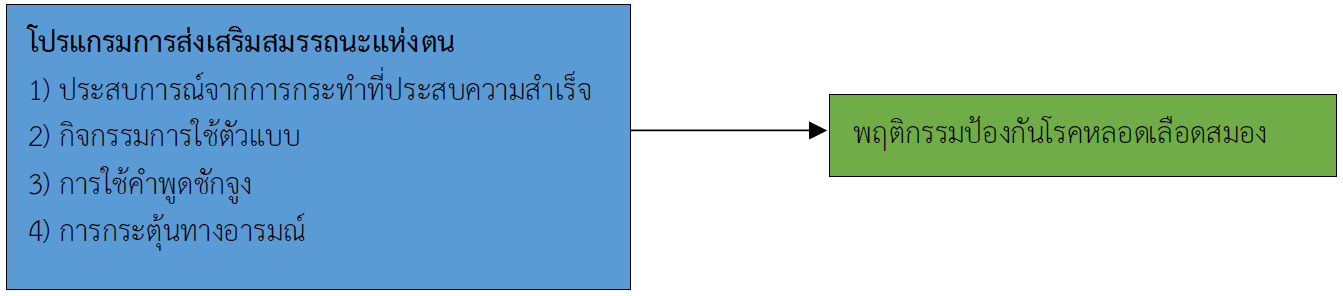
This two-group pre-posttest quasi-experimental study aimed to examine the effects of a self-efficacy enhancement program on stroke prevention behaviors among patients with uncontrolled hypertension living in an urban area at Vajira Hospital. The sample consisted of 60 participants who were purposively selected and assigned to the experimental and control groups, with 30 participants in each group. The research instruments consisted of: 1) the experimental instruments, including the self-efficacy enhancement program developed based on Bandura’s concept and a health education handbook; and 2) the data collection instruments, including a personal information questionnaire and a stroke prevention behavior assessment form. Three experts evaluated the content validity of the program, the health education handbook, and the behavior assessment form, yielding content validity indices of .92, 1.00, and .86, respectively. The behavior assessment form demonstrated a reliability coefficient of .85. Data were analyzed using descriptive statistics, paired t-test, and independent t-test. The results revealed that:
1. After the intervention, the experimental group had a significantly higher mean score in stroke prevention behavior than pre-intervention scores (p-value < .05).
2. After the intervention, the experimental group also had a significantly higher mean score in stroke prevention behaviors than the control group (p-value < .05).
These findings can serve as a foundation for developing clinical practices and health promotion strategies for stroke prevention. Healthcare teams may consider applying the self-efficacy enhancement program for patients with uncontrolled hypertension in urban settings or in other communities with similar characteristics.
References
กองโรคไม่ติดต่อ กรมควบคุมโรค กระทรวงสาธารณสุข. (2567). แผนปฏิบัติการด้านการป้องกันและควบคุมโรคไม่ติดต่อของประเทศไทย พ.ศ. 2567 – 2570. สำนักงานเลขานุการการขับเคลื่อนแผนโรคไม่ติดต่อชาติ กองโรคไม่ติดต่อ กรมควบคุมโรค.
ชวนพิศ เจริญพงศ์ และจุรีภรณ์ เจริญพงศ์. (2565). ผลของโปรแกรมส่งเสริมพฤติกรรมสุขภาพต่อพฤติกรรมสุขภาพและระดับความดันโลหิตในผู้ป่วยโรคความดันโลหิตสูงชนิดปฐมภูมิ. วารสารวิจัยสุขภาพและการพยาบาล, 38(3), 71-81.
ชิณกรณ์ แดนกาไสย, ศุภวรรน ยอดโปร่ง, จันทร์จิรา อินจีน, ชัยวัฒน์ อินไชยา และอรอุมา แก้วเกิด. (2566). ผลของโปรแกรมการส่งเสริมสมรรถนะแห่งตนต่อพฤติกรรมการป้องกันโรคหลอดเลือดสมองและระดับความดันโลหิตของผู้ป่วยโรคความดันโลหิตสูง. วารสารการพยาบาลและสุขภาพ, 17(3), 179-191.
นวพร วุฒิธรรม, รัตนา ช้อนทอง และชุติญา สมประดิษฐ์. (2563). ผลของการเสริมสร้างการรับรู้สมรรถนะแห่งตนต่อการควบคุมระดับความดันโลหิตในกลุ่มเสี่ยงโรคความดันโลหิตสูง. วารสารพยาบาลทหารบก, 21(1), 309-319.
พรธิรา บุญฉวี และปชาณัฏฐ์ นันไทยทวีกุล. (2567). ผลของโปรแกรมการส่งเสริมความรอบรู้ด้านสุขภาพต่อพฤติกรรมการป้องกันโรคในผู้ป่วยโรคหลอดเลือดสมองระยะฟื้นฟูสภาพ. วารสารพยาบาล, 73(2), 51-60.
วงเดือน วงศ์อนันต์. (2567). ผลของโปรแกรมเสริมสร้างสมรรถนะแห่งตนต่อพฤติกรรมการป้องกันโรคหลอดเลือดสมองในผู้สูงอายุโรคไม่ติดต่อเรื้อรัง ตำบลดงแคนใหญ่ อำเภอคำเขื่อนแก้ว จังหวัดยโสธร. วารสารสำนักงานสาธารณสุขจังหวัดยโสธร, 5(2), 1-17.
สมศรี ภูแพง. (2567). รูปแบบการเสริมสร้างความรอบรู้ด้านสุขภาพในการปรับเปลี่ยนพฤติกรรมสุขภาพของกลุ่มเสี่ยงความดันโลหิตสูง โรงพยาบาลส่งเสริมสุขภาพตำบลกุดโดน. วารสารอนามัยสิ่งแวดล้อม และสุขภาพชุมชน, 9(4), 526-532.
สาธิต คูระทอง. (2559). เวชศาสตร์เขตเมือง. วชิรเวชสารและวารสารเวชศาสตร์เขตเมือง, 60(1), 1-4.
Bandura, A. (1977). Self-efficacy: Toward a unifying theory of behavioral change. Psychological Review, 84(2), 191-215. https://doi.org/10.1037//0033-295x.84.2.191.
Best, J. W. (1977). Research in Education (3rd ed.). Prentice Hall.
Carey, R. M., & Whelton, P. K.. (2018). Prevention, detection, evaluation, and management of high blood pressure in adults: Synopsis of the 2017 American college of cardiology/American heart association hypertension guideline. Annals of Internal Medicine, 168(5), 351-358. doi.org/10.7326/m17-3203 %m 29357392.
European Renal Association. (2023). ESH guidelines for the management of arterial hypertension. Journal of hypertension, 41(12), 1874–2071. doi.org/10.1097/HJH.0000000000003480.
Hardy, S. T., Jaeger, B. C., Foti, K., Ghazi, L., Wozniak, G., & Muntner, P. (2025). Trends in blood pressure control among US adults with hypertension, 2013–2014 to 2021–2023. American Journal of Hypertension, 38(2), 120-128. doi.org/10.1093/ajh/hpae141.
Kario, K., Okura, A., Hoshide, S., & Mogi, M. (2024). The WHO Global report 2023 on hypertension warning the emerging hypertension burden in globe and its treatment strategy. Hypertension Research, 47(5), 1099-1102. doi.org/10.1038/s41440-024-01622-w.
Kreutz, R., Brunström, M., Burnier, M., Grassi, G., Januszewicz, A., Muiesan, M. L., et al. (2024).
European society of hypertension clinical practice guidelines for the management of arterial hypertension. European Journal of Internal Medicine, 126(1), 1-15. doi.org/10.1016/j.ejim.2024.05.033.
Polit, F. D., & Beck, C. T. (2021). Nursing Research: Generating and Assessing Evidence for Nursing Practice (11th ed.). Lippincott Williams & Wilkins.
Sermsinsiri, K., & Sriklo, M. (2025). Improving health behaviors and blood pressure control through self-efficacy health promotion program among adults with uncontrolled hypertension: A quasi-experimental study. Pacific Rim International Journal of Nursing Research, 29(2), 412-425. doi.org/10.60099/prijnr.2025.272545.
World health organization. (2024). Hypertension: Key Facts. World health organization. Retrieved January 11, 2025 from https://www.who.int/news-room/fact-sheets/detail/hypertension.
Downloads
Published
Issue
Section
License
Copyright (c) 2025 The Southern College Network Journal of Nursing and Public Health

This work is licensed under a Creative Commons Attribution-NonCommercial-NoDerivatives 4.0 International License.
1. บทความหรือข้อคิดเห็นใด ๆ ที่ปรากฏในวารสารเครือข่าย วิทยาลัยพยาบาลและการสาธารณสุขภาคใต้ ที่เป็นวรรณกรรมของผู้เขียน บรรณาธิการหรือเครือข่ายวิทยาลัยพยาบาลและวิทยาลัยการสาธารณสุขภาคใต้ ไม่จำเป็นต้องเห็นด้วย
2. บทความที่ได้รับการตีพิมพ์ถือเป็นลิขสิทธิ์ของ วารสารเครือข่ายวิทยาลัยพยาบาลและการสาธารณสุขภาคใต้