Development of Safety Performance Measurement Instrument for Charge Nurses in Tertiary Hospitals
Keywords:
Safety Performance, Charge Nurse, Tertiary Hospitals, Measurement InstrumentAbstract
This descriptive research aimed to develop and evaluate the quality of an instrument measuring safety performance among charge nurses in tertiary care hospitals, based on the safety performance framework proposed by Griffin and Neal (2000). The sample consisted of 160 charge nurses working in tertiary care hospitals. Instrument development procedures included a literature review, operational definition formulation, item construction, content validation by experts, and assessment of instrument quality. Data were collected using the newly developed safety performance questionnaire. Content validity yielded a content validity index of .89, and reliability analysis demonstrated a Cronbach’s alpha coefficient of .89. Construct validity was examined through exploratory factor analysis and confirmatory factor analysis.
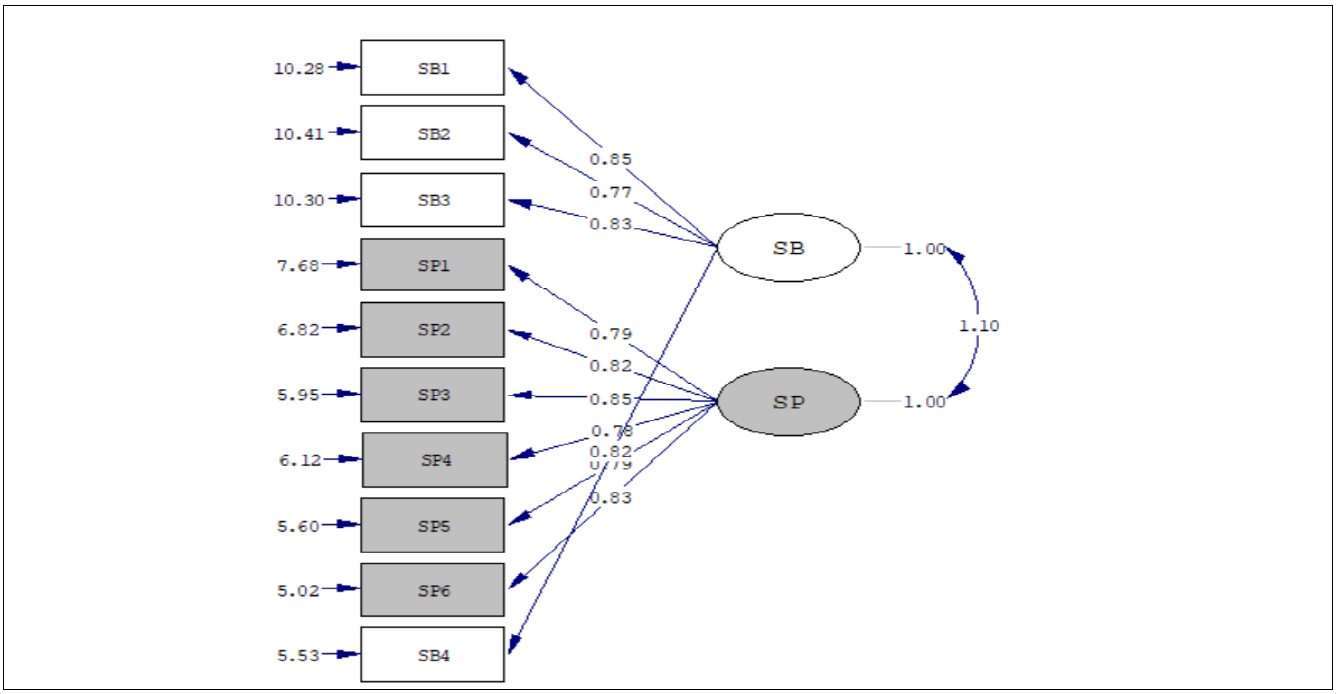
The results indicated that the developed instrument showed construct validity consistent with the theoretical framework and empirical data. The confirmatory factor analysis demonstrated an excellent model fit (χ²= 2.63, df = 34, p-value = 1.00, RMSEA = 0.00). The instrument comprised two major components: (1) Compliance with safety requirements (4 indicators) and (2) Participation in safety-related activities (6 indicators), with factor loadings ranging from 0.78 to 0.85, meeting acceptable criteria.
This study highlights the importance of a psychometrically sound instrument for assessing safety performance among charge nurses. Such an instrument can support nurse administrators in evaluating safety practices and enhancing patient safety systems within healthcare services.
References
เอื้อมพร จันทร์หอม, เพชรน้อย สิงห์ช่างชัย. (2567). รูปแบบภาวะผู้นำและคุณภาพการพยาบาลในมิติของพยาบาล: การทบทวนวรรณกรรมอย่างเป็นระบบ. วารสารเครือข่ายวิทยาลัยพยาบาลและการสาธารณสุขภาคใต้, 11(1), e266064.
Burns, N., & Grove, S. K. (2001). The Practice of Nursing Research: Conduct, Critique, and Utilization (4th ed.). W.B. Saunders.
Clarke, S. (2010). An integrative model of safety climate: Linking psychological climate and work attitudes to individual safety outcomes using meta-analysis. Journal of Occupational and Organizational Psychology, 83(3), 553-578.
Clarke, S. P., & Donaldson, N. E. (2008). Nurse Staffing and Patient Care Quality and Safety. In R. G. Hughes (Ed.), Patient Safety and Quality: An Evidence-Based Handbook for Nurses. Agency for Healthcare Research and Quality (US).
Dawson, B., & Trapp, R. G. (2011). Basic and Clinical Biostatistics (4th ed.). Lange Medical Books/McGraw-Hill.
DeVellis, R. F. (2017). Scale Development: Theory and Applications (4th ed.). Sage Publications.
Ginsburg, L., Tregunno, D., Norton, P. G., Mitchell, J. I., Howley, H., & Schalm, C. (2020). 'Not another safety culture survey': Using the canadian patient safety climate survey (Can-PSCS) to guide quality improvement. BMJ Quality & Safety, 29(11), 913–922. doi.org/10.1136/bmjqs-2019-010611
Griffin, M. A., & Neal, A. (2000). Perceptions of safety at work: A framework for linking safety climate to safety performance, knowledge, and motivation. Journal of Occupational Health Psychology, 5(3), 347-358.
Hair, J. F., Black, W. C., Babin, B. J., Anderson, R. E., & Tatham, R. L. (2006). Multivariate Data Analysis (6th ed.). Pearson Prentice Hall.
Kim, H., Lee, Y., & Kim, J. (2023). Safety behavior among nurses: A structural equation modeling approach. Journal of Nursing Management, 31(3), 678–687. doi.org/10.1111/jonm.13823
Lee, S. E., & Dahinten, V. S. (2020). The enabling, enacting, and elaborating factors of safety culture associated with patient safety: A multilevel analysis. Journal of Nursing Scholarship, 52(5), 544–552. doi.org/10.1111/jnu.12585
Manapragada, A., & Bruk-Lee, V. (2016). Staying silent about safety issues: Conceptualizing and measuring safety silence motives. Accident Analysis & Prevention, 91, 144–156. doi.org/10.1016/j.aap.2016.02.014
Neal, A., & Griffin, M. A. (2006). A study of the lagged relationships among safety climate, safety motivation, safety behavior, and accidents at the individual and group levels. Journal of Applied Psychology, 91(4), 946-953.
Polit, D. F., & Beck, C. T. (2008). Nursing Research: Generating and Assessing Evidence for Nursing Practice (8th ed.). Wolters Kluwer Health/Lippincott Williams & Wilkins.
Wagner, C., Mannion, R., Hammer, A., Groene, O., Arah, O. A., Dersarkissian, M., et al. (2014). The associations between organizational culture, organizational structure and quality management in European hospitals. International Journal for Quality in Health Care, 26(suppl_1), 74-80.
World Health Organization. (2023). Patient safety [Fact sheet]. World Health Organization. Retrieved July 25, 2024 from https://www.who.int/news-room/fact-sheets/detail/patient-safety
Xu, L., Clarke, S., Reed, S., Kumbakumba, E., Srinivas, S., Tsankwanchi, T., et al. (2021). Impact of a quality improvement program on maternal and perinatal health outcomes in Uganda: A cluster randomized controlled trial. BMJ Global Health, 6(2), e004635.
Downloads
Published
Issue
Section
License
Copyright (c) 2025 The Southern College Network Journal of Nursing and Public Health

This work is licensed under a Creative Commons Attribution-NonCommercial-NoDerivatives 4.0 International License.
1. บทความหรือข้อคิดเห็นใด ๆ ที่ปรากฏในวารสารเครือข่าย วิทยาลัยพยาบาลและการสาธารณสุขภาคใต้ ที่เป็นวรรณกรรมของผู้เขียน บรรณาธิการหรือเครือข่ายวิทยาลัยพยาบาลและวิทยาลัยการสาธารณสุขภาคใต้ ไม่จำเป็นต้องเห็นด้วย
2. บทความที่ได้รับการตีพิมพ์ถือเป็นลิขสิทธิ์ของ วารสารเครือข่ายวิทยาลัยพยาบาลและการสาธารณสุขภาคใต้