Development of a Lifestyle-Coaching Model to Prevent Complication among Muslim Older Adults with Type 2 Diabetes in Yala Province
Keywords:
Older Adults Thai Muslim, Lifestyle-coaching, Type 2 Diabetes, Diabetes Complication Prevention, Health Behavior ModificationAbstract
This research and development study aimed to investigate the situation, develop a lifestyle-coaching model, and examine its effectiveness for preventing complications among older adults from Muslim communities with type 2 diabetes. Study was divided in three phases. First one was a situation analysis, including a quantitative study among 250 older adults with type 2 diabetes, as well as a qualitative study, using focus group discussions with 35 participants, including 15 older adults with type 2 diabetes, 10 caregivers, and 10 healthcare providers. Quantitative data were analyzed using descriptive statistics, while qualitative data were analyzed using content analysis. The second phase consisted in the development of a lifestyle-coaching model, based on the concept of lifestyle coaching and validated by five experts. Third phase was dedicated to the model implementation and evaluation. The effectiveness of the model was tested using a one-group pretest–posttest quasi-experimental design with 35 older adults, determined through G*Power analysis. Data were analyzed using descriptive statistics and paired t-test. The results showed as follows.
1. The self-care behavior of Thai older adults from Muslim cultural background with type 2 diabetes was at a moderate level. The highest-performing behavior was dietary management (75.20%), followed by medication adherence (40.40%). Qualitative data indicated that lifestyle coaching is a new approach that requires coaching skills, and no prior studies were found on providing coaching services for this population.
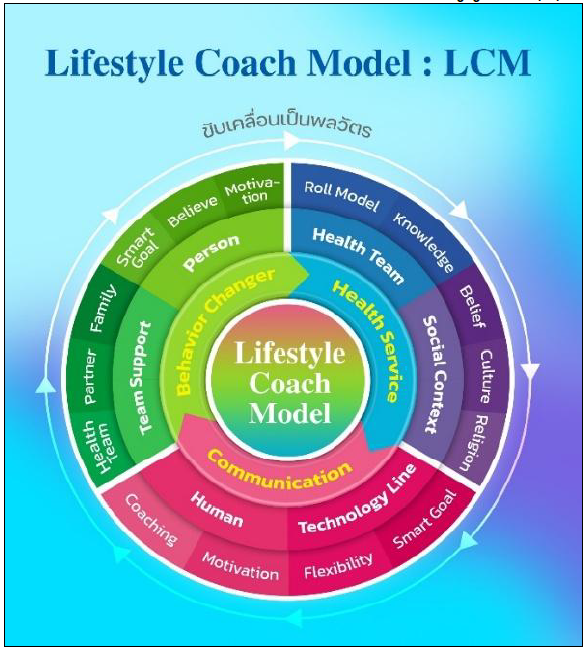
2. The developed lifestyle-coaching model emphasized three dynamic components (HBC) that interact continuously and dynamically to promote sustainable behavioral change including health service system (H), behavior changer coaching (B), and communication (C).
3. After implementation, participants showed significantly higher mean scores in self-care behaviors and overall health status compared to before the intervention (p-value < .05). The incidence of diabetes-related complications decreased, and satisfaction with the coaching activities was at the highest level.
This study suggest that the developed model is effective in improving health behaviors and enhancing well-being. It supports the Ministry of Public Health’s strategic plan for reducing and preventing the severity of non-communicable diseases. Therefore model can be expanded to health promotion units across all health regions.
References
กรมควบคุมโรค. (2562). รายงานสถานการณ์โรคเบาหวาน ความดันโลหิตสูง และปัจจัยเสี่ยงที่เกี่ยวข้อง. สำนักพิมพ์อักษรดีไซค์. สืบค้นเมื่อ 30 กันยายน 2567 จาก https://ddc.moph.go.th/uploads/publish/1035820201005073556.pdf
กองยุทธศาสตร์และแผนงาน. (2567). รายงานการป่วย ปี พ.ศ. 2565. กลุ่มข้อมูลและสารสนเทศสุขภาพ กองยุทธศาสตร์และแผนงาน. สืบค้นเมื่อ 30 กันยายน 2567 จาก https://n9.cl/e18o8
เกรียงศักดิ์ นิรัติพัฒนะศัย. (2566). พัฒนาทักษะการโค้ชผู้บริหารแบบมืออาชีพ. สถาบันเพิ่มผลผลิตแห่งชาติ.
จุไรรัตน์ สกุลจีน. (2568). ผลการรักษาแบบการแพทย์ทางไกลผ่านการวีดีโอคอลต่อพฤติกรรมการดูแลตนเองและระดับน้ำตาลสะสมในเลือดของผู้ป่วยเบาหวานไทยมุสลิม. วารสารเครือข่ายวิทยาลัยและการสาธารณสุขภาคใต้. 12(2), 1-14.
ณัฐภัสสร เดิมขุนทด, สว่างจิต สุรอมรกูล, รัชนีวรรณ ขวัญเจริญ และชาญวัฒน์ ชวนตันติกมล. (2022). ผลของการให้ความรู้และสนับสนุนการจัดการตนเองของผู้เป็นเบาหวาน ในผู้ป่วยเบาหวานชนิดที่ 2 ที่ควบคุมไม่ดี. วชิรสารการพยาบาล, 24(1), 1–24.
นุชษญากร คณาภรณ์ทิพย์. (2561). พฤติกรรมการดูแลตนเองของผู้ป่วยเบาหวานที่มารับบริการโรงพยาบาลส่งเสริมสุขภาพตำบลโพสะ อำเภอเมือง จังหวัดอ่างทอง. วารสารสถาบันบำราศนราดูร, 12(2), 60–69.
เทศบาลเมืองสะเตงนอก. (2025). รายงานสรุปผลการดำเนินงานด้านสาธารณสุข ประจำปีงบประมาณ พ.ศ. 2568. สืบค้นเมื่อ 30 กันยายน 2567 จาก https://www.satengnok.go.th/report/2025-public-health-summary
ประภาเพ็ญ สุวรรณ. (2564). การฝึกส่วนตัวเพื่อวิถีชีวิตสุขภาวะ: สิ่งท้าทายของสังคมไทย: (Health Lifestyle Coaching: A Challenge of Thai Sociaey)”. ใน เอกสารวิชาการนำเสนอในประชุมวิชาการและเสนอผลงานวิจัยระดับชาติ ครั้งที่19 มหาวิทยาลัยเวสเทิร์น. (105–117).
สรินฎา ปุติ. (2561). ความสัมพันธ์ระหว่างความเชื่อด้านสุขภาพกับการเข้าถึงบริการสุขภาพในกลุ่มโรคไม่ติดต่อเรื้อรังของประชาชนห้าจังหวัดชายแดนใต้ ประเทศไทย. วารสารพยาบาลสงขลานครินทร์, 6(4), 114–127.
สันต์ ใจยอดศิลป์ และพิจิกา วัชราภิชาต. (2566). คัมภีร์สุขภาพดี สุขภาพดีได้ง่ายๆ ด้วยตนเอง. กรีนไลฟ์พริ้นติ้งเฮ้า จำกัด.
สำนักงานสาธารณสุขจังหวัดยะลา. (2567). รายงานข้อมูลจำนวนผู้ป่วยเบาหวานรายใหม่ ประจำเดือน พฤษภาคม. Health Data Center (HDC). สืบค้นเมื่อ 12 พฤษภาคม 2568 จาก https://hdc.moph.go.th/yla/public/standard-report-etail/150edaa99ecbe538378b8150e0776763
สุนันทา กาญจนพงศ์. (2566). การพัฒนารูปแบบการสร้างสุขภาพดี วิถีใหม่ วิถีธรรม วิถีไทย วิถีเศรษฐกิจพอเพียงสำหรับผู้ป่วยโรคเบาหวานที่นับถือศาสนาอิสลาม. วารสารวิชาการสาธารณสุข, 32(เพิ่มเติม1), 86 – 101.
Ahmann, E., Saviet, M., Conboy, L., Smith, K., Iachini, B., & DeMartin, R. (2023). Health and wellness coaching and sustained gains: A rapid systematic review. American Journal of Lifestyle Medicine, 18(2), 162–180. doi.org/10.1177/15598276231180117
Association for Coaching. (2003). A Position on Health Coaching and Chronic Disease Management. Retrieved March 25, 2025 from https://www.associationforcoaching.com/page/CoachingDefine
Cohen, J. (1977). Statistical Power Analysis for The Behavioral Sciences. Academic Press.
Cohen, J. (1988). Statistical Power Analysis For The Behavioral Sciences (2nd ed.). Lawrence Erlbaum Associates. doi.org/10.4324/9780203771587
Crabtree, B. F., & Miller, W. L. (1992). The Analysis of Qualitative Data in Primary Care Research. In B. F. Crabtree & W. L. Miller (Eds.), Doing Qualitative Research (pp. 33-47). Sage Publications.
Faul, F., Erdfelder, E., Lang, A. G., & Buchner, A. (2007). G*Power 3: A flexible statistical power analysis program for the social, behavioral, and biomedical sciences. Behavior Research Methods, 39(2), 175–191. doi.org/10.3758/BF03193146
Huang, L. C., Chang, Y.-T., Chen, R.-Y., & Yang, S. H. (2021). Effectiveness of health coaching in diabetes control and lifestyle improvement: A randomized-controlled trial. Nutrients, 13(3878), 1–10.
Hyman, M. A., Ornish, D., & Roizen, M. (2009). Lifestyle medicine: Treating the causes of disease.
Alternative Therapies in Health and Medicine, 15(6), 12–14.
James, F. W. (2019). Introduction to Lifestyle Medicine: Evidence-based Clinical Practice. Lifestyle Medicine Institute.
Tan, C. C. L., Cheng, K. K. F., Hwang, S. W., Zhang, N., Holroyd, E., & Wang, W. (2020). Effect of a diabetes self-efficacy enhancing program on older adults with type 2 diabetes: A randomized controlled trial. Clin Nurs Res, 29(5), 293-303. doi: 10.1177/1054773818792480.
World Health Organization. (2023). Health Service Delivery Framework for Prevention and Management of Obesity. Retrieved September 30, 2024 from https://n9.cl/qnpe9
Downloads
Published
Issue
Section
License
Copyright (c) 2025 The Southern College Network Journal of Nursing and Public Health

This work is licensed under a Creative Commons Attribution-NonCommercial-NoDerivatives 4.0 International License.
1. บทความหรือข้อคิดเห็นใด ๆ ที่ปรากฏในวารสารเครือข่าย วิทยาลัยพยาบาลและการสาธารณสุขภาคใต้ ที่เป็นวรรณกรรมของผู้เขียน บรรณาธิการหรือเครือข่ายวิทยาลัยพยาบาลและวิทยาลัยการสาธารณสุขภาคใต้ ไม่จำเป็นต้องเห็นด้วย
2. บทความที่ได้รับการตีพิมพ์ถือเป็นลิขสิทธิ์ของ วารสารเครือข่ายวิทยาลัยพยาบาลและการสาธารณสุขภาคใต้