The Effects of Using the Line Official Account “Malnutrition” on the Knowledge, Satisfaction, and Experiences of Parents of Toddlers in Narathiwat Municipality
Keywords:
Toddlers, Line Official Account, Malnutrition, CaregiversAbstract
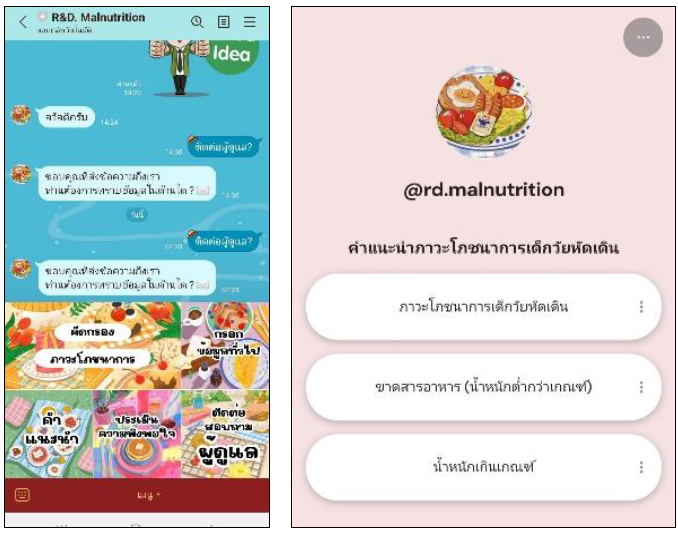
This mixed-methods study aimed to: 1) compare parents’ knowledge scores before and after receiving nutritional education for toddlers through the Line Official Account “Malnutrition”, 2) assess parents’ satisfaction with the channel, and 3) explore parents’ experiences in maintaining toddlers’ a normal nutritional status. Participants were 27 caregivers of toddlers from six child development centers in Narathiwat Municipality. There were four research instruments: 1) the contents of the Line "Official Account" called “Malnutrition”, 2) a pre- and post-test knowledge questionnaire, 3) a satisfaction questionnaire, and 4) an interview guide. The content validity index (CVI) of the instruments was measured at the 0.86 level. Reliability of knowledge test (KR-20) yielded 0.83, and the satisfaction questionnaire showed a reliability (Cronbach’s alpha) of 0.89. Quantitative data were analyzed using descriptive statistics and paired t-tests, while content analysis was used for qualitative data. Results were as follows.
1. Parents’ knowledge significantly improved after using the Line channel “Malnutrition” (p-value < .001), with mean scores increasing from 6.11 (SD = 1.36) to 7.96 (SD = 1.31).
2. Satisfaction with the channel was rated at a high level, particularly regarding the application of content to real practices (M = 4.93, SD = 0.26).
3. Caregivers’ experiences in maintaining toddlers’ nutritional status included meal preparation, observation of eating behaviors, and the use of a social media that was familiar.
Overall, this study indicates that the Line Official Account “Malnutrition” is a useful digital tool for screening toddlers’ nutritional status by inputting weight, height, age, and sex. The channel seems to effectively provide appropriate nutritional guidance to parents and caregivers.
References
Ahmed, M. (2024). Criteria for establishing trustworthiness in qualitative research. Qualitative Research Journal, 24(2), 123–135.
Alqahtani, N., Al Ghamdi, S., Al Qahtani, A., Al Humaidi, M., & Al Qahtani, M. (2021). The role of culturally tailored digital health interventions in improving caregiver engagement. BMC Health Services Research, 21, 1245.
Bandura, A. (1977). Social Learning Theory. Englewood Cliffs, NJ: Prentice Hall.
Bandura, A. (1997). Self-efficacy: The Exercise of Control. W.H. Freeman.
Barrera, M., Rothenberg, S. J., Barrows, C., & Dominguez, B. (2020). Nutrition and early childhood development: A global perspective. Early Childhood Research Quarterly, 52, 23–35.
Chen, B., Guedes, C., Cooper, S., & Lung, C. (2022). Malnutrition and cognitive development in early childhood. Child: Care, Health and Development, 48(4), 485–492.
Cohen, J. (1988). Statistical Power Analysis for The Behavioral Sciences (2nd ed.). Lawrence Erlbaum.
Díaz-Rizzolo, D. A., Llauradó, E., Falguera, M., & Farran-Codina, A. (2021). Childhood obesity and risk factors for type 2 diabetes. Nutrients, 13(5), 1605.
Elo, S., Kääriäinen, M., Kanste, O., Pölkki, T., Utriainen, K., & Kyngäs, H. (2014). Qualitative content analysis: A focus on trustworthiness. SAGE Open, 4(1), 1–10.
Faul, F., Erdfelder, E., Lang, A. G., & Buchner, A. (2007). G*Power 3: A flexible statistical power analysis program for the social, behavioral, and biomedical sciences. Behavior Research Methods, 39(2), 175–191.
Hassandra, M., Kalajas-Tilga, H., & Koka, A. (2022). The impact of bilingual digital health education on caregivers' knowledge. Health Education Research, 37(2), 105–117.
Health Data Center. (2022). Child Health Statistics: Narathiwat Province. Ministry of Public Health, Thailand.
Limvongvatana, M., Pithan, P., & Yodchai, K. (2022). Development of a Line Official Account for mothers of premature infants: Enhancing knowledge, confidence, and reducing stress. Journal of Nursing Science, 40(3), 15–28.
Mangmee, T., Perngyai, C., Chumprasert, W., & Kherlee, C. (2024). The effectiveness of a preschool child development promotion program combined with social support on caregivers’ knowledge, behavior, and skills in Chaiburi Subdistrict, Phatthalung Province. The Southern College Network Journal of Nursing and Public Health, 11(3), e270777.
Nguyen, T. H., Do, H. L., Tran, Q. M., & Le, A. T. (2023). Interactive online media and caregiver motivation: Implications for child health. JMIR Pediatrics and Parenting, 6, e42984.
Phan, T. T., Nguyen, T. H., Tran, Q. M., & Do, H. L. (2022). Digital health communication and parental satisfaction: Evidence from Vietnam. Journal of Medical Internet Research, 24(8), e35678.
Phongphuttha, S., Sittichai, R., & Yusoh, S. (2022). Nutritional status among children under 5 years old in Narathiwat province, Thailand. Journal of Health Research, 36(5), 897–906.
Puder, J. J., & Munsch, S. (2022). Psychological correlates of childhood obesity. International Journal of Obesity, 46, 1–10.
Rosanbalm, K. D., & Murray, D. W. (2020). Promoting self-regulation in early childhood: The role of nutrition and sleep. Early Childhood Education Journal, 48, 653–663.
Sukonthaman, P., Thavorncharoensap, M., & Teerawattananon, Y. (2020). Empowering caregivers through digital health interventions: A Thai perspective. Health Policy and Technology, 9(4), 100486.
Thongsri, N., Bao, Y., & Chongsuphajaisiddhi, T. (2021). Factors influencing satisfaction with e-health services in Thailand. International Journal of Environmental Research and Public Health, 18(14), 7483.
UNICEF Thailand. (2023). The State of Children in Thailand 2023. UNICEF Thailand.
UNICEF, World Health Organization, & World Bank Group. (2023). Levels and Trends in Child Malnutrition: UNICEF/WHO/World Bank Group Joint Child Malnutrition Estimates. UNICEF. https://data.unicef.org
Wang, H., Zhang, J., Chen, Y., & Liu, Y. (2023). Improving child nutrition knowledge through mobile health: Evidence from a quasi-experimental study. Nutrients, 15(2), 376.
Wang, L., Zhang, X., Li, Y., & Sun, J. (2023). Mobile nutrition applications and caregiver knowledge: A randomized controlled trial. BMC Public Health, 23, 456.
Wu, Y., Li, X., Xu, Q., & Zhao, H. (2023). Mobile application-based malnutrition screening for preschool children in rural China. Public Health Nutrition, 26(5), 1123–1133.
Downloads
Published
Issue
Section
License
Copyright (c) 2025 The Southern College Network Journal of Nursing and Public Health

This work is licensed under a Creative Commons Attribution-NonCommercial-NoDerivatives 4.0 International License.
1. บทความหรือข้อคิดเห็นใด ๆ ที่ปรากฏในวารสารเครือข่าย วิทยาลัยพยาบาลและการสาธารณสุขภาคใต้ ที่เป็นวรรณกรรมของผู้เขียน บรรณาธิการหรือเครือข่ายวิทยาลัยพยาบาลและวิทยาลัยการสาธารณสุขภาคใต้ ไม่จำเป็นต้องเห็นด้วย
2. บทความที่ได้รับการตีพิมพ์ถือเป็นลิขสิทธิ์ของ วารสารเครือข่ายวิทยาลัยพยาบาลและการสาธารณสุขภาคใต้