The Effectiveness of a Lean Service Model on Service Duration and Satisfaction among Healthcare Providers and Caregivers of Pediatric Thalassemia Patients Receiving Day Care Blood Transfusion at Surin Hospital
Keywords:
Day-care Service Model, Pediatric Thalassemia Patients, Lean ConceptAbstract
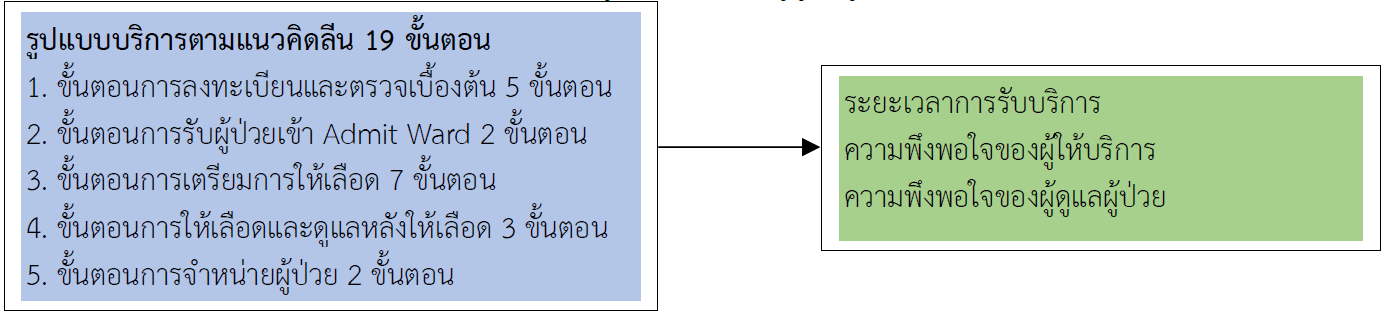
This one-group pretest–posttest quasi-experimental study aimed to examine the effects of implementing a new lean service model on service duration and satisfaction among healthcare providers and caregivers of pediatric thalassemia patients receiving day care blood transfusion at Surin Hospital. The study sample consisted of 30 participants, selected through purposive sampling. Data were collected from November to December 2024. Research instruments included: 1) the lean service model for pediatric thalassemia patients receiving day care blood transfusion at Surin Hospital, 2) a satisfaction questionnaire for caregivers, 3) a satisfaction questionnaire for healthcare providers, and 4) a service duration record form for each step of the service process. The content validity index of the instruments was 1.00, and the Cronbach’s alpha coefficients for the satisfaction questionnaires were .87 and .89, respectively. Data were analyzed using descriptive statistics and paired t-tests. The research findings were as follows.
1. After implementation, pediatric thalassemia patients receiving day care blood transfusion at Surin Hospital experienced a statistically significant reduction in service duration compared to pre-implementation (p-value < .001). The total turnaround time (TAT) from the beginning to the end of the service process decreased from 852.30 minutes (SD = 90.831) to 755.70 minutes (SD = 78.391).
2. Satisfaction scores among healthcare providers showed no significant difference between pre- and post-implementation.
3. Satisfaction scores among caregivers also showed no significant difference between pre- and post-implementation.
The findings suggest that hospitals should consider expanding the application of lean principles to other service units, such as the phlebotomy and laboratory departments, to further improve efficiency and reduce patient waiting times.
References
Aessopos, A., Farmakis, D., & Hatziliami, A. (2007). Heart disease in thalassemia intermedia:
A review of the pathophysiology and clinical features. Haematologica, 92(5), 658–665.
Brandao, C. R., Paixao, E. J. O., Costa, E. M., & Dias, C. A. (2020). Lean methodology in healthcare: A systematic review of literature. Journal of Health Organization and Management, 34(4), 481-499.
Chaikledkaew, U., Chittikun, J., Talungjit, P., Wongkrajang, P., Malasai, K., Saengrungruang, S., & Mahasirimongkol, S. (2022). Economic Evaluation of Genetic Testing for the Diagnosis of Thalassemia Carriers in Couples in Thailand. Health Systems Research Institute. (in Thai)
Cohen, J. (1988). Statistical Power Analysis for the Behavioral Sciences (2nd ed.). Lawrence Erlbaum Associates, Publishers.
Dawongsri, B. & Kakhai, R. (2023). The development care process of diabetic retinopathy patients by lean concept. Udon Thani Hospital Medical Journal, 31(2), 276-292. (in Thai)
dos Santos, P. H., Leite, L. A., & de Carvalho, M. M. (2020). Lean healthcare: A systematic review of implementation barriers and facilitators. Total Quality Management & Business Excellence, 31(7-8), 754-777.
Faul, F., Erdfelder, E., Lang, A. G., & Buchner, A. (2007). G*Power 3: A flexible statistical power analysis program for the social, behavioral, and biomedical sciences. Behavior Research Methods, 39(2), 175-191.
Fillingham, D. (2007). Application of lean thinking to health care. Clinical Medicine, 7(3), 253-256.
Jasti, N. V. K., & Kodali, R. (2015). Lean production: Literature review and trends. International Journal of Lean Six Sigma, 6(2), 118-148.
Jintawong, S., & Sirinavin, C. (2021). Epidemiology of thalassemia among the hill tribe population in Thailand. PLoS ONE, 16(2), e0246736. doi.org/10.1371/journal.pone.0246736
Lean Enterprise Institute. (n.d.). Waste. Retrieved May 1, 2025 from https://www.lean.org/WhoWeAre/NewsArticleDocuments/Lean_Waste_Definitions.pdf
Mazzocato, P., Savage, C., Brommels, M., Aronsson, H., Donnelly, P. D., Sculli, G. L., et al. (2010). Lean thinking in healthcare: A realist review of the literature. Quality & Safety in Health Care, 19(5), 376-382.
Psychological Aspects in Children and Adolescents with Major Thalassemia: A Case-Control Study. (2015). ResearchGate. Retrieved May 1, 2025 from https://www.researchgate.net/publication/277626060_Psychological_Aspects_in_Children_and_Adolescents_With_Major_Thalassemia_A_Case-Control_Study
Radnor, Z., & Boaden, R. (2008). The Lean Approach to Service Improvement: A Guide to the Application of Lean Principles to Service Delivery. Manchester Business School.
Saengthong, W., Hownarn, C., & Phantong, W. (2020). Effects of supporting system and formal education on knowledge and self-care behavior of school-aged children with thalassemia. The Southern College Network Journal of Nursing and Public Health, 7(2), 39-50. (in Thai)
Stanford Medicine Children's Health. (n.d.). Beta Thalassemia in Children. Retrieved May 1, 2025 from https://www.stanfordchildrens.org/en/topic/default?id=beta-thalassemia-in-children-90-P02330
Surin Hospital Medical Records. (2021-2023). Summary Report of Pediatric Thalassemia Patients Receiving Regular Blood Transfusions 2021-2023. [Unpublished raw data]. (in Thai)
Wannasiri, U. (2016). Application of lean concept to healthcare services to reduce system waste: A case study of the radiotherapy department in a tertiary hospital. Naresuan University Journal: Science and Technology, 24(3), 75-85. (in Thai)
Womack, J. P., & Jones, D. T. (2003). Lean Thinking: Banish Waste and Create Wealth in Your Corporation. Free Press.
Young, T., & McClean, S. (2008). A problem structuring method for the application of lean thinking in healthcare. The Journal of the Operational Research Society, 59(1), 3-10.
Downloads
Published
Issue
Section
License
Copyright (c) 2025 The Southern College Network Journal of Nursing and Public Health

This work is licensed under a Creative Commons Attribution-NonCommercial-NoDerivatives 4.0 International License.
1. บทความหรือข้อคิดเห็นใด ๆ ที่ปรากฏในวารสารเครือข่าย วิทยาลัยพยาบาลและการสาธารณสุขภาคใต้ ที่เป็นวรรณกรรมของผู้เขียน บรรณาธิการหรือเครือข่ายวิทยาลัยพยาบาลและวิทยาลัยการสาธารณสุขภาคใต้ ไม่จำเป็นต้องเห็นด้วย
2. บทความที่ได้รับการตีพิมพ์ถือเป็นลิขสิทธิ์ของ วารสารเครือข่ายวิทยาลัยพยาบาลและการสาธารณสุขภาคใต้