Quality of Life among Patients with Chronic Diseases Receiving Integrated Care
Keywords:
Quality of Life, Chronic Patients, Integrated Care, Thai Traditional MedicineAbstract
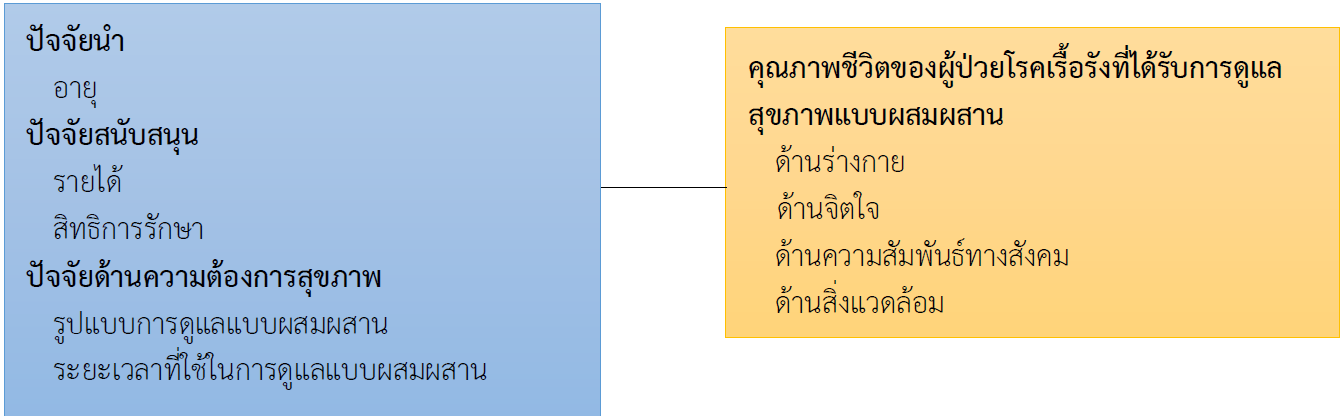
This descriptive study aimed to examine the quality of life of patients with chronic diseases receiving integrated care, and to compare their quality of life according to age, income, health insurance entitlement, types of integrated care, and duration of integrated care utilization. The sample consisted of 175 patients with chronic diseases receiving integrated care in Thai traditional medicine and alternative medicine clinics. The sample size was calculated using the G*Power program and selected through simple random sampling. Research instruments included: 1) a general information questionnaire, 2) a questionnaire on the use of integrated healthcare, and 3) a quality of life questionnaire. Content validity was verified by three experts, yielding a CVI of .84, and reliability was tested using Cronbach’s alpha coefficient (.86). Data were analyzed using descriptive statistics and one-way ANOVA, with Scheffe’s method for post hoc comparison. The results were as follows.
1. The overall quality of life of patients with chronic diseases receiving integrated care was at a moderate level (M = 3.30, SD = 0.42).
2. Patients with different types of integrated care had significantly different levels of quality of life (F = 4.477, p-value = .013). Specifically, patients receiving biologically-based therapies (M = 3.45, SD = 0.45) reported significantly higher quality of life than those receiving mind-body system therapies (M = 3.22, SD = 0.42, p-value <.05). Age, income, health insurance entitlement, and duration of care showed no significant differences.
Therefore, alternative medicine service units should provide patients with information and consultation to enable them to choose from various forms of integrated healthcare services.
References
Andersen, R. M. (1995). Revisiting the behavioral model and access to medical care: does It matter?. Journal of Health and Social Behavior, 36, 1-8. doi.org/10.2307/2137284
Aphisamacharayothin, P. (2018). Chronic patients and integrated medicine. RMUTI Journal Humanities and Social Sciences, 5(2), 150–156. (in Thai)
Chompoopan, W., Chompoopan, W., Kechit, T., Seedaket, S., Niponchai, S., & Eungpinichpong, W. (2022). The effect of an elderly care program on anxiety and health-related quality of life. The Southern College Network Journal of Nursing and Public Health, 9(2), 208-219. (in Thai)
Jiraratsatit, K., & Samakkeekarom, R. (2020). Thai traditional medicine and conventional medicine service for non-communicable diseases: case studies for integrative treatment. Thai Journal of Public Health, 50(2), 198-210. (in Thai)
Mahatnirunkul, S., Tuntipivatanaskul, W., & Pumpisanchai, W. (1998). Comparison of the WHOQOL100 and the WHOQOL-BREF (26 items). Journal of Mental Health of Thailand, 5, 4-15. (in Thai)
Nailwal, D., B, V. R., & Gupta, A. (2021). Patterns and predictors of complementary and alternative medicine use in people presenting with the non-communicable disease in an urban health facility, North India. Journal of Public Health Research, 10(1), 2109. doi.org/10.4081/jphr.2021.2109
National Center for Complementary and Alternative Medicine. (2005). Classification of Complementary and Alternative Medical Practices. NCCAM Publication. Retrieved October 10, 2024 from http:// nccam.nih.gov/health/whatiscam/index/htm.
Peltzer, K., & Pengpid, S. (2019). The use of herbal medicines among chronic disease patients in Thailand: a cross-sectional survey. Journal of Multidisciplinary Healthcare, 12, 573–582. doi.org/10.2147/JMDH.S212953
Petchsuk, R., & Cheevakasemsook, A. (2024). Seamless healthcare services in the new normal era:
Challenges for health teams. Journal of Nursing and Health Innovation, 1(1), 1-13. (in Thai)
Polit, D. F., & Beck, C. T. (2017). Nursing Research Generating and Assessing Evidence for Nursing Practice (10th ed.). Wolters Kluwer.
Praditbatuka, C., & Toemklinchan, W. (2021). Quality of life among the elderly using alternative medicine through acupuncture at Buddhachinaraj medical center, Srinakharinwirot university. Srinakharinwirot Research and Development Journal (Humanities and Social Sciences), 13(25), 25–36. (in Thai)
Pragodpol, P., Suwannaka, Y., Chaiyarit, A., Sosoem, B., Seethan, S., Sroisrisawat, M., et al. (2015). Quality of Life of Chronic Disease Patients With and Without Complications and Guidelines for Improving Quality of Life of Chronic Disease Patients. Health Systems Research Institute (HSRI). Retrieved July 12, 2025 from https://kb.hsri.or.th/dspace/handle/11228/4371 (in Thai)
Prasopthum, A., Insawek, T., & Pouyfung, P. (2022). Herbal medicine use in Thai patients with type 2 diabetes mellitus and its association with glycemic control: A cross-sectional evaluation. Heliyon, 8(10), e10790. doi.org/10.1016/j.heliyon.2022.e10790
Sombunrattanachoke, T., & Lomthaisong, W. (2020). The comparison of quality of life for the elderly in eastern economic corridor (EEC). RRBR Journal, 14(2), 12-22. (in Thai)
Srisaard, B. (2017). Preliminary Research (10th ed.). Suviriyasarn. (in Thai)
World Health Organization [WHO]. (2022). Noncommunicable Diseases. World Health Organization. Retrieved July 12, 2025 from https://www.who.int/news-room/fact-sheets/detail/noncommunicable-diseases
Downloads
Published
Issue
Section
License
Copyright (c) 2025 The Southern College Network Journal of Nursing and Public Health

This work is licensed under a Creative Commons Attribution-NonCommercial-NoDerivatives 4.0 International License.
1. บทความหรือข้อคิดเห็นใด ๆ ที่ปรากฏในวารสารเครือข่าย วิทยาลัยพยาบาลและการสาธารณสุขภาคใต้ ที่เป็นวรรณกรรมของผู้เขียน บรรณาธิการหรือเครือข่ายวิทยาลัยพยาบาลและวิทยาลัยการสาธารณสุขภาคใต้ ไม่จำเป็นต้องเห็นด้วย
2. บทความที่ได้รับการตีพิมพ์ถือเป็นลิขสิทธิ์ของ วารสารเครือข่ายวิทยาลัยพยาบาลและการสาธารณสุขภาคใต้