Development of a Health Literacy Enhancement Model Using Online Media for High-Risk Pregnant Women at Pathum Thani Hospital
Keywords:
Health Literacy Enhancement Model, High-risk Pregnant Women, Online MediaAbstract
This research aimed to analyze the situation, develop a model, implement, and evaluate the effectiveness of health literacy promotion through online media among high-risk pregnant women at Pathum Thani Hospital. The study was conducted in four phases: (1) situational analysis, problems, and needs assessment among 12 healthcare personnel; (2) model development using patient medical history records and focus group discussions; (3) model implementation with a sample of 30 high-risk pregnant women; and (4) evaluation of the outcomes. Research instruments included a health literacy assessment questionnaire and focus group guidelines. Content validity, assessed using the Index of Item-Objective Congruence (IOC), ranged from .67 to 1.00, while reliability was measured by Cronbach’s alpha coefficient, which was .86. Quantitative data were analyzed using descriptive statistics and the paired t-test, whereas qualitative data were analyzed through thematic analysis. The findings revealed that:
1. Pregnant women lack knowledge and understanding of self-care, engage in inappropriate health behaviors, and receive little support from close relatives. In addition, healthcare personnel face time constraints and limitations in providing counseling.
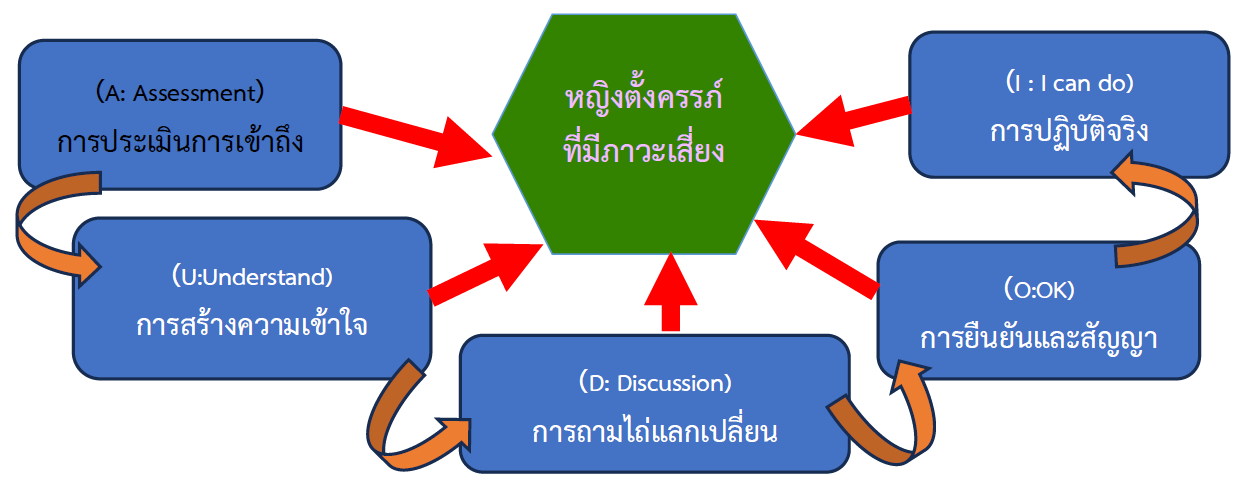
2. A health literacy promotion model utilizing online media for high-risk pregnant women, known as the AUDOI Model, was developed. It consists of five components: Assessment (evaluating access), Understand (building understanding), Discussion (asking and exchanging), OK (confirmation and commitment), and I can do (practical implementation).
3. After applying the model, it was found that both health literacy scores and health care behaviors significantly increased at the statistical level of .01 and .001.
Therefore, promoting health literacy among pregnant women with high-risk conditions should involve the use of media that is appropriate to the users’ context. It should be developed to ensure easy accessibility, contain reliable content, and align with the specific needs of this group to enhance self-care effectiveness and reduce the risk of potential complications.
References
American College of Obstetricians and Gynecologists. (2020). Obstetric Care for High-Risk Pregnancies. ACOG Publications.
Asadi, L., Amiri, F., & Safinejad, H. (2020). Investigating the effect of health literacy level on improving the quality of care during pregnancy in pregnant women covered by health centers. Journal of Education and Health Promotion, 9(1), 286.
Faul, F., Erdfelder, E., Lang, A.-G., & Buchner, A. (2007). G*Power 3: A flexible statistical power analysis program for the social, behavioral, and biomedical sciences. Behavior Research Methods, 39(2), 175-191. doi.org/10.3758/BF03193146
Ghanbari, S., Majlessi, F., Ghaffari, M., & Mahmoodi Majdabadi, M. (2020). Evaluation of health literacy of pregnant women in urban health centers of Shahid Beheshti Medical University. Daneshvar Medicine, 19(6), 1-12.
Guler, D. S., Sahin, S., Ozdemir, K., Unsal, A., & Uslu Yuvacı, H. (2021). Health literacy and knowledge of antenatal care among pregnant women. Health & Social Care in the Community, 29(6), 1815-1823.
Jia, X., Pang, Y., & Liu, L. S. (2021). Online health information seeking behavior: A systematic review. Healthcare (Basel, Switzerland), 9(12), 1740. doi.org/10.3390/healthcare9121740
Juangtrakul, C. (2010). Research Methodology in Social Sciences. O.S. Printing House. (in Thai)
Karabutr, T., Klomyong, S., Sripum, J., Ngarmkhum, R., & Prasertsri, U. (2025). The effects of a Preventive Program on the intention behaviors to prevent preterm labor and rate of preterm birth. The Southern College Network Journal of Nursing and Public Health, 12(1), e272388.
Kitcharoentanarux, P. (2024). Factors associated with preterm birth among pregnant women at Sisaket Hospital. Medical Journal of Sisaket Surin Buriram Hospitals, 39(3), 631–640.
Liu, L., Oza, S., Hogan, D., Perin, J., Rudan, I., Lawn, J. E., et al. (2019). Global, regional, and national causes of under-5 mortality in 2000–15: An updated systematic analysis with implications for the Sustainable Development Goals. The Lancet, 388(10063), 3027–3035. doi.org/10.1016/S0140-6736(16)31593-8
Nola Holness, C. N. M. (2018). High-risk pregnancy. Women’s Health Across the Lifespan, An Issue of Nursing Clinics, E-Book, 53(2), 241.
Nutbeam, D. (2000). Health literacy as a public health goal: A challenge for contemporary health education and communication strategies into the 21st century. Health Promotion International, 15(3), 259-267. doi.org/https://doi.org/10.1093/heapro/15.3.259
Nutbeam, D. (2008). The evolving concept of health literacy. Social Science & Medicine, 67(12), 2072-2078.
Samlee, S., Hirunwatthanakul, P., & Promasatayaprot, V. (2024). Results of the health literacy program for pregnant women in Borabue hospital, Borabue district, Mahasarakham province. Lampang Medical Journal, 45(1), 9–17.
Seechalee, P., & Duangsong, R. (2022). The effects of pregnancy prevention program by application of health literacy concept among secondary school female students in Udon Thani province. KKU Journal for Public Health Research, 15(1), 24-36. (in Thai)
Songsermpong, S., Rodphothong, J., & Piriyaudomporn., P. (2023). Development of a care model for high-risk pregnant women in the digital transformation era. Journal of Health Science, 32(1), s125-s137. (in Thai)
Souza, F. M. L. C., Santos, W. N., Dantas, J. C., Sousa, H. R. A., Moreira, O. A. A., & Silva, R. A. R. (2022).
Development of a mobile application for prenatal care and content validation. Acta Paul Enferm, 35, eAPE01861.
Suwanampa, T., & Purksametanan, T. (2023). Effects of a mobile application-based health education program on health literacy in pregnant women. Journal of Thailand Nursing and Midwifery Council, 38(1), 98-111. (in Thai)
Tachasuksri, T., Siriarunrat, S., Suppasri, P., Suppaseemanont, W., Boonnate, N., & Kwannate, C. (2017). Causal model for quality of life among pregnant women. The Southern College Network Journal of Nursing and Public Health, 4(1), 28-46. (in Thai)
Tavananezhad, N., Bolbanabad, A. M., Ghelichkhani, F., Effati-Daryani, F., & Mirghafourvand, M. (2022). The relationship between health literacy and empowerment in pregnant women: A cross-sectional study. BMC Pregnancy and Childbirth, 22(1), 351.
World Health Organization. (2017). Managing Complications in Pregnancy and Childbirth. Retrieved September 1, 2025 from https://www.who.int/publications/i/item/WHO-MCA-17.02
Zibellini, J., Muscat, D. M., Kizirian, N., & Gordon, A. (2021). Effect of health literacy interventions on pregnancy outcomes: A systematic review. Women and Birth, 34(2), 180-186.
Downloads
Published
Issue
Section
License
Copyright (c) 2025 The Southern College Network Journal of Nursing and Public Health

This work is licensed under a Creative Commons Attribution-NonCommercial-NoDerivatives 4.0 International License.
1. บทความหรือข้อคิดเห็นใด ๆ ที่ปรากฏในวารสารเครือข่าย วิทยาลัยพยาบาลและการสาธารณสุขภาคใต้ ที่เป็นวรรณกรรมของผู้เขียน บรรณาธิการหรือเครือข่ายวิทยาลัยพยาบาลและวิทยาลัยการสาธารณสุขภาคใต้ ไม่จำเป็นต้องเห็นด้วย
2. บทความที่ได้รับการตีพิมพ์ถือเป็นลิขสิทธิ์ของ วารสารเครือข่ายวิทยาลัยพยาบาลและการสาธารณสุขภาคใต้