Assessing Ethical Sensitivity among Nursing Administrators: A Scoping Review of Research Tools
Keywords:
Ethical Sensitivity, Instruments, Nursing AdministratorsAbstract
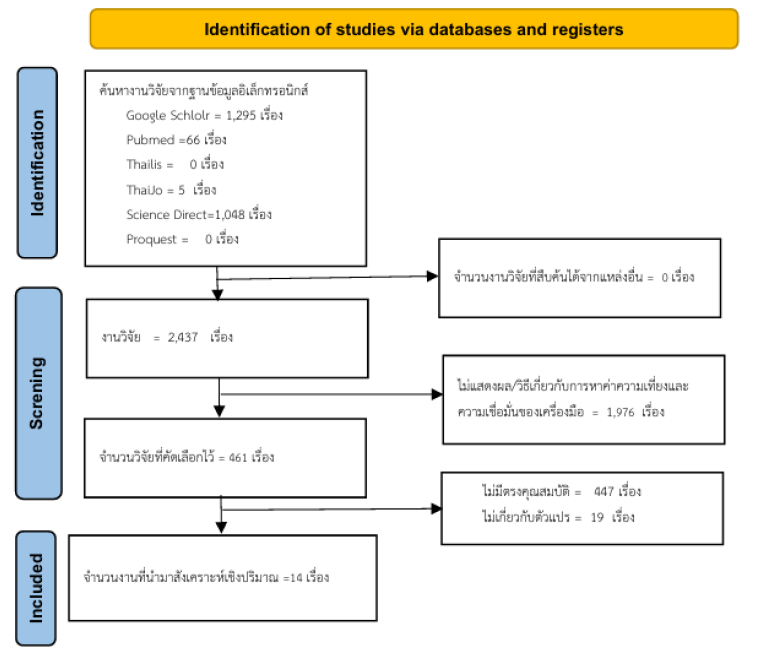
This scoping review aimed to synthesize existing knowledge regarding the characteristics of published research articles and conceptual frameworks related to the development of instruments for measuring ethical sensitivity, published between 2010 and 2020. Research articles were retrieved from both national and international databases, including CINAHL, ResearchGate, Google, Google Scholar, ProQuest, ThaiLIS, ThaiJO, Academia, ScienceDirect, and university electronic databases that met the inclusion criteria. The quality of the research articles was assessed using the appraisal tool developed by Kemet Lee and Cook . Inter-rater reliability was tested using Cohen's kappa coefficient, and descriptive statistics were employed. The Kappa test indicated no statistically significant differences (k = 0.54, p-value = .220). The findings showed as follows.
1. A total of 14 studies focused on measuring ethical sensitivity. Most were conducted in educational organizations (n = 7) and all were published in international journals (n = 14). Psychology was the predominant discipline (n = 6). The instruments commonly employed Likert scaling with 5 - 7 points (n = 14).The most frequent sample group was students (n = 5), with a sample sizes ranging from 200 – 300 participants (n = 9).
2. The instruments were referred to as the “Moral Sensitivity Questionnaire (MSQ)” or “Ethical Sensitivity Questionnaire”. Reliability was most often assessed using Cronbach’s Alpha, with coefficients ranging between .70 - .90 (n = 14). Construct validity was examined using CFA and EFA (n = 14). All studies adopted Rest’s conceptual framework, emphasizing ethical decision-making as the foundation (n = 14).
This review highlights the absence of published research in Thailand and within nursing organizations on measuring ethical sensitivity among nursing administrators. It underscores the need for nursing administrators to have reliable and valid instruments with strong validity to assess ethical sensitivity. Such tools would support the managerial capacity to foster ethically sensitive behavior, thereby reducing ethical conflicts and enhancing organizational quality in nursing contexts.
References
พันธุ์ธัช ศรีทิพันธุ์, วิไลรัตน์ จุลเดช, และรักษ์ทวี เถาโต. (2565). การพัฒนาคุณธรรมจริยธรรมของนักเรียนอนุบาล 2 โดยการประยุกต์ใช้การวิจัยเป็นฐานโรงเรียนเทศบาลชุมชนวิมลวิทยา. ศึกษาศาสตร์ มมร, 11(2), 362-376. https://so04.tci-thaijo.org/index.php/edj/article/view/270862
เพชรน้อย สิงห์ช่างชัย. (2549). หลักการและการใช้สถิติการวิเคราะห์ตัวแปรหลายตัวสำหรับการวิจัยทางการพยาบาล (พิมพ์ครั้งที่ 3). ชานเมืองการพิมพ์.
บุญใจ ศรีสถิตย์นรากูร. (2555). การพัฒนาและตรวจสอบคุณภาพเครื่องมือวิจัย: คุณสมบัติทางจิตมิติ. โรงพิมพ์แห่ง จุฬาลงกรณ์มหาวิทยาลัย.
มณี อาภานันทิกุล, สุปาณี เสนาดิสัย, พิศสมัย อรทัย, และวรรณภา ประไพพานิช. (2559). จริยธรรมในวิชาชีพพยาบาล. สำนักพิมพ์มหาวิทยาลัยมหิดล.
อาภาพรรณ ประทุมไทย. (2553). การวิเคราะห์อภิมานคุณภาพของแบบวัดความถนัด. (วิทยานิพนธ์ปริญญามหาบัณฑิต). จุฬาลงกรณ์มหาวิทยาลัย, คณะครุศาสตร์, สาขาวิชาการวัดและประเมินผลการศึกษา.
Alyousefi, N., Alibrahim, A., Taleb, H., Alotaibi, L., Alrahmah, L., Aldubaib, N., et al. (2021).
The predictors of moral sensitivity among physicians. International Journal of General Medicine, 6815-6823.
Audi, R. (2004). The Good in the Right. New Jersey: Princeton University Press.
Barkow, J. H. (2000). Code of Conduct and Behavior of Evolution. In J. P. Changeux (Ed.), Natural Origins of Ethics (pp. 95–113). Mavi Ada Publisher.
Borhani, F., Keshtgar, M., & Abbaszadeh, A. (2015). Moral self-concept and moral sensitivity in Iranian nurses. Journal of Medical Ethics and History of Medicine, 8, 4.
Borhani, F., Abbaszadeh, A., & Hoseinabadi-Farahani, M. J. (2016). Moral sensitivity and its dimensions in Iranian nursing students. Journal of Medical Ethics and History of Medicine, 9, 19.
Czusz, A., & Otrebski, W. (2013). Wrazliwosć moralna wychowanka – mozliwosci pomaru u osób z niepełnosprawnosciaumysłowa [The Moral Sensitivity of the Charge – Measuring it in Persons with Intellectual Disability]. In I. Jazukiewicz, & E. Rojewska (Eds.), Sprawnosci Moralne a Rozwój Moralny (pp. 62–102). Uniwersytet Szczecinski.
Gholami, K., & Tirri, K. (2012). The cultural dependence of the ethical sensitivity scale questionnaire: The case of Iranian Kurdish teachers. Education Research International, 2012(1), 387027.
Huang, F. F., Yang, Q., Zhang, J., Khoshnood, K., & Zhang, J. P. (2016). Chinese nurses’ perceived barriers and facilitators of ethical sensitivity. Nursing ethics, 23(5), 507-522.
Jiménez-Herrera, M. F., Font-Jimenez, I., Bazo-Hernández, L., Roldán-Merino, J., Biurrun-Garrido, A., & Hurtado-Pardos, B. (2022). Moral sensitivity of nursing students. Adaptation and validation of the moral sensitivity questionnaire in Spain. Plos one, 17(6), e0270049.
Jones, T. M. (1990). Ethical decision making by individuals in organizations: An issue-contingent model. Academy of Management Review, 16(2), 366–395. doi.org/10.5465/amr.1991.4278958
Jordan, J. (2009). A social cognition framework for examining moral awareness in managers and academics. Journal of Business Ethics, 84, 237-258.
Karcher, J. N. (1996). Auditors’ ability to discern the presence of ethical problems. Journal of Business Ethics, 15, 1033–1050. doi.org/10.1007/BF00412045
Kırılmaz, H., Akbolat, M., & Kahraman, G. (2015). A research about the ethical sensitivity of healthcare professionals. International Journal of Health Sciences, 3(3), 73–82. doi.org/10.15640/ijhs.v3n3a7
Kırılmaz, H., Harun, M. A., & Kahraman, G. (2015). A research about the ethical sensitivity of healthcare professionals. International Journal of Health Sciences, 3(3), 73–82.
Kmet, L. M., Lee, R. C., & Cook, L. S. (2004). Standard Quality Assessment Criteria for Evaluating Research Papers from a Variety of Fields. Interpret Design Inc.
Kohlberg, L. (1984). The Psychology of Moral Development: The Nature and Validity of Moral Stages (Essays on Moral Development, Vol. 2). Harper & Row.
Kuilman, L., Jansen, G. J., Mulder, L. B., Middel, B., & Roodbol, P. F. (2020). Re-assessing the validity of the Moral Sensitivity Questionnaire (MSQ): Two new scales for moral deliberation and paternalism. Journal of Evaluation in Clinical Practice, 26(2), 659-669.
Lamberton, L., & Minor-Evans L. (2009). Human Relations: Strategies for Success. (4th ed.). Irwin Mirror Press.
Lützén, K., Evertzon, M., & Nordin, C. (1997). Moral sensitivity in psychiatric practice. Nursing Ethics, 4(6), 472–482.
Lützén, K., Dahlqvist, V., Eriksson, S., & Norberg, A. (2006). Developing the concept of moral sensitivity in health care practice. Nursing Ethics, 13(2), 187–196.
Lützén, K, Nordin C. (1994). Conceptualization and instrumentation of nurses’ moral sensitivity in psychiatric practice. Intenational Journal Methods Psychiatre Research, 4, 241–248.
Midyarany, D., & Kurnia, K. (2016). Pengaruh sensitivitas etis, gender, dan locus of control terhadap perilaku etis mahasiswa [The influence of ethical sensitivity, gender, and locus of control on student ethical behavior]. Jurnal Ilmu dan Riset Akuntansi (JIRA), 5(4), 1–18.
Muttaqin, A. Z., & Yuyetta, E. N. A. (2014). Analisis Faktor-Faktor Yang Mempengaruhi Sensitivitas Etika Auditor Pemerintah (Doctoral dissertation, Fakultas Ekonomika dan Bisnis).
Narvaez, D. (2001). Ethical Sensitivity. Activity Booklet 1. Retrieved July 14, 2025 from http :// www.nd.edu/.
Narvaez, D., & Endicott, L. G. (2009). Ethical Sensitivity: Nurturing Character in the Classroom (EthEx Series Book 1). ACE Press.
Otrebski, W., & Czusz-Sudol, A. (2022). Moral sensitivity of young people with intellectual disability--its role in the process of their education. European Educational Researcher, 5(1), 37-57.
Pedersen, L. J. T. (2009). See no evil: Moral sensitivity in the formulation of business problems. Business Ethics: A European Review, 18, 335–348.
Rest, J. R. (1982). A psychologist looks at the teaching of ethics. Hastings Center Report, 12(1), 29–36.
Rest, J. R. (1983). Morality. In J. H. Flavell & E. M. Markman (Eds.), Handbook of Child Psychology: Vol. 3. Cognitive Development (pp. 556–629). John Wiley & Sons.
Rest, J. R. (1994). Moral Development in the Professions: Psychology and Applied Ethics. Psychology Press.
Robichaux, C. (2012). Developing ethical skills: From sensitivity to action. Critical Care Nurse, 32(2), 65-72.
Schluter, J., Winch, S., Holzhauser, K., & Henderson, A. (2008). Nurses' moral sensitivity and hospital ethical climate: A literature review. Nursing ethics, 15(3), 304-321.
Shaub, M. K. (1989). An Empirical Examination of the Determinants of Auditors’ Ethical Sensitivity. (Doctoral dissertation). Retrieved July 14, 2025 from http://hdl.handle.net/2346/20429
Sparks, J. R., & Hunt, S. D. (1998). Marketing researcher ethical sensitivity: Conceptualization, measurement, and exploratory investigation. Journal of Marketing, 62, 92–109.
doi.org/ 10.2307/1252163
Stankovska, G., Dimitrovski, D., Memedi, I., & Ibraimi, Z. (2019). Ethical Sensitivity and Global Competence among University Students. In N. Popov, C. Wolhuter, J. de Beer, G. Hilton, J. Ogunleye, E. Achinewhu-Nworgu, & E. Niemczyk (Eds.), BCES Conference Books: Vol. 17. Global, Regional and Local Dynamics in Comparative and International Education (pp. 132–138). Bulgarian Comparative Education Society.
Svara, J.H. (2007). The Ethics Primer: For Public Administrators in Government and Nonprofit Organizations. Jones and Bartlett Publishers.
Takizawa, M., Ota, K., & Maeda, J. (2021). Development of a questionnaire to measure the moral sensitivity of nursing students. Nagoya Journal of Medical Science, 83(3), 477.
Tongsuebsai, K., Sujiva, S., & Lawthong, N. (2015). Development and construct validity of the moral sensitivity scale in Thai version. Procedia-Social and Behavioral Sciences, 191, 718-722
Ye, B., Luo, E., Zhang, J., Chen, X., & Zhang, J. (2022). Moral sensitivity and emotional intelligence in intensive care unit nurses. International Journal of Environmental Research and Public Health, 19(9), 5132.
Yilmaz Sahin, S., Iyigun, E., & Acikel, C. (2015). Validity and reliability of a Turkish version of the modified moral sensitivity questionnaire for student nurses. Ethics & Behavior, 25(4), 351-359.
Downloads
Published
Issue
Section
License
Copyright (c) 2026 The Southern College Network Journal of Nursing and Public Health

This work is licensed under a Creative Commons Attribution-NonCommercial-NoDerivatives 4.0 International License.
1. บทความหรือข้อคิดเห็นใด ๆ ที่ปรากฏในวารสารเครือข่าย วิทยาลัยพยาบาลและการสาธารณสุขภาคใต้ ที่เป็นวรรณกรรมของผู้เขียน บรรณาธิการหรือเครือข่ายวิทยาลัยพยาบาลและวิทยาลัยการสาธารณสุขภาคใต้ ไม่จำเป็นต้องเห็นด้วย
2. บทความที่ได้รับการตีพิมพ์ถือเป็นลิขสิทธิ์ของ วารสารเครือข่ายวิทยาลัยพยาบาลและการสาธารณสุขภาคใต้