Digital Leadership among First-Line Nurse Administrators in Health Region 10: A Confirmatory Factor Analysis
Keywords:
Digital Leadership, First-line Nurse Administrators, Confirmatory Factor AnalysisAbstract
The objectives of this study were to examine digital leadership and to analyze the confirmatory components of digital leadership among first-line nurse administrators in Health Region 10. The sample consisted of 210 first-line nurse administrators, selected through stratified random sampling.Research instruments included a personal information questionnaire and a digital leadership scale, with content validity indices ranging from .60 to 1.00, and a Cronbach’s alpha coefficient of .96. Data were collected via Google Forms. Statistical analyses employed percentage, mean, standard deviation, and confirmatory factor analysis. The results showed as follows.
1. The overall digital leadership scores of first-line nurse administrators in Health Region 10 were at a high level (M = 3.67, SD = 0.66). The highest mean score was found for the digital vision dimension, followed by digital leadership characteristics.
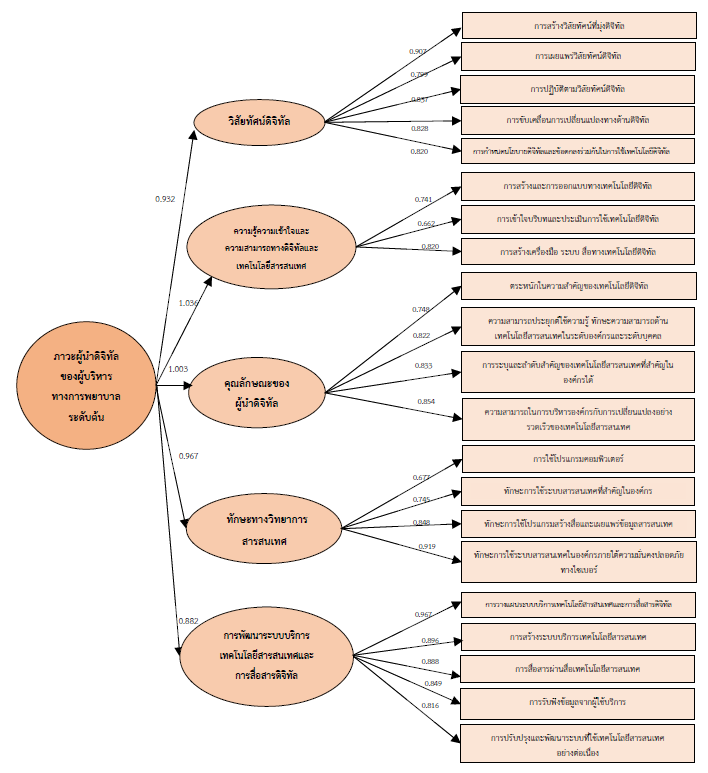
2. Digital leadership of first-line nurse administrators in Health Region 10 comprised five components: 1) digital vision, 2) digital and information technology knowledge, understanding, and competence, 3) digital leadership characteristics, 4) information science skills, and 5) development of digital information and communication technology services. Confirmatory factor analysis indicated that the model of digital leadership was consistent with empirical data, with c2 = 165.06, df = 137, p-value = 0.051, RMSEA = 0.031, SRMR = 0.013, GFI = 0.934, AGFI = 0.889, and c2df = 1.200.
The study suggests that first-line nurse administrators in Health Region 10 can apply this CFA analysis as a framework for promoting and enhancing digital leadership. This includes strengthening digital vision, knowledge, understanding, as well as digital and IT competence, leadership characteristics, information science skills, and development of digital ICT services, in order to achieve organizational goals in alignment with the Ministry of Public Health’s digital health strategy and to improve administrative efficiency.
References
Avolio, B. J. (2014). Examining leadership and organizational behavior across the boundaries of science. Consulting Psychology Journal: Practice and Research, 66(4), 288-292.
Christian, J., & Michael, J. (2019). Eliciting e-leadership style and trait preference among nurses via conjoint analysis. Enfermería Clínica, 9(1), 78–80.
Faisal. B., Tirta. N. M., Mohammad. H., & Rano, K. R. (2024). Does digital leadership impact the performance of lower-middle-class hospitals. International Journal of Innovation and Technology Management, 21(6), 2450044.
Hair, J. F., Risher, J. J., Sarstedt, M., & Ringle, C. M. (2019). When to use and how to report the sults of PLS-SEM. European Business Review, 31, 2-24.
John A. D., & Francis, K. A. (2024). Organizational culture, e-leadership, and commitment among administrators of a Christian community: Inputs to management efficiency. International Journal of Open-Access, Interdisciplinary & New Educational Discoveries of ETCOR Educational Research Center (iJOINED ETCOR), 3(1), 224–240.
Kaihlanen, A. M., Virtanen, L., Kainiemi, E., Sulosaari, V., & Heponiemi, T. (2024). Continuing education in digital skills for healthcare professionals-mapping of the current situation in EU member states. Internal Journal Health Policy Management, 13(1),1-12.
Karakose, T., Kocabas, I., Yirci, R., Papadakis, S., Ozdemir, T. Y., & Demirkol, M. (2022). The development and evolution of digital leadership: A bibliometric mapping approach-based study. Sustainability, 14(23), 16171.
Khunphun, P. (2018). A Study of Ward Head Nurses’ Leadership in Nursing Administration among Generation Y. Retrieved March 22, 2024, from http://cuir.car.chula.ac.th/handle/123456789/61341
Kumar, S., Patel, V., & Thomas, J. (2022). The role of digital leadership in advancing nursing care quality. Journal of Clinical Nursing, 31(1-2), 45–53.
Margreet, V. D. C., Richtsje, A., & Barf, H. (2023). Nursing leadership in hospital practice. A research program into perceptions, experiences, and self-assessment of leadership competencies of nurses in a top-clinical hospital in the Netherlands. Science Talks, 5, 100127.
McGowan, M. P., Seyed, H. H. D., Patrick, M. M., & Barton, D. (2019). Diagnosis and treatment of heterozygous familial hypercholesterolemia. Journal American Heart Association, 8(24), e013225.
Ministry of Public Health. (2020). Digital Health Strategy. Bangkok: Bureau of Policy and Strategy.
Muthuram, G., Dhakshinamoorthy, S., & Rajendran, R. (2023). Assessment of nurses' competencies in informatics-Towards embracing digital future. Journal of Nursing and Health Science, 12(1), 45–52.
Netwong, T. (2021). Integration of digital learning and design thinking to overcome COVID-19 challenges with creative innovation. Sakon Nakhon Rajabhat University Journal of Management Science, 1(1), 27–40.
Pasolong, H., Nilna, M., & Justina, A. J. (2021). Digital leadership in facing challenges in the era of Industrial Revolution 4.0. Webology, 18, 975-990.
Schumacker, R. E., & Lomax, R. G. (2010). A Beginners Guide to Structural Equation Modeling. New York: Routledge.
Silanoi, L. (2017). Quatitative Research Methodologies for Humanities and Social Sciencesb (Focus on business management, tourism and hotel). (2nd ed.). Faculty of Tourism and Hotel Management: Mahasarakham University. (in Thai)
Sinan, T., Ferhat O. A., & Murat, B. (2024). Can digital leadership transform AI anxiety and attitude in nurses. Journal of Nursing Scholarship, 57(5), 28-38.
Wang, Y., Liu, X., & Chen, Y. (2023). Digital leadership and its impact on nursing management performance in the digital health era. Journal of Healthcare Leadership, 15, 101–110.
Downloads
Published
Issue
Section
License
Copyright (c) 2025 The Southern College Network Journal of Nursing and Public Health

This work is licensed under a Creative Commons Attribution-NonCommercial-NoDerivatives 4.0 International License.
1. บทความหรือข้อคิดเห็นใด ๆ ที่ปรากฏในวารสารเครือข่าย วิทยาลัยพยาบาลและการสาธารณสุขภาคใต้ ที่เป็นวรรณกรรมของผู้เขียน บรรณาธิการหรือเครือข่ายวิทยาลัยพยาบาลและวิทยาลัยการสาธารณสุขภาคใต้ ไม่จำเป็นต้องเห็นด้วย
2. บทความที่ได้รับการตีพิมพ์ถือเป็นลิขสิทธิ์ของ วารสารเครือข่ายวิทยาลัยพยาบาลและการสาธารณสุขภาคใต้