A Structural Equation Model on Transformational Leadership, Organizational Learning, and Innovation Climate on Innovation Performances among First-Line Nursing Managers in Tertiary Care Hospitals
Keywords:
Transformational Leadership, Organizational Learning, Innovation Climate, Innovation PerformanceAbstract
This quantitative research on first-line nurse managers from tertiary hospitals in Thailand aimed to: 1) examine the levels of transformational leadership, organizational learning, innovation climate, and innovation performance; 2) test the structural equation model of relationships among the four variables; and 3) investigate the direct and indirect influences among the variables. The sample consisted of 311 first-line nurse managers from tertiary hospitals, selected using stratified random sampling. The research instruments were divided into five parts, one for general information and 4 questionnaires measuring the studied variables, totaling 37 items on a 5-point rating scale. The instruments had a content validity index (CVI) ranging from 0.81 to 0.94, Cronbach’s alpha coefficients ranging from 0.95 to 0.98, and construct validity was consistent with empirical data. Data were analyzed using mean, standard deviation, and structural equation modeling. The results showed the following.
1. The mean scores for perceptions of all four variables were at a high level (M = 3.12, SD = 0.46).
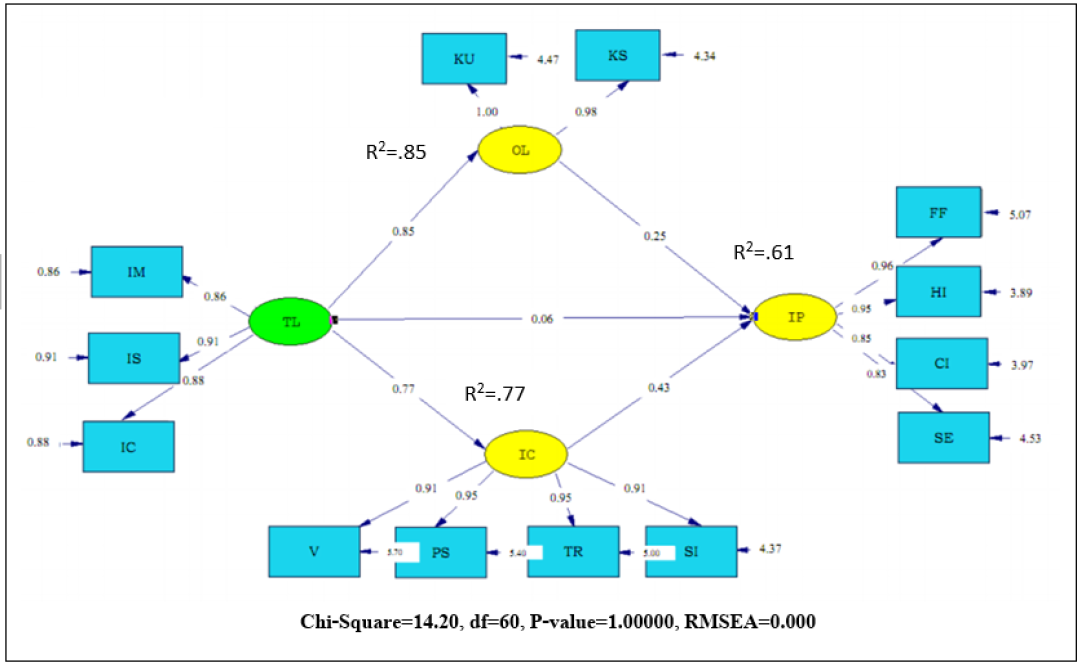
2. The structural equation model of the four variables fit the empirical data (c2 /df = 0.24, GFI = 0.99, AGFI = 0.98, CFI = 1.00, SRMR = 0.02, RMSEA = 0.00).
3. Transformational leadership had a direct influence on innovation performance (b = .06). In addition, transformational leadership indirectly influenced innovation performance through organizational learning (b = .25) and through the innovation climate (b = .43).
This study contributes new knowledge by confirming the model's consistency with empirical evidence, suggesting its applicability to nurse managers in the public healthcare sector. Further testing and development of the research instrument in private hospital settings are recommended to encompass the broader context of nursing in Thailand.
References
Aarons, G. A., & Sommerfeld, D. (2015). Leadership, innovation climate, and attitudes toward evidence-based practice during a statewide implementation. Journal of the American Academy of Child & Adolescent Psychiatry, 51(2), 423-431.
Anderson, N. R., & West, M. A. (1998). Measuring climate for work group innovation: Development and validation of the team climate inventory. Journal of Organizational Behavior, 19(3), 235–258.
Aragon-Correa, I. A., Garcia-Morales, J., & Cordon-Pozo, E. (2007). Leadership and organizational learning's role on innovation and performance: Lesson from spain. Journal of Industrial Marketing Management, 36, 349-358.
Bass, B. M., & Riggio, R. E. (2006). Transformational Leadership 2nd Edition. Mahwen, NJ: Lawrence Erlbaum.
Birchall, D., Chanaron, J. J., Tovstiga, G. & Hillenbrand, C. (2011). Innovation performance measurement: Current practices, issues and management challenges. Int. J. Technology Management, 56(1), 1-20.
Burns, N. & Grove, S. K. (2010). The Practice of Nursing Research: Appraisal, Synthesis, and Generation of Evidence (6 "ed.). Saunders Elsevier.
Cui, F., Lim, H., & Song, J. (2022). The influence of leadership style in China SMEs on enterprise innovation performance. MDPI Journal, 14 (3249), 1-17.
Flegal, K. (2015). Tertiary hospitals must provide general care. Canadian Medical Association Journal, 187(4), 235-245.
Garcia-Morales, V. S., Jimenez-Barrionuevo, M. M., & Gutierrez-Gutierrez, L. (2014). Transformational leadership influence on organizational performance through organizational learning and innovation. Journal of Business Research, 65(2), 1040-1050.
Gupta, K. K., Attri, J. P., Singh, A., Karu, H., & Karu, G. (2016). Basic concepts for sample sizecalculation: Critical step for any clinical trials. Saudi J Anaesth, 10(3), 328-331.
Huber, G. P. (1991). Organizational learning: The contributing processes and the literatures. Organization Science, 2(1), 88–115.
Jiang, W., Wang, H., Zhang, Y., & Liu, W. (2023). Transformational leadership, adaptability, and job crafting. Journal of Vocational Behavior, 100, 185-195.
Jimenez-Jimenez, D., & Sanz-Valle, R. (2011), Innovation, organizational learning, and performance. Journal of Business Research, 64(4), 408-417.
Krejcie, R. V. & Morgan, D. W. (1970). Determining sample size for research activities. Educational and Psychological Measurement, 30, 607-610.
Limjaroen, K., Singchangchai, P., & Pathumarak, N. (2021). A structural equation model of transformational leadership, innovation management, and innovation performance as perceived by first-line nurse managers of general hospitals under ministry of public health. Journal of Bamrasnaradura Infectious Diseases Institute, 15(3), 150-161. (in Thai)
Ngaithe, L., & Aol, G. (2023). Effect of idealized influence and inspirational motivation on staff performance. European Journal of Business and Management, 8(30), 6-13.
Nursing Division of Ministry of Public Health Thailand. (2023). National Nursing Service Strategy 2019-2024 according to the National Strategy Plan 20 years. Retrieved Aug 18, 2023 from www.don.go.th. (in Thai)
Office of the Nation Economic and Social Development Board. (2009). Regional and Provincial Products for The New Base Year 1981-1991. Retrieved March 20, 2023 from http://www.nesdb.go.th. (in Thai)
Ongsawang, A., & Nilrat, N. (2018). Transformational leadership, and characteristics of followers that influence organization effectiveness in sub-district health promoting hospitals, Narathiwat province. The Southern College Network Journal of Nursing and Public Health, 5(2), 272-287. (in Thai).
Puspitawati, R., & Ricky, R. (2024). The influence of idealized influence, inspirational motivation, intellectual stimulation and individualized consideration on teaching behavior mediated by entrepreneurial behavior. Petra International Journal of Business Studies, 7(2), 201-210.
Robertson, J., Caruana, A., & Ferreira, C. (2023). Innovation performance: The effect of knowledge-based dynamic capabilities in cross-country innovation ecosystem. Journal of International Business Review, 32(2), 1-14.
Schumacker, R. E., & Lomax, R. G. (2010). A Beginner's Guide to Structural Equation Modeling (3"ed.). Lawrence Erlbaum Associates.
Singchungchai, P. (2019). Innovative leadership in nursing management. The Southern College Network Journal of Nursing and Public Health, 6(1), 260-267. (in Thai).
Thanomsaksri, N., Singchangchai, P., & Pathumarak, N. (2020). Factors influencing innovation performance in nursing organizations as perceived by head nurses of community hospitals under the ministry of public health. Journal of Health and Nursing Research, 36(2), 77-94. (in Thai)
Tidd, J., & Bessent, J. (2015). Management Innovation (5thed.) West Sussex; Wiley.
Tohidi, M., Seyedaliakbar, M., & Mandegari, M. (2018). Organizational learning and the effect on innovation. Journal of Enterprise Information Management, 25(3), 219-245.
Zuraik, A., & Kelly, L. (2018). The role of CEO transformational leadership and innovation climate in exploration and exploitation. European Journal of Innovation Management, 3(12), 1-12.
Downloads
Published
Issue
Section
License
Copyright (c) 2025 The Southern College Network Journal of Nursing and Public Health

This work is licensed under a Creative Commons Attribution-NonCommercial-NoDerivatives 4.0 International License.
1. บทความหรือข้อคิดเห็นใด ๆ ที่ปรากฏในวารสารเครือข่าย วิทยาลัยพยาบาลและการสาธารณสุขภาคใต้ ที่เป็นวรรณกรรมของผู้เขียน บรรณาธิการหรือเครือข่ายวิทยาลัยพยาบาลและวิทยาลัยการสาธารณสุขภาคใต้ ไม่จำเป็นต้องเห็นด้วย
2. บทความที่ได้รับการตีพิมพ์ถือเป็นลิขสิทธิ์ของ วารสารเครือข่ายวิทยาลัยพยาบาลและการสาธารณสุขภาคใต้