Effect of a Critical Practice Guideline on the Management of Nausea and Vomiting in Patients Undergoing Chemotherapy : A Best Practice Implementation Project in the Thai Context
Keywords:
Practice Guideline, Nausea and Vomiting Management, Cancer Treatment, ChemotherapyAbstract
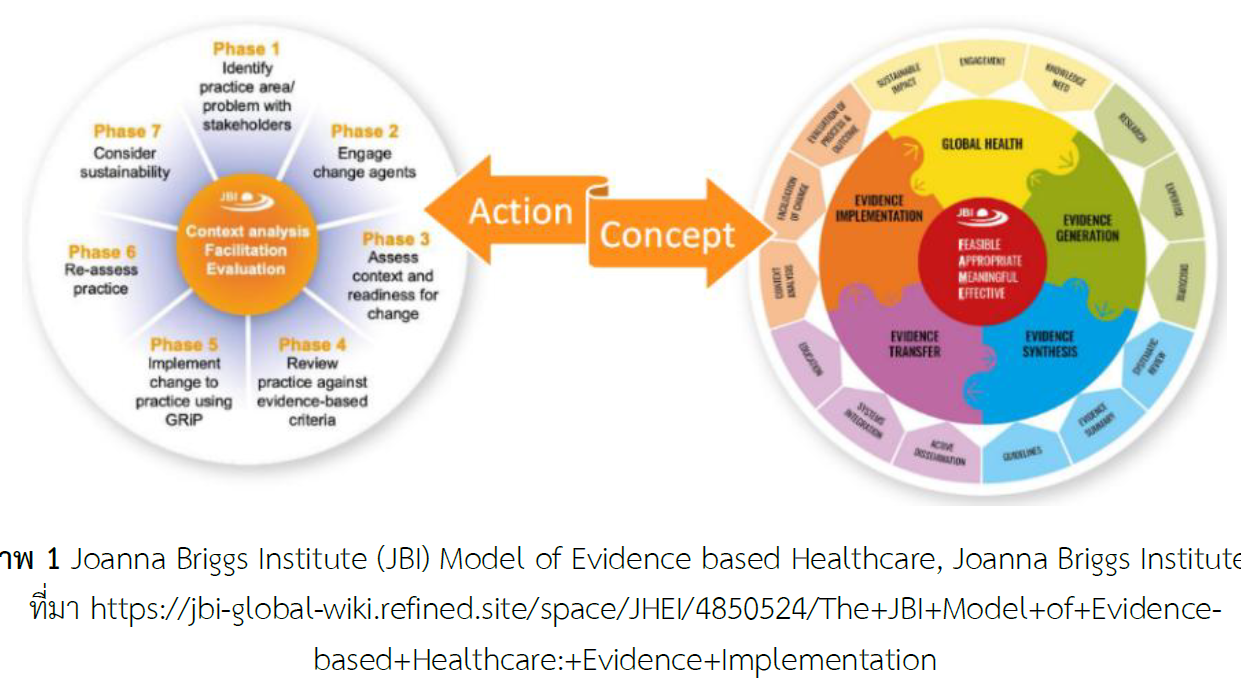
This experimental study aimed to evaluate the effectiveness of a practice guideline for managing chemotherapy-induced nausea and vomiting (CINV) in cancer patients within the Thai healthcare context. The study was conducted at Tha-Bo Crown Prince Hospital, Nong Khai Province, involving 120 cancer patients receiving chemotherapy. The patients were recruited by convenience sampling between January and July 2024. The guideline was adapted based on an evidence-based healthcare framework, utilizing the seven-step evidence-based practice process from the Joanna Briggs Institute, Australia. Research instruments included: (1) a risk assessment tool for chemotherapy-induced nausea and vomiting, (2) Nausea and vomiting recording form, (3) Function Living Index : Emesis, and (4) Audit criteria checklist. Data were analyzed using descriptive statistics, frequencies, percentages, and Pearson’s chi-square test.
The results showed a significant improvement in symptom management. The proportion of patients experiencing no nausea or mild nausea increased from 40% to 95% (p-value < .001). Additionally, the proportion of patients with no vomiting or only mild vomiting that did not require medication increased from 65% to 100% (p-value < .001). Quality of life assessments indicated that participants maintained a good quality of life, with no significant negative impact from CINV before or after guideline implementation. Moreover, adherence to practice criteria showed a 100% improvement in audit criteria 1 and 4.
In conclusion, the practice guideline demonstrated effectiveness in managing CINV and can be applied in healthcare settings to improve patient outcomes.
References
Chanthawong, S., (2019). Prevention of chemotherapy-induced nausea and vomiting. Srinagarind Medical Journal, 34(1), 115-126.
Damschroder, L. J., Aron, D. C., Keith, R. E., Kirsh, S. R., Alexander, J. A., & Lowery, J. C., (2009). Fostering implementation of health services research findings into practice: a consolidated framework for advancing implementation science. Implementation Science, 4(50), 1-15. doi.org/10.1186/1748-5908-4-50
Dielenseger, P., Börjeson, S., Vidall, C., Young, A., & Jahn, P., (2019). Evaluation of antiemetic practices for prevention of chemotherapy-induced nausea and vomiting (CINV): results of a European oncology nurse survey. Supportive Care in Cancer, 27(11), 4099-4106. doi.org/10.1007/s00520-019-04697-1.
Dranitsaris, G., Molassiotis, A., Clemons, M., Roeland, E., Schwartzberg, L., Dielenseger, P., et al. (2017). The development of a prediction tool to identify cancer patients at high risk for chemotherapy-induced nausea and vomiting. Annals of Oncology, 28(6), 1260–1267. doi.org/10.1093/annonc/mdx100
Einhorn, L. H., Rapoport, B., Navari, R. M., Herrstedt, J., & Brames, M. J. (2017). 2016 updated MASCC/ESMO consensus recommendations: prevention of nausea and vomiting following multiple-day chemotherapy, high-dose chemotherapy, and breakthrough nausea and vomiting. Supportive Care in Cancer, 25, 303-308. https://www.ncbi.nlm.nih.gov/pubmed/27815710
Hashimoto, H., Abe, M., Tokuyama, O., Mizutani, H., Uchitomi, Y., Yamaguchi, T., et al., (2020). Olanzapine 5 mg plus standard antiemetic therapy for the prevention of chemotherapy-induced nausea and vomiting (J-FORCE): a multicentre, randomised, double-blind, placebo-controlled, phase 3 trial. The Lancet Oncology, 21(2), 242-249.
Hesketh, P. J., Kris, M. G., Basch, E., Bohlke, K., Barbour, S. Y., Clark-Snow, R. A., et al., (2020). Antiemetics: ASCO guideline update. Journal of Clinical Oncology, 38(24), 2782–2797. doi.org/10.1200/JCO.20.01296
Lindley, C. M., Hirsch, J. D., O’Neill, C. V., Transau, M. C., Gilbert, C. S., Osterhaus, J. T., (1992). Quality of life consequences of chemotherapy-induced emesis. International journal of quality of life aspects of treatment, care and rehabilitation, 1(5), 331-334. doi.org/10.1007/BF00434947
Maher, L., Gustafson, D., & Evans, A. (2010). NHS Sustainability Model and Guide. Institute for Innovation and Improvement. Retrieved March 20, 2024 from https://www.ktpathways.ca/system/files/resources/2019-11/nhs_sustainability_model_-_february_ 2010_1_.pdf
Martin, A. R., Pearson, J. D., Cai, B., Elmer, M., Horgan, K., Lindley, C., (2003). Assessing the impact of chemotherapy-induced nausea and vomiting on patients' daily lives: a modified version of the Functional Living Index-Emesis (FLIE) with 5-day recall. Journal of Multinational Association Supportive Care in Cancer. 11, 522–527. doi.org/10.1007/s00520-003-0482-4
National Cancer Institute. (2017). Common Terminology Criteria for Adverse Events (CTCAE) Version 5.0., U.S. Department of Health and Human Services. Retrieved June 20, 2024 from https://ctep.cancer.gov/protocoldevelopment/electronic_applications/docs/CTCAE_v5_Quick_Reference_8.5x11.pdf
National Comprehensive Cancer Network (NCCN), (2023). NCCN Clinical Practice Guidelines in Oncology Version 2. Antiemesis. National Comprehensive Cancer Network. Retrieved May 15, 2024 from http://www.nccn.org/ professionals/physician_gls/pdf/antiemesis.pdf.
Patel, P., Robinson, P.D., Wahib, N., Cheung, P., Wong, T., Cabral, S., et al., (2022). Interventions for the prevention of acute phase chemotherapy-induced nausea and vomiting in adult and pediatric patients: a systematic review and meta-analysis. Support Care Cancer. 30, 8855–8869. doi.org/10.1007/s00520-022-07287-w
Piechotta, V., Adams, A., Haque, M., Scheckel, B., Kreuzberger, N., Monsef, I., et al. (2021). Antiemetics for adults for prevention of nausea and vomiting caused by moderately or highly emetogenic hemotherapy: a network meta-analysis. Cochrane Database of Systematic Reviews, 11, CD012775. doi.org/10.1002/14651858.CD012775.pub2
Schleicher, S. M., Bach, P. B., Matsoukas, K., & Korenstein, D. (2018). Medication overuse in oncology: current trends and future implications for patients and society. The Lancet Oncology, 19(4), e200-e208. doi.org/10.1016/S1470-2045(18)30099-8.
Schwartzberg, L., Harrow, B., Lal, L. S., Radtchenko, J., & Lyman, G. H. (2015). Resource utilization for chemotherapy-induced nausea and vomiting events in patients with solid tumors treated with antiemetic regimens. American Health & Drug Benefits, 8(5), 273-282.
Sommariva, S., Pongiglione, B., & Tarricone, R. (2016). Impact of chemotherapy-induced nausea and vomiting on health-related quality of life and resource utilization: a systematic review. Critical reviews in oncology/hematology, 99, 13-36. doi:10.1016/j.critrevonc.2015.12.001.
Wang, D. S., Hu, M. T., Wang, Z. Q., Ren, C., Qiu, M. Z., Luo, H. Y., et al., (2021). Effect of aprepitant for the prevention of chemotherapy-induced nausea and vomiting in women: A randomized clinical trial. JAMA Network Open, 4(4), e215250. doi.org/10.1001/jamanetworkopen.2021.5250
Wu, Y. (2024). Massive multi-site audit projects: preparation, organization, and project management. JBI Evidence Implement, 22, 119. doi.org/10.1097/XEB.0000000000000427
Downloads
Published
Issue
Section
License
Copyright (c) 2025 The Southern College Network Journal of Nursing and Public Health

This work is licensed under a Creative Commons Attribution-NonCommercial-NoDerivatives 4.0 International License.
1. บทความหรือข้อคิดเห็นใด ๆ ที่ปรากฏในวารสารเครือข่าย วิทยาลัยพยาบาลและการสาธารณสุขภาคใต้ ที่เป็นวรรณกรรมของผู้เขียน บรรณาธิการหรือเครือข่ายวิทยาลัยพยาบาลและวิทยาลัยการสาธารณสุขภาคใต้ ไม่จำเป็นต้องเห็นด้วย
2. บทความที่ได้รับการตีพิมพ์ถือเป็นลิขสิทธิ์ของ วารสารเครือข่ายวิทยาลัยพยาบาลและการสาธารณสุขภาคใต้