Leadership Experience in Talent Management among First-Line Nurse Administrators in University Hospitals
Keywords:
Leadership, Talent Management, Experience, First-Line Nurse Managers, University HospitalsAbstract
This phenomenological qualitative study explored the meaning and traits of leadership for talent management among first-line nurse managers (FLNMs) in university hospitals. Ten FLNMs with at least one year of experience in nursing administration were selected using snowball sampling. Data were collected through in-depth interviews and analyzed using Colaizzi's method. Triangulation was used to ensure the validity of the qualitative data. The results showed the following.
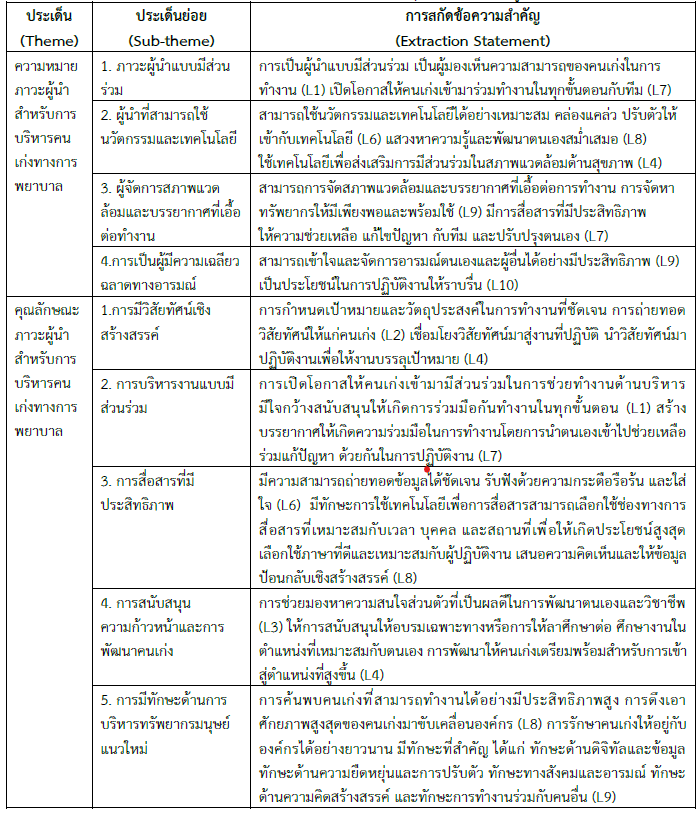
1. The meaning of leadership for talent management among FLNMs encompassed four aspects: 1) participative leadership; 2) the ability to utilize innovation and technology; 3) managing a conducive work environment to create a satisfactory workplace; and 4) possessing emotional intelligence.
2. Key leadership characteristics for talent management among FLNMs included five aspects: 1) visionary and creative thinking; 2) participatory management; 3) effective communication; 4) support for career growth and development; and 5) modern human resource management skills.
This study highlights that leadership for talent management in first-line nurse administrators is an emerging concept. Further research, both qualitative and quantitative, is needed to enhance understanding in nursing administration. These findings can be used as a framework for developing quantitative tools to assess leadership for talent management in nursing organizations.
References
Cabral, A., Oram, C., & Allum, S. (2019). Developing nursing leadership talent-Views from the NHS nursing leadership for south‐east England. Journal of Nursing Management, 27(1), 75-83.
Chan, S. C. (2019). Participative leadership and job satisfaction: The mediating role of work engagement and the moderating role of fun experienced at work. Leadership & Organization Development Journal, 40(3), 319-333.
Collings, D. G., & Mellahi, K. (2009). Strategic talent management: A review and research agenda. Human resource management review, 19(4), 304-313.
DuBrin, A. J. (2016). Leadership. Research Findings, Practice, and Skill. (8th ed.). Boston, MA: Cengage Learning.
Fowler, K. R., Robbins, L. K., & Lucero, A. (2021). Nurse manager communication and outcomes for nursing: An integrative review. Journal of nursing management, 29(6), 1486–1495. doi.org/10.1111/jonm.13324
Goffee, R., & Jones, G. (2007). Leading clever people. Harvard business review, 85(3), 72.
Gubman, L. E. (1998). The Talent Solution: Aligning Strategy and People to Achieve Extraordinary Results. New York : McGraw-Hill.
Hatch, T. (2009). The Outside-Inside Connection:Educational Leadership. New York: McGraw-Hill.
Huang, X., Iun, J., Liu, A., & Gong, Y. (2010). Does participative leadership enhance work performance by inducing empowerment or trust? The differential effects on managerial and non‐managerial subordinates. Journal of Organizational Behavior, 31(1), 122-143.
Ingham-Broomfield, R. (2015). A nurses' guide to qualitative research. Australian Journal of Advanced Nursing, The, 32(3), 34-40.
Jing, Z., Jianshi, G., Jinlian, L., & Yao, T. (2017). A case study of the promoting strategies for innovation contest within a company. Science Research Management. 38, 57–65. doi: 10.19571/j.cnki.1000-2995.2017.11.007
Karwan, D. H., Hariri, H. & Ridwan, R. (2021). Visionary leadership: What, why, and how. doi.10.4108/eai.16-10-2020.2305217.
Kumar, R. D. (2022). Leadership in healthcare. Clinics in Integrated Care, 10, 100080.
Kunie, K., Kawakami, N., Shimazu, A., Yonekura, Y., & Miyamoto, Y. (2017). The relationship between work engagement and psychological distress of hospital nurses and the perceived communication behaviors of their nurse managers: A cross-sectional survey. International Journal of Nursing Studies, 71, 115-124. doi.org/10.1016/j.ijnurstu.2017.03.011
Luedi M. M. (2022). Leadership in 2022: A perspective. Best practice & research. Clinical Anaesthesiology, 36(2), 229–235. doi.org/10.1016/j.bpa.2022.04.002
Mabona, J. F., van Rooyen, D., & Ten Ham-Baloyi, W. (2022). Best practice recommendations for healthy work environments for nurses: An integrative literature review. Health SA Gesondheid, 27, a1788. doi.org/10.4102/hsag.v27i0.1788
Mccauley, C. & Wakefield, M.. (2006). Talent management in the 21st century: Help your company find, develop, and keep its strongest workers. The Journal for Quality and Participation. 29. 4-7.
Mey, M. R., Poisat, P., & Stindt, C. (2021). The influence of leadership behaviours on talent retention: An empirical study. SA Journal of Human Resource Management, 19(0), a1504. doi. org/10.4102/sajhrm. v19i0.1504.
Myers, E., (2024). Participative Leadership Style. Retrieved November 3, 2024 from https://www.simplypsychology.org/participative-leadership.html
Navarro Martínez, O., & Leyva-Moral, J. M., (2024). Digital transformation led by nurses and nursing managers’ priorities: A qualitative study, Journal of Nursing Management, 8873127. doi.org/10.1155/2024/8873127
Nojedeh, S. H., & Ardabili, F. S. (2015). An overview on talent management in nursing. Management
Issues in Healthcare System, 1, 4-17
Northouse, P. G. (2016). Leadership: Theory and Practice (7th ed.). Thousand Oaks: Sage Publications.
Nowak, H. E., & Scanlan, J. M. (2021). Strategy to stay ahead of the curve: A concept analysis of talent management. Nursing forum, 56(3), 717–723. doi.org/10.1111/nuf.12571.
Rafiq, M., Zhang, X., Jia-hai, Y. & Naz, S. (2020). Human resource management: Theory to practice: evidence from literature. 2019. International Journal of Management Research and Emerging Sciences. doi.10.56536/ijmres.v9i1.45.
Rothwell, W. J. & Kazanas, H.C. (2004). Strategic Development of Talent. Massachusetts: HRD Press.
Singchungchai, P. (2009). Principles and Application of Qualitative Research in Nursing and Health. 3rded, Songkhla: Chanmaung. (in Thai)
Downloads
Published
Issue
Section
License
Copyright (c) 2025 The Southern College Network Journal of Nursing and Public Health

This work is licensed under a Creative Commons Attribution-NonCommercial-NoDerivatives 4.0 International License.
1. บทความหรือข้อคิดเห็นใด ๆ ที่ปรากฏในวารสารเครือข่าย วิทยาลัยพยาบาลและการสาธารณสุขภาคใต้ ที่เป็นวรรณกรรมของผู้เขียน บรรณาธิการหรือเครือข่ายวิทยาลัยพยาบาลและวิทยาลัยการสาธารณสุขภาคใต้ ไม่จำเป็นต้องเห็นด้วย
2. บทความที่ได้รับการตีพิมพ์ถือเป็นลิขสิทธิ์ของ วารสารเครือข่ายวิทยาลัยพยาบาลและการสาธารณสุขภาคใต้