การพัฒนารูปแบบการเฝ้าระวัง ป้องกัน ควบคุมโรคติดต่อในศูนย์พัฒนาเด็กเล็ก อำเภอควนโดน จังหวัดสตูล
คำสำคัญ:
โรคติดต่อ, เด็กวัยก่อนเรียน, ศูนย์พัฒนาเด็กเล็ก, การเฝ้าระวังป้องกันบทคัดย่อ
การวิจัยเชิงปฏิบัติการนี้มีวัตถุประสงค์ 1) เพื่อศึกษาสภาพการณ์ และปัญหาการดำเนินงานเฝ้าระวัง ป้องกันและควบคุมโรคติดต่อในศูนย์พัฒนาเด็กเล็ก 2) เพื่อพัฒนารูปแบบการเฝ้าระวัง ป้องกันและควบคุมโรคติดต่อในศูนย์พัฒนาเด็กเล็ก 3) เพื่อประเมินผลลัพธ์ของรูปแบบ ดำเนินการ 3 ขั้นตอน ขั้นตอนที่ 1 สังเคราะห์สภาพการณ์ และปัญหาการดำเนินงาน กลุ่มตัวอย่างแบบเฉพาะเจาะจง จำนวน 25 คน ขั้นตอนที่ 2 พัฒนารูปแบบ กลุ่มตัวอย่างเป็นครูผู้ดูแลเด็ก จำนวน 46 คน ขั้นตอนที่ 3 ประเมินผลลัพธ์ กลุ่มตัวอย่างเป็นครูผู้ดูแลเด็กจำนวน 46 คน วิเคราะห์ข้อมูลเชิงคุณภาพโดยการวิเคราะห์เนื้อหา สำหรับข้อมูลเชิงปริมาณใช้ความถี่ ร้อยละ ค่าเฉลี่ย และสถิติ Paired t-test ผลการวิจัย พบว่า
1. สภาพการณ์การดำเนินงานเฝ้าระวัง ป้องกัน ควบคุมโรคติดต่อ พบว่า ส่วนใหญ่ครูผู้ดูแลเด็ก ขาดความรู้ สำหรับมาตรการในป้องกันควบคุมโรคติดต่อยังดำเนินการไม่ถูกต้อง ได้แก่ มาตรการการคัดกรองเด็ก การบันทึกอาการป่วยของเด็กในแบบคัดกรองอาการป่วยรายห้องเรียนและการไม่แจ้งข่าวการพบเด็กป่วย
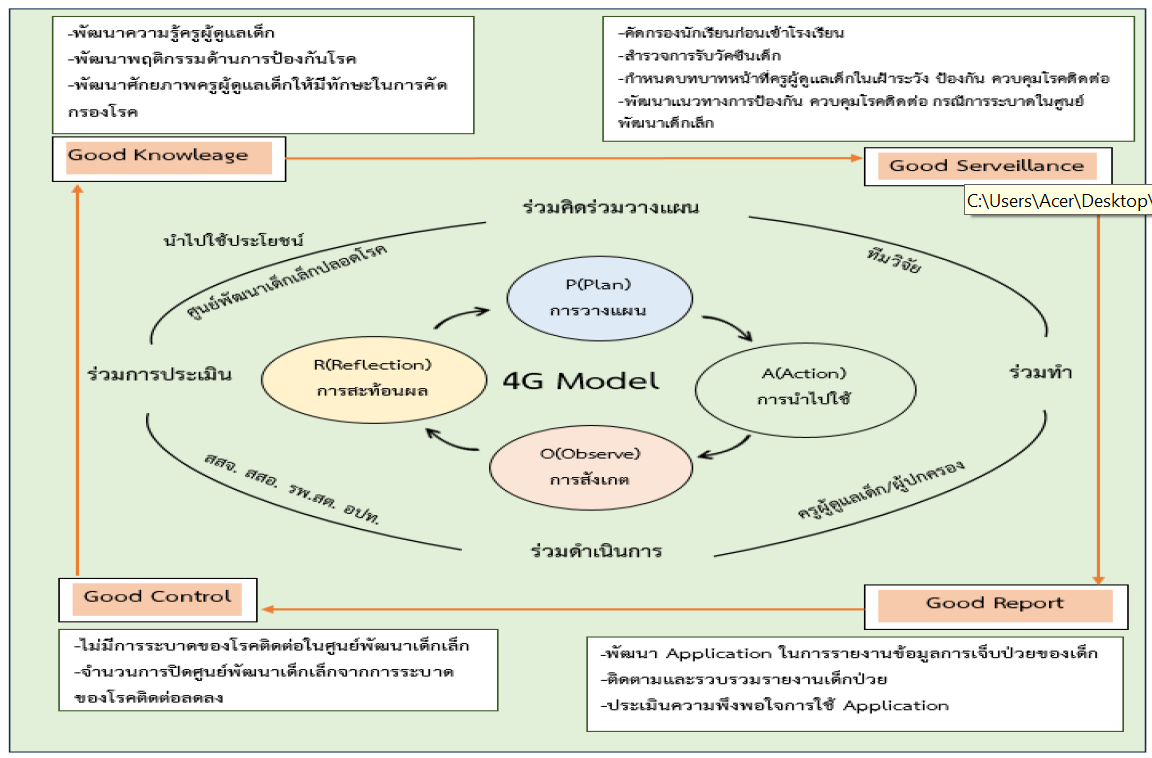
2. รูปแบบการเฝ้าระวัง ป้องกันและควบคุมโรคติดต่อในศูนย์พัฒนาเด็กเล็ก อำเภอควนโดน จังหวัดสตูล เป็นรูปแบบ 4 G Model ประกอบด้วย 1) Good Knowledge พัฒนาความรู้ครูผู้ดูแลเด็ก 2) Good Surveillance System มีระบบเฝ้าระวังที่ดี 3) Good Report โดยการพัฒนา Application ในการรายงานข้อมูลเด็กป่วย 4) Good Control มีการควบคุมโรคที่มีประสิทธิภาพไม่มีการระบาดของโรคติดต่อ
3. ผลลัพธ์ของรูปแบบฯ พบว่า กลุ่มตัวอย่างมีความรู้และพฤติกรรมการป้องกันโรค สูงกว่าก่อนการพัฒนารูปแบบ อย่างมีนัยสำคัญทางสถิติที่ระดับ .001 ครูผู้ดูแลเด็กมีความพึงพอใจในการใช้ Application ในระดับสูง ผลลัพธ์ของรูปแบบที่พัฒนาขึ้นพบว่า ศูนย์พัฒนาเด็กเล็กในอำเภอควนโดนไม่มีรายงานการปิดศูนย์พัฒนาเด็กเล็กจากการระบาดของโรคติดต่อ เมื่อเปรียบเทียบกับช่วงเวลาเดียวกันของ 3 ปีย้อนหลัง
ข้อเสนอแนะ รูปแบบการเฝ้าระวัง ป้องกัน ควบคุมโรคติดต่อในศูนย์พัฒนาเด็กเล็กที่เหมาะสม จะต้องมีการเสริมความรู้ มีการฝึกทักษะ มีแนวทางการปฏิบัติที่ชัดเจน และมีการกำกับดูแลติดตามอย่างต่อเนื่อง กิจกรรมดังกล่าวข้างต้นจะสามารถป้องกันและลดอุบัติการณ์การระบาดของโรคติดต่อในศูนย์พัฒนาเด็กเล็กลงได้
เอกสารอ้างอิง
Amporn, S., Sukhonthachit, P., & Ditsuwan, T. (2020). Development of the prevention and control model for hand foot and mouth disease in child care center, Sadao District, Songkhla Province. Disease Control Journal, 46(4), 405-413. (in Thai)
Best, J. W. (1977). Research in Education. (3rd ed.) Englewood Cliffs, New Jersey: Prentice Hall.
Bloom, B. S., Hastings, J. T., & Madaus, G. F. (1971). Handbook on Formative and Summative Evaluation of Student Learning. New York: McGraw–Hill.
Bureau of Epidemiology Ministry of Public Health. (2017). Surveillance System (Report 506). Retrieved October 2, 2017 from: http://www.boe.moph.go.th/boedb/surdata/disease.
Chan, J. H., Law, C. K., Hamblion, E., Fung, H., & Rudge, J. (2017). Best practices to prevent transmission and control outbreaks of hand foot and mouth disease in childcare facilities: a systematic review. Hong Kong Medical Journal, 23(2), 177-190.
Cronbach, L. J. (1951). Coefficient alpha and the internal structure of tests. Psychometrika, 16(3), 297-334.
Division of Communicable Diseases. (2019). Technical Guide for Developing Childcare Centers to Excellence Prevention and Control of Communicable Diseases. Retrieved May 6, 2021 from http://klb.ddc.moph.go.th/dataentry/handbook/form/74. (in Thai)
Issarasongkhram, M., Boonprakong, T., & Chunkao, K. (2017). Knowledge attitude and behavior in prevention control of communicable diseases between individualized instruction by principles of environmental education and teaching large groups. Disease Prevention and Control Office 7, Khon Kaen Journal, 24(1), 91-104. (in Thai)
Junram, S. (2017). Operation model of child care center in accordance with the disease-free standards of child care centers, Ban Nongbok,Tambon Puhtthaisong, Puhtthaisong district, Buriram province. Mahasarakham Hospital Journal, 12(1), 151-158. (in Thai)
Junsawang, P., Namwong, T., & Pholkhaew, N. (2019). Development of surveillance system among human rabies exposure in community. Thai-Charoen district, Yasothon province. Journal of Environment Health and Community Health, 4(2) ,1-17. (in Thai)
Kemmis, S. & Mc Taggart, R. (1988). The Action Research Planner. Victoria: Deakin University press.
Kuder, G. F. & Richardson, M. W. (1937). The theory of the estimation of test reliability. Psychometrika, 2(3), 151–160.
Laemthaisong, J. (2019). Factors predicting preventive behaviors of respiratory infected diseases among caregivers of preschool children in child care centers. Journal of Public Health Nursing, 33(1), 1-19. (in Thai)
Lertsuphotvanit, S., Kloimklinsuk, A., Sanaprom, J., Tongfak, O., & Ponsanong, N. (2023). Guidelines for Control and Prevention of Disease and Health Hazard for Childcare Teacher. Nonthaburi: Department of Disease Control. (in Thai)
Lertsuphotvanit, S., Phadoongmai, M., Nak-ai, W., & Yoocharoen, P. (2017). Knowledge attitude and practice regarding prevention and control of communicable diseases in children among child care workers and parents. Disease Control Journal, 44(2), 207-216. (in Thai)
Registration Management Office., Department of Provincial Administration. (1999). System Registration Statistics. Retrieved November 3, 2017 from http:// stat.dopa.go.th.
Sukkasem, P., Lertsuphotwanich, S., & Yucharoen, P. (2014). Disease Prognosis Report. Hands Foot and Mouth of Thailand. Nonthaburi: Bureau of General Communicable Diseases Ministry of Public Health.
World Bank. (n.d.). Outlier Detection and Treatment LECTURE 12. Retrieved May 5, 2024 from https://thedocs.worldbank.org/en/doc/20f02031de132cc3d76b91b5ed8737d0-0050012017/ related/lecture-12-1.pdf
World Health Organization (WHO). (2014). Global Nutrition Targets 2025: Low Birth Weight Policy Brief (WHO/NMH/NHD/14.5). Geneva: World Health Organization.
World Health Organization (WHO). (2024). Low Birth weight. Retrieved May 5, 2024 from https://www.who.int/data/nutrition/nlis/info/low-birth-weight
Xie, N. (2022). A summary of grey forecasting models. Grey Systems: Theory and Application, 12(4), 703–722. doi:10.1108/GS-06-2022-0066
ดาวน์โหลด
เผยแพร่แล้ว
ฉบับ
ประเภทบทความ
สัญญาอนุญาต
ลิขสิทธิ์ (c) 2024 วารสารเครือข่ายวิทยาลัยพยาบาลและการสาธารณสุขภาคใต้

อนุญาตภายใต้เงื่อนไข Creative Commons Attribution-NonCommercial-NoDerivatives 4.0 International License.
1. บทความหรือข้อคิดเห็นใด ๆ ที่ปรากฏในวารสารเครือข่าย วิทยาลัยพยาบาลและการสาธารณสุขภาคใต้ ที่เป็นวรรณกรรมของผู้เขียน บรรณาธิการหรือเครือข่ายวิทยาลัยพยาบาลและวิทยาลัยการสาธารณสุขภาคใต้ ไม่จำเป็นต้องเห็นด้วย
2. บทความที่ได้รับการตีพิมพ์ถือเป็นลิขสิทธิ์ของ วารสารเครือข่ายวิทยาลัยพยาบาลและการสาธารณสุขภาคใต้