Development of a Home Nursing Care Model Combined with Tele-nursing Services for Intermediate Care (IMC) Patients in Primary Care Units Network under Songkhla Hospital in Songkhla Province
Keywords:
Home Nursing Care, Tele-nursing, Intermediate Care Patients, Self-ManagementAbstract
This research and development study aimed to analyze the current situation, develop a Home Nursing Care (HNC) model combined with tele-nursing services for intermediate care (IMC) patients in primary care units network under Songkhla Hospital in Songkhla Province, and then evaluate its effectiveness. The study was conducted in three phases. First was the situation analysis, using descriptive statistics, including challenges and needs, using data from 20 participants through questionnaires and focus group discussion. Second was the model development and pilot testing. The HNC model was developed based on the Goal 3S self-health management framework. It was tested with 5 participants, and validated by 5 experts. Third phase was effectiveness evaluation, using a quasi-experimental design with one-group pre-test post-test method. The sample included 32 intermediate care patients. Data were analyzed using descriptive statistics and a paired t-test. The key findings were as follows.
1. Current situation analysis found that the number of intermediate care patients has steadily increased, from 1,812 in 2019 to 2,020 in 2020, and to 2,595 in 2023. From the 330 patients referred for home visits via the Continuity of Care (COC Link) program, there were limited tele-nursing services and no integration to promote patient self-management.
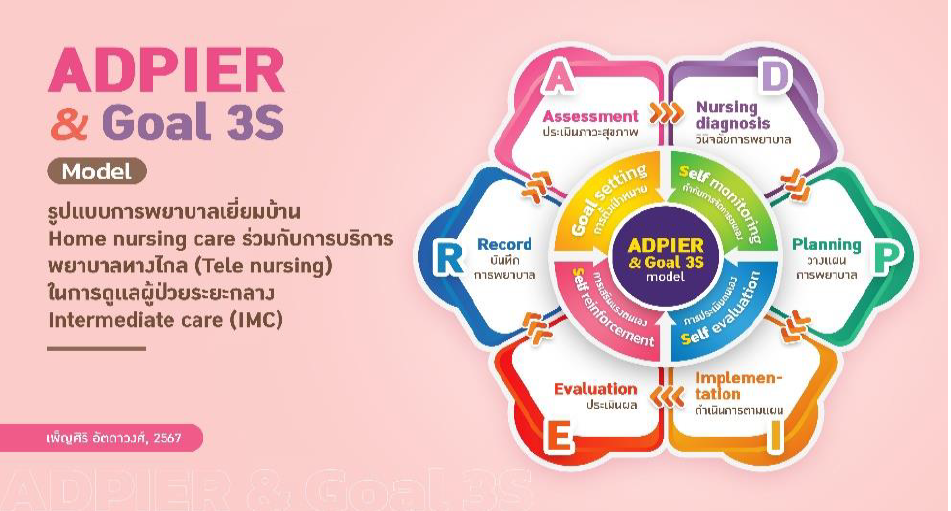
2. This new HNC model includes a) the first nursing visit (onsite) that followed the ADPIER nursing process (A for Assessment, D for Nursing Diagnosis, P for Planning, I for Implementation, E for Evaluation, and R for Record), and b) subsequent visits (online), delivered via tele-nursing, focusing on the Goal 3S self-management framework.
3. After implementation of the model, patients showed statistically significant improvements (p-value < .05) in daily living activities and quality of life. No complications were observed in three key disease groups. Patient, caregiver, and nurse satisfaction were rated as "very high", with satisfaction rates of 86.25% and 92.38%, respectively.
Per findings, the model reduces healthcare personnel workload, integrates digital technology for seamless services, and aligns with the policy for continuity of care. For patients, it improves accessibility, reduces costs, and enhances convenience. This model is recommended for expansion to primary care units in other health regions.
References
Afik, A., & Pandin M. G. R. (2021). Telenursing as a new nursing paradigm in the 21 century: A literature review. Preprints. doi: 10.20944/preprints202103.0704.v1
Arannapoom, V. (2021). A Study of Nursing Service Management of AOB-AOON Nursing Community Clinics. Master of Nursing Science Thesis. Chulalongk orn University. (in Thai)
Atthawong, P., Anusornprasert, N., & Sardlee, H. (2017). The effect of the home nursing care (HNC) system for bedridden patients type 3 in primary care units. The Southern College Network Journal of Nursing and Public Health, 4(1), 73-85. (in Thai)
Chinnawong, T. (2023). Research and Development of Short Course Training: Rehabilitation Case Management for Clients Who Need Continuing of Care from Hospital to Home. Retrieved October 6, 2023, from https://binlaacademy.medicine.psu.ac.th/courses/rehabilitation-free/. (in Thai)
Cohen, J. (1988). Statistical Power Analysis for the Behavioral Sciences. (2nd). NJ: Lawrence Erlbaum Associates, Publishers. doi.org/10.4324/9780203771587
Crabtree, B. F., & Miller, W. L. (1992). Doing Qualitative Research. London: SAGE Publications, Inc.
Deelertpaiboon, S., Mamuangbon, J., Tangkulpithaporn, S., Kunkunadet, K., Thanakornpornsawat, A. Vannavijit, J., et al. (2023). Digital literacy development of professional nurses. Vajira Nursing Journal, 25(1), 70-79. (in Thai)
Donabedian A. (2005). Evaluating the quality of medical care. 1966. The Milbank quarterly, 83(4), 691–729. doi.org/10.1111/j.1468-0009.2005.00397.x
Faul, F., Erdfelder, E., Lang, A. G., & Buchner, A. (2007). G*Power 3: a flexible statistical power analysis program for the social, behavioral, and biomedical sciences. Behavior Research Methods, 39(2), 175–191. doi.org/10.3758/bf03193146
Harnyoot, O. (2014). Nursing process and implications. Journal of The Royal Thai Army Nurses, 15(3), 137-143. (in Thai)
Health Administration Division. (2019). Intermediate Care Rehabilitation Manual for Patients: Guideline for Medical Personnel According to the Health Service System Development Plan (Service Plan). Samut Sakhon: Born to be publishing CO.,LTD. (in Thai)
Houwelingen, Van, C. T., Moerman, A. H., Ettema, R. G., Kort, H. S., & Ten Cate, O. (2016). Competencies required for nursing telehealth activities: A Delphi-study. Nurse education today, 39, 50–62. doi.org/10.1016/j.nedt.2015.12.025
Institute of Neurology. (2007). Guidelines for Rehabilitation of Patients with Cerebrovascular Disease. Department of Medical Services. Bangkok. (in Thai)
Jonsson, A., & Willman, A. (2008). Implementation of telenursing within home healthcare. telemedicine and e-HEALTH, 1057-1062. doi: 10.1089/tmj.2008.0022
Kamei, T. (2013). Information and communication technology for home care in the future. Japan Journal of Nursing Science, 10(2), 154-161. doi.org/10.1111/jjns.12039
Kanfer, F. H., & Gaelick-Buys, L. (1991). Self-Management Methods. In F. H. Kanfer & A. Goldstein (Eds.), Helping People Change: A textbook of methods. NewYork: Pergamon Press.
Katan, M., & Luft, A. (2018). Global burden of stroke. Seminars in Neurology, 38(2), 208–211. doi.org/10.1055/s-0038-1649503
Kitrenu, P., Jittanoon, P. & Boonyasopun, U. (2023). Effects of a community health nurse telehealth care program on self-management and quality of life among persons with peritoneal dialysis. Journal of Health Research, 37(6), 438-449. (in Thai)
Lee, A. Y. L., Wong, A. K. C., Hung, T. T. M., Yan, J., & Yang, S. (2022). Nurse-led telehealth intervention for rehabilitation (Telerehabilitation) among community-dwelling patients with chronic diseases: Systematic review and meta-analysis. Journal of Medical Internet Research, 24(11), e40364. doi.org/10.2196/40364
Lee, F. T. (2023). Utilizing Mobile Video Conferencing for Effective Communication Elderly Patients, Mute Individuals, and Overseas Family Members. Taipei City Hospital, Zhongxing Branch, Taiwan.
Luangon, P., & Nakarit, K. (2023). The development of the palliative care system for end-of-life patients by using tele-nursing, Ranong hospital. Journal of Health Research and Innovation, 6(2), 1-15. (in Thai)
Mahatnirankun, S., Tantipivatanasakul, W., Phumpaisanchai, W., Wongsuwan, K. & Phrommanarangkun, W. (2002). World Health Organization Quality of Life Brief – Thai, WHOQOL-BREF-THAI. Project to Develop a Ready-Made Program for Surveying Mental Health in The Area, 1-8. Retrieved December 5, 2023, from https://gdcatalog.go.th/dataset/gdpublish-whoqol-bref-thai (in Thai)
Mahoney, F. I., & Barthel, D. W. (1965). Functional evaluation: The Barthel index. Maryland State Medical Journal, 14, 61–65.
Manikat, R. (2019). Effectiveness of development of a care model of stroke patients at home. (2019). Effectiveness of development of a care model of stroke patients at home. Journal of Environment Health and Community Health, 4(3), 86-94. (in Thai)
Moradi, V., Babaee, T., Esfandiari, E., Lim, S. B., & Kordi, R. (2021). Telework and telerehabilitation programs for workers with a stroke during the COVID-19 pandemic: A commentary. Work, 68(1), 77–80. doi.org/10.3233/WOR-203356
Nursing Division Ministry of Public Health. (2019). Guidelines for Collecting Quality Improvement Indicators for Nursing Services for the Fiscal Year 2019. Nonthaburi: Publishing of Suetawan Company Limited. (in Thai)
Nursing Division Ministry of Public Health. (2019). Guideline for Intermediate Care in the Elderly. Nonthaburi: Publishing of Suetawan Company limited. (in Thai)
Nursing Division Ministry of Public Health. (2023). Guidelines for Organizing Tele Nursing Services for the Elderly at Home through Self Management. Nonthaburi (in Thai)
Office of the Permanent Secretary of MOPH. (2021). Guideline for Screening and Health Assessment of the Elderly,2021. Bangkok: Najanta Creation CO.,LTD. (in Thai)
Pattanasuwanna, P. (2019). Outcomes of intermediate phase post-stroke inpatient rehabilitation in community hospital. ASEAN Journal of Rehabilitation Medicine, 29(1), 8-13. (in Thai)
Pluemsong, K. (2022). The effect of home visit model in patients with post-operative hip fracture in contracting unit for primary care Maharaj Nakhon Si Thammarat hospital. Maharaj Nakhon Si Thammart Medical journal, 6(1), 18-30. (in Thai)
Promnoi, C., Atthawong, P., Somsiri, V., Kitrungrote, L., Sangchan, H., Suwanwaha, S., et al. (2023). Development of Telehealth Led Self-Management in Older Patients with High Risk of Stroke. Chiang Mai: Siampimnana Company Limited. (in Thai)
Sathira-Angkura, T. (2023). Development of Nursing Academic Work. In Lecture Materials for the Workshop on Capacity Building to Create Expert-Level Nursing Academic Work, 1st 15-17 November 2023. Nonthaburi: Best Western Plus Wanda Gran Hotel. Retrieved December 5, 2023, from https://www.don.go.th/?p=11020. (in Thai)
Sharma, S. (2018). Telenursing: A new opportunity for nurses in the digital era. Journal of Kathmandu Medical College,7(2), 45-46.
Shu, F. S., Heng, H. T., Szu, Y. L. & Chun, H. L. (2023). Self-Management as Moderator or Mediator between the Severity of Symptom and Quality of Life in Older Adults with Cardiovascular Disease. MacKay Medical College, Taiwan National Yang Ming Chiao Tung University, Taiwan Taitung MacKay Memorial Hospital.
Singthongwan, W., & Puanfai, S. (2023). The effects of telenursing on the abilities of caregivers of patients with stroke after discharging from Chiang Mai neurological hospital. Journal of Nurses Association of Thailand Northern Office, 29(1), 43-57. (in Thai)
Sirindhorn National Medical Rehabilitatin Institute. (2022). Intermediate Care Rehabilitation Manual for Patients: Guideline for Medical Personnel According to the Health Service System Development Plan (Service Plan). Nonthaburi Sirindhorn National Medical Rehabilitatin Institute. (in Thai)
Sittiwang, S., Aungwattana, S., & Tamdee, D. (2020). Sittiwang, S., Aungwattana, S., & Tamdee, D. (2020). Effects of self-management promoting program on health behaviors and blood pressure level of persons with uncontrolled hypertension. Nursing Journal, 47(2), 85-97. (in Thai)
Songkhla hospital. (2023). Report from the Songkhla Hospital Database. Retrieved December 15, 2023, from https://www.skhospital.go.th/ (in Thai)
Souza-Junior, V. D., Mendes, I. A., Mazzo, A., & Godoy, S. (2016). Application of telenursing in nursing practice: an integrative literature review. Applied Nursing Research : ANR, 29, 254–260. doi.org/10.1016/j.apnr.2015.05.005
Thailand Nursing and Midwifery Council. (2021). Tele-Nursing Guidelines. Retrieved December 15, 2023, from https://www.tnmc.or.th/images/userfiles/files/T_0049.PDF (in Thai)
TU, C. & Chang, Y. (2023). Nursing Experience of Using Video-Feedback to Improve Rehabilitation Self-Efficacy in Stroke Patients. Chi Mei Medical Center Liouying, Taiwan Department of Nursing, Fooyin University.
Wosik, J., Fudim, M., Cameron, B., Gellad, Z. F., Cho, A., Phinney, D., et al. (2020). Telehealth transformation: COVID-19 and the rise of virtual care. Journal of the American Medical Informatics Association: JAMIA, 27(6), 957–962.
Downloads
Published
Issue
Section
License
Copyright (c) 2024 The Southern College Network Journal of Nursing and Public Health

This work is licensed under a Creative Commons Attribution-NonCommercial-NoDerivatives 4.0 International License.
1. บทความหรือข้อคิดเห็นใด ๆ ที่ปรากฏในวารสารเครือข่าย วิทยาลัยพยาบาลและการสาธารณสุขภาคใต้ ที่เป็นวรรณกรรมของผู้เขียน บรรณาธิการหรือเครือข่ายวิทยาลัยพยาบาลและวิทยาลัยการสาธารณสุขภาคใต้ ไม่จำเป็นต้องเห็นด้วย
2. บทความที่ได้รับการตีพิมพ์ถือเป็นลิขสิทธิ์ของ วารสารเครือข่ายวิทยาลัยพยาบาลและการสาธารณสุขภาคใต้